

Pakistan’s Oraan raises $3 million in largest seed round closed by women-led startup

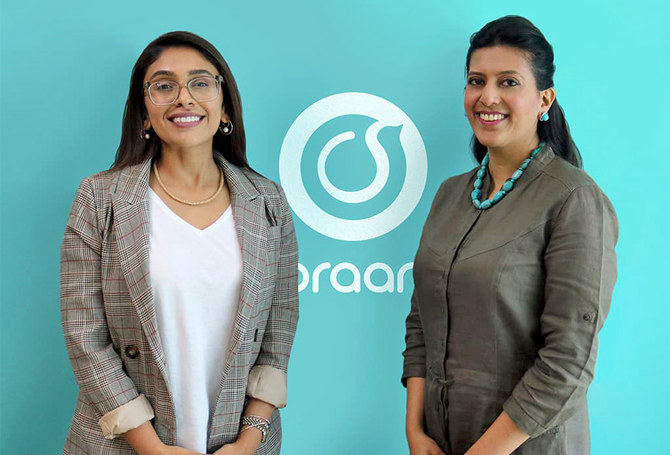
This undated photo shows Oraan founders Halima Iqbal (left) and Farwah Tapal posing for picture in Karachi, Pakistan. (Photo courtesy: Social media)
Short Url
Updated 27 September 2021
Follow

Pakistan’s Oraan raises $3 million in largest seed round closed by women-led startup

  • Women use Oraan committees to save, borrow, build emergency funds, pay for education, travel and medical treatments
  • Oraan allows users to form committees and save with groups beyond immediate geographical and social networks

KARACHI: Pakistani fintech firm Oraan has raised $3 million in the largest seed funding closed by a women-led startup in the country, the company said on Monday. 
The startup was founded in 2018 by former investment banker Halima Iqbal and design strategist Farwah Tapal, both of whom said they faced difficulty in accessing financial services when they moved back to Pakistan three years ago. Focusing on gender-specific innovation, Oraan has designed products and services around credit, insurance and savings in Pakistan – home to five percent of the world’s unbanked female population. 
“Oraan was founded when we realized that the large majority of the Pakistani population struggles to access financial services simply because they are not designed for them,” said Iqbal, chief executive officer and co-founder at Oraan. “While there is a demand among women for credit, insurance and savings services, they are unable to approach financial institutions due to mistrust, complexity of products and challenges around mobility.” 
Oraan today boasts a community of over 10,000 savers, 84 percent of whom are women, from over 170 cities, according to Faisal Chowdry, a general partner at Zayn Capital, which co-led the financing round with Wavemaker Partners.



A Pakistani woman surfs webpage of the fintech firm Oraan on November 02, 2020. (Photo courtesy: Karandaaz Pakistan)

Women use Oraan committees to save, borrow, build emergency funds and achieve other goals like travel and pay for education, working capital and medical treatments. The committees, the startup’s flagship product, are a digital reimagination of the Rotating Saving and Credit Associations (ROSCAs), an age-old method of group saving and credit in South Asia. They are also known as ‘beesees’ in Pakistan and used by 41 percent of the Pakistani population, with up to $5 billion rotating annually. 
Using the Oraan app, savers are able to sign up for committees that suit their needs and save with groups beyond their immediate geographical and social networks. 
Gavin Lee, general partner at Wavemaker Partners in Southeast Asia, said with half of Pakistan’s 200 million population being women, the country had one of the most serious gender gaps in banking access in the world. 
“We believe that designing a female-friendly financial product to help women access the banking system, and in turn allow them to access credit, insurance, and investment, is one of the most critical ways to promote sustainable economic growth in Pakistan,” Lee said. 
Oraan says it will use the latest round of funding to accelerate its expansion into other products that will position the company to become Pakistan’s first women-first digital, social bank. 


Pakistan drops 8,000 MW power procurement, claims $17 billion savings amid IMF-driven reforms

Updated 11 sec ago
Follow

Pakistan drops 8,000 MW power procurement, claims $17 billion savings amid IMF-driven reforms

  • Government says decision taken “on merit” as it seeks to cut losses, circular debt, ease consumer pressure 
  • Power minister says losses fell from $2.1 billion to $1.4 billion, circular debt dropped by $2.8 billion

ISLAMABAD: Pakistan has abandoned plans to procure around 8,000 megawatts of expensive electricity, the power minister said on Sunday, adding that the decision was taken “purely on merit” and would save about $17 billion.

The power sector has long been a major source of Pakistan’s fiscal stress, driven by surplus generation capacity, costly contracts and mounting circular debt. Reforming electricity pricing, reducing losses and limiting new liabilities are central conditions under an ongoing $7 billion IMF program approved in 2024.

Pakistan has historically contracted more power generation than it consumes, forcing the government to make large capacity payments even for unused electricity. These obligations have contributed to rising tariffs, budgetary pressure and repeated IMF bailouts over the past two decades.

“The government has abandoned the procurement of around 8000 megawatts of expensive electricity purely on merit, which will likely to save 17 billion dollars,” Power Minister Sardar Awais Ahmed Khan Leghari said while addressing a news conference in Islamabad, according to state broadcaster Radio Pakistan.

He said the federal government was also absorbing losses incurred by power distribution companies rather than passing them on to consumers.

The minister said the government’s reform drive was already showing results, with losses reduced from Rs586 billion ($2.1 billion) to Rs393 billion ($1.4 billion), while circular debt declined by Rs780 billion ($2.8 billion) last year. Recoveries, he added, had improved by Rs183 billion ($660 million).

Leghari said electricity tariffs had been reduced by 20 percent at the national level over the past two years and expressed confidence that prices would be aligned with international levels within the next 18 months.

Power sector reform has been one of the most politically sensitive elements of Pakistan’s IMF-backed adjustment program, with higher tariffs and tighter enforcement weighing on households and industry. The government says cutting losses, improving recoveries and avoiding costly new capacity are essential to stabilizing public finances and restoring investor confidence.