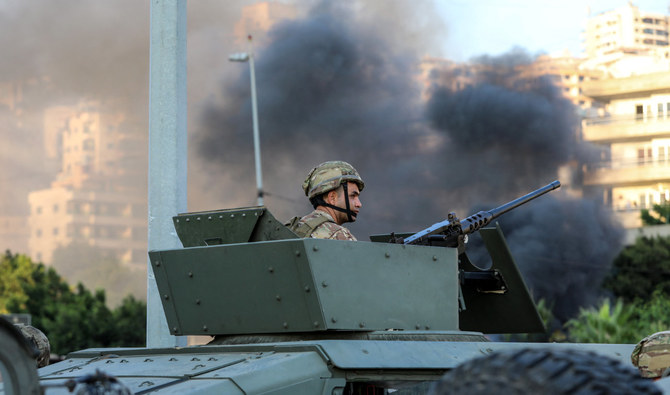

BEIRUT: The Lebanese army has ‘redeployed’ soldiers away from several regions, notably Beirut’s southern suburbs, with its command saying in a statement that the redeployment is intended “to reduce the economic burdens on the army.”
The military has been struggling due to Lebanon’s economic meltdown. In his notorious speech in March, Joseph Aoun, commander of the Lebanese Army, said: “Soldiers are struggling like other people; a soldier’s salary has lost its value and soldiers are going hungry like others.”
Aoun, who is currently visiting Turkey, met with his Turkish counterpart and other officials on Friday and requested logistical support, including equipment and machinery.
He will also visit Washington at the end of September to ask for direct American aid and promises of military assistance for the Lebanese army.
In recent months, some soldiers have deserted as the depreciation of the Lebanese pound has seen the relative value of their salaries plummet to the equivalent of $60 per month. Army command claims the number of deserters is “limited.”
Residents of the Lebanese capital’s southern suburbs were surprised when the army withdrew its forces from checkpoints in the area. Soldiers have been deployed there since 2013, when the suburbs were targeted by bombings that were blamed on Daesh, and seen as connected to the war in Syria and Hezbollah’s interference in the interests of Syrian President Bashar Assad’s regime.
Lebanese army command stressed on Friday that its troops would “continue to set up observation points in all areas, work on patrols, and carry out security missions.”
Meanwhile, dozens of families of victims of the August 2020 explosion in Beirut Port gathered in the capital to protest against the political pressure being placed on Judge Tarek Bitar, who is leading the investigation into the blast.
Bitar was recently threatened by Hezbollah and, on Friday, the attorney representing Nohad Machnouk, the former interior minister who is accused in the case, filed a request to dismiss Bitar from the investigation.
If Bitar were to be dismissed from the case, he would be the second judge to have been removed from the investigation. Like his predecessor, Judge Fadi Sawan, Bitar has issued a subpoena for a former prime minister, ministers and security officials in connection with the explosion..
Machnouk visited Dar Al-Fatwa — Lebanon’s highest Sunni authority — and gave a speech there in which he claimed that Bitar “takes his orders from” Salim Jreissati, a member of the Free Patriotic Movement led by Gebran Bassil and an advisor to Lebanese President Michael Aoun, Bassil’s father-in-law.
Machnouk warned against summoning former Prime Minister Hassan Diab — also accused in the case — based on a subpoena Bitar issued after Diab failed to show up for questioning. He said Bitar is implementing “a political agenda, away from the constitution, law and logic.”
Hezbollah leader Hassan Nasrallah has also previously accused Bitar of being “politicized.”
Former minister Youssef Fenianos — another accused in the case — has requested that the file be transferred from Bitar to another judge.
The campaign against Bitar intensified on Friday. Jaafarite Mufti Sheikh Ahmad Qabalan said in his Friday sermon: “It is not allowed to play with fire. What happened in the investigation … increases strong doubts about fabrication as well as (demands for) the dismissal of Judge Bitar, as the country is teeming with corruption.”
After his meeting with the president on Friday, Maronite Patriarch Bechara Boutros Al-Rahi said: “Sects should not deal with justice; we are a country that separates between religion and state.”