

Lebanon banks under fire as PM promises audit

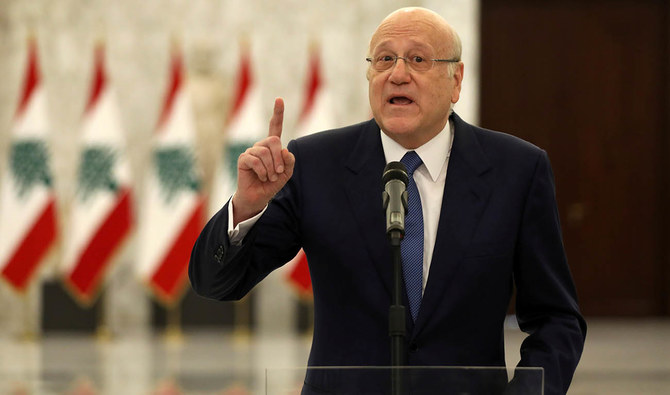
Lebanon's Prime Minister Najib Mikati gestures as he speaks to the press at the presidential palace in Baabda, Lebanon. (Reuters/File)
Short Url
Updated 21 September 2021
Follow

Lebanon banks under fire as PM promises audit

  • There are 63 banks operating in Lebanon with more than 1,000 branches and 25,000 employees

BEIRUT: The conduct of Lebanese banks amid the country’s worsening economic crisis has been defended by Salim Sfeir, head of the Association of Banks of Lebanon, who responded on Tuesday to criticism by MPs from the Hezbollah and Free Patriotic Movement blocs.

The condemnation of the country’s banks came during Monday’s vote of confidence.

In a response statement, Sfeir said: “Banks invested their surplus of liquidity in the Lebanese Central Bank. Banks demanded the adoption of a law that establishes capital controls while the multiple formulas offered by others aim to legislate cash withdrawals and international transfers.”

Lebanon was hit by an unprecedented economic crisis in 2019, leading to the collapse of its currency and an inability to pay its debts. The country’s political class was accused of looting the country’s local treasury, siphoning off middle-class wealth and exercising authority without responsibility.

In its statement, the ABL urged the Lebanese Parliament “to speed up the reforms required by the international community,” and called on the new government to “start serious work” to launch international aid packages and put the country back on the international map “by enhancing communication with Lebanon’s friends from Arab and foreign states.”

It said: “There is a pressing need to stop the collapse. Therefore, the government must immediately commit to its obligations in accordance with its ministerial statement that noted a prompt resumption of talks with the International Monetary Fund to address the negative impacts of previous policies.”

It added that the government must begin talks with debtors, reform the banking sector and approve a budget — “all of which are clauses that the ABL has demanded since the start of the crisis.”

There are 63 banks operating in Lebanon with more than 1,000 branches and 25,000 employees.

According to Sfeir, the banking sector constituted “an engine of growth in the country through loans that outgrew the size of the economy.” He added: “The formal banking sector’s taxes are some of the major public treasury income items.”

A group of Lebanon’s bondholders — that include some of the largest investment funds in the world — also urged the new government “to start talks to restructure the country’s debts as early as possible to help deal with the crushing economic crisis in the country.”

Lebanon defaulted on its external debt in March 2020, leaving it unable to service a debt burden that was then worth more than 170 percent of its gross domestic product.

The group said it “hopes and expects the new government to promote a speedy, transparent and equitable debt restructuring process. Such a process will need the government to engage meaningfully with the IMF as well as Lebanon’s international creditors.”

At the end of the vote of confidence, Prime Minister Najib Mikati said: “Discussions with the IMF have begun. The talks are not a picnic and the fund is not a charity. This issue is not an option but a mandatory passageway that must succeed in order to serve as the first foundation toward salvation and the right way for Lebanon’s revival.”

He urged Lebanon’s Parliament to act quickly to approve a capital control law as early as possible, and promised to carry out “a forensic audit of all institutions and ministries without any exceptions.”

Mikati was quick to note the importance of the banking sector in any economic recovery: “I wish there were any banks left in Lebanon to help them. Do you know the reality of the banking sector? There is no economic recovery without banks.”

However, the prime minister added: “More than $10 billion was spent in the past on subsidies for banks — money that could have been used to build power plants, treat waste and construct roads.”


Tunisia’s famed blue-and-white village threatened after record rains

Updated 31 January 2026
Follow

Tunisia’s famed blue-and-white village threatened after record rains

  • The one-time home of French philosopher Michel Foucault and writer Andre Gide, the village is protected under Tunisian preservation law, pending a UNESCO decision on its bid for World Heritage status

SIDI BOU SAID, Tunisia: Perched on a hill overlooking Carthage, Tunisia’s famed blue-and-white village of Sidi Bou Said now faces the threat of landslides, after record rainfall tore through parts of its slopes.
Last week, Tunisia saw its heaviest downpour in more than 70 years. The storm killed at least five people, with others still missing.
Narrow streets of this village north of Tunis — famed for its pink bougainvillea and studded wooden doors — were cut off by fallen trees, rocks and thick clay. Even more worryingly for residents, parts of the hillside have broken loose.
“The situation is delicate” and “requires urgent intervention,” Mounir Riabi, the regional director of civil defense in Tunis, recently told AFP.
“Some homes are threatened by imminent danger,” he said.
Authorities have banned heavy vehicles from driving into the village and ordered some businesses and institutions to close, such as the Ennejma Ezzahra museum.

- Scared -

Fifty-year-old Maya, who did not give her full name, said she was forced to leave her century-old family villa after the storm.
“Everything happened very fast,” she recalled. “I was with my mother and, suddenly, extremely violent torrents poured down.”
“I saw a mass of mud rushing toward the house, then the electricity cut off. I was really scared.”
Her Moorish-style villa sustained significant damage.
One worker on site, Said Ben Farhat, said waterlogged earth sliding from the hillside destroyed part of a kitchen wall.
“Another rainstorm and it will be a catastrophe,” he said.
Shop owners said the ban on heavy vehicles was another blow to their businesses, as they usually rely on tourist buses to bring in traffic.
When President Kais Saied visited the village on Wednesday, vendors were heard shouting: “We want to work.”
One trader, Mohamed Fedi, told AFP afterwards there were “no more customers.”
“We have closed shop,” he said, adding that the shops provide a livelihood to some 200 families.

- Highly unstable -

Beyond its famous architecture, the village also bears historical and spiritual significance.
The village was named after a 12th-century Sufi saint, Abu Said Al-Baji, who had established a religious center there. His shrine still sits atop the hill.
The one-time home of French philosopher Michel Foucault and writer Andre Gide, the village is protected under Tunisian preservation law, pending a UNESCO decision on its bid for World Heritage status.
Experts say solutions to help preserve Sidi Bou Said could include restricting new development, building more retaining walls and improving drainage to prevent runoff from accumulating.
Chokri Yaich, a geologist speaking to Tunisian radio Mosaique FM, said climate change has made protecting the hill increasingly urgent, warning of more storms like last week’s.
The hill’s clay-rich soil loses up to two thirds of its cohesion when saturated with water, making it highly unstable, Yaich explained.
He also pointed to marine erosion and the growing weight of urbanization, saying that construction had increased by about 40 percent over the past three decades.
For now, authorities have yet to announce a protection plan, leaving home and shop owners anxious, as the weather remains unpredictable.