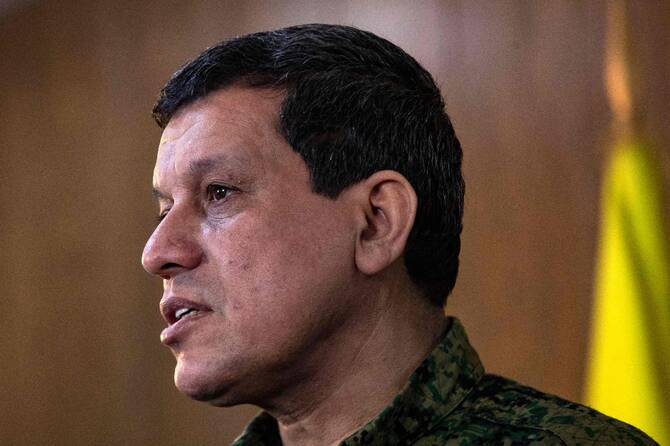
DAMASCUS: Syrian Kurdish leader Mazloum Abdi said Thursday that “all efforts” were being made to prevent the collapse of talks on an agreement with Damascus to integrate his forces into the central government.
The remarks came days after Aleppo saw deadly clashes between the two sides before their respective leaders ordered a ceasefire.
In March, Abdi signed a deal with Syrian President Ahmed Al-Sharaa to merge the Kurds’ semi-autonomous administration into the government by year’s end, but differences have held up its implementation.
Abdi said the Syrian Democratic Forces (SDF), the Kurds’ de facto army, remained committed to the deal, adding in a statement that the two sides were working toward “mutual understanding” on military integration and counter-terrorism, and pledging further meetings with Damascus.
Downplaying the year-end deadline, he said the deal “did not specify a time limit for its ending or for the return to military solutions.”
He added that “all efforts are being made to prevent the collapse of this process” and that he considered failure unlikely.
Abdi also repeated the SDF’s demand for decentralization, which has been rejected by Syria’s Islamist authorities, who took power after ousting longtime ruler Bashar Assad last year.
Turkiye, an important ally of Syria’s new leaders, sees the presence of Kurdish forces on its border as a security threat.
In Damascus this week, Turkish Foreign Minister Hakan Fidan stressed the importance of the Kurds’ integration, having warned the week before that patience with the SDF “is running out.”
The SDF control large swathes of the country’s oil-rich north and northeast, and with the support of a US-led international coalition, were integral to the territorial defeat of the Daesh group in Syria in 2019.
Syria last month joined the anti-IS coalition and has announced operations against the jihadist group in recent days.


Syria Kurds chief says ‘all efforts’ being made to salvage deal with Damascus
https://arab.news/gpszp
Syria Kurds chief says ‘all efforts’ being made to salvage deal with Damascus

- Abdi said the Syrian Democratic Forces (SDF), the Kurds’ de facto army, remained committed to the deal
- The two sides were working toward “mutual understanding” on military integration and counter-terrorism


Syria accuses Hezbollah of firing shells into its territory
- “The Syrian Arab Army will not tolerate any aggression targeting Syria,” the army said in a statement to SANA
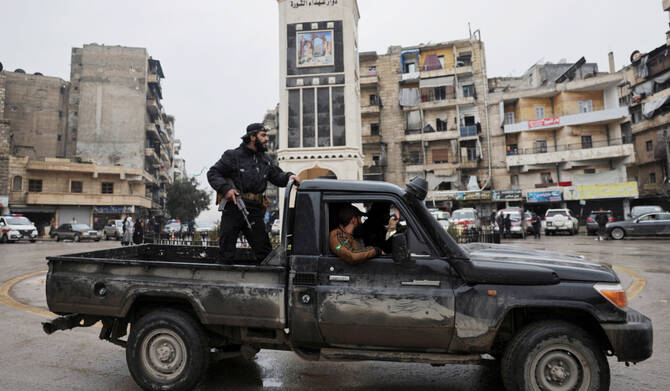
DAMASCUS: Syria said Iran-backed Hezbollah had fired artillery shells into its territory from Lebanon overnight, state media reported on Tuesday, amid the ongoing conflict between Israel and the Lebanese Shia movement.
Syrian army officials said artillery shells fired from Lebanon landed near the town of Serghaya, west of Damascus, the state news agency SANA reported on Tuesday.
The army accused Hezbollah of targeting Syrian army positions, telling the news agency it observed Hezbollah reinforcements at the Syrian-Lebanese border.
“The Syrian Arab Army will not tolerate any aggression targeting Syria,” the army said in a statement to SANA.
Lebanon was drawn into the Middle East war last week when Hezbollah attacked Israel in response to the killing of Iranian supreme leader Ayatollah Ali Khamenei during US-Israeli strikes.
Hezbollah and Israeli forces have clashed in eastern Lebanon in recent days, and Israel has carried out strikes across Lebanon, including on the capital Beirut.
Lebanese President Joseph Aoun accused Hezbollah of working to “collapse” the state, while the head of the group’s parliamentary bloc said it had “no other option... than the option of resistance.”
Hezbollah provided military support to former Syrian president Bashar Assad, who was overthrown in December 2024 by an Islamist coalition hostile to the pro-Iranian Shia movement.
Since then, its supply routes from Syria have been cut off, and Lebanese and Syrian authorities are trying to combat smuggling across the porous border between the two countries.