BERLIN: The contenders to succeed Angela Merkel as Germany’s chancellor sought to mobilize voters Friday as the election campaign neared its close.
They touted their credentials to lead Europe’s biggest economy into a new era as it grapples with the fallout from the coronavirus pandemic and climate change.
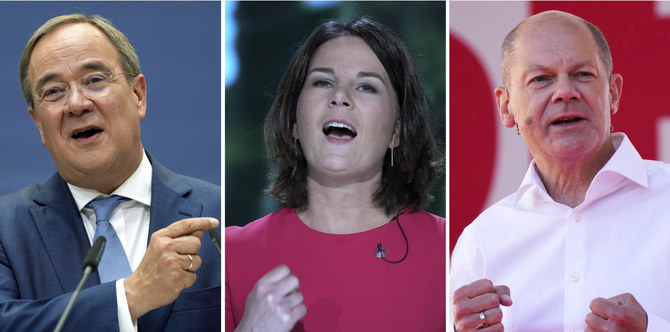
Merkel is stepping down after 16 years in power, and the race is wide open ahead of Sunday’s parliamentary election. Polls show the outgoing leader’s center-right Union bloc, with Armin Laschet as its candidate for chancellor, a little behind or nearly level with the center-left Social Democrats, who have Finance Minister Olaf Scholz seeking the chancellorship.
The Greens, with Annalena Baerbock making the party’s first run for chancellor, are trailing in third place but could end up playing the kingmaker in forming a government.
Experts say one reason why this year’s German election is tighter and less predictable than usual is that the candidates are relative unknowns to most voters.
“It’s certainly not the most boring election,” University of Leipzig political scientist Hendrik Traeger said. “There were those in which Angela Merkel stood as the incumbent and it was simply a question of who she would govern with.”
This time, Merkel’s party has struggled to energize its traditional base, which has so far failed to warm to Laschet, the governor of North Rhine-Westphalia state.
“The key question is whether these voters will overcome the Laschet hurdle and vote for the Union despite Laschet” said Peter Matuschek of polling company Forsa. “Or will they abstain from the vote or even choose another party?”
Scholz, whose party has made steady gains in opinion polls during the campaign on the strength of his relative popularity, touted the outgoing government’s success in preserving jobs during the pandemic.
“What we have seen is that we are succeeding in avoiding the major economic and social crisis that otherwise would have hit us,” he said at a rally in Cologne. “We put a lot of money into bringing jobs and companies through this crisis, and today, we can say that we have succeeded. We see an upswing ahead of us.”
Scholz, who wants to raise Germany’s minimum wage and increase taxes for top earners, argued that anyone calling for tax relief for the rich now “can’t count, doesn’t understand anything about finance.”
The Union bloc, an alliance of Merkel’s Christian Democratic Union party and its Bavaria-only sister party, the Christian Social Union, contends that any tax increases would be counterproductive as the German economy recovers. Laschet said at a rally in Munich that it would be “exactly the wrong way” out of the pandemic.
“The pandemic is now in its final phase, and (the Social Democrats) are beginning again with their old socialist classics from the 80s — bureaucracy, tax increases, patronizing people,” he said.
Merkel declared that “for Germany to remain stable, Armin Laschet must become chancellor and (the Union) must be the strongest party.” She was making the second of three appearances in the final week of a campaign from which she has been largely absent.
Laschet praised Merkel’s record. “It’s up to us to carry this legacy forward,” he said. “If we get it wrong now, everything that was achieved in 16 years could be squandered.”
Baerbock, the Greens’ candidate, focused her pitch on fighting climate change, her party’s central issue.
“This election is a choice of direction,” she said in Duesseldorf. “This election is a climate election.”
“We can’t afford half-measures anymore,” said Baerbock, whose party wants to ramp up carbon prices and end the use of coal earlier than planned. “We need finally to have a climate government — with all its strength, with all its heart and with full passion.”
“Yes, it’s a risk to do something new, but where has government experience alone brought us, if that’s the standard for a parliamentary election?” asked Baerbock, the only candidate for chancellor who lacks government experience. “It has led us to a dead end.”
Tens of thousands of environmental activists staged a rally outside Germany’s parliament earlier Friday to demand that politicians take stronger action to curb climate change.
Migration has been less of a concern to many voters than in 2017. Foreign policy has not come up much during the campaign but became an issue during the final television debate Thursday, with the Greens calling for a tougher stance on China.
About 60.4 million Germans are eligible to vote for a new parliament on Sept. 26. The strongest party will be best-placed to form a governing coalition, though that isn’t automatic.
The business-friendly Free Democrats are angling for a place in government after pulling the plug on coalition talks after the 2017 election. The far-right Alternative for Germany is expected to do well in the country’s east, but other parties refuse to work with it.
The Left Party, which opposes NATO and German military deployments abroad, remains a possible governing partner for the Greens and Social Democrats, a prospect that has drawn alarm from conservatives. Friday’s center-right rally was larded with warnings that such an alliance would damage Germany’s economy and international standing.
Election officials say many more people will vote by mail this year due to the pandemic, but this isn’t expected to affect turnout significantly.


![]()

Contenders tout credentials in close vote to replace Merkel
Short Url
https://arab.news/696uc
Contenders tout credentials in close vote to replace Merkel
- Merkel is stepping down after 16 years in power, and the race is wide open ahead of Sunday's parliamentary election
- Polls show the outgoing leader's center-right Union bloc, with Armin Laschet as its candidate for chancellor


Latest updates


Recommended


© 2026 SAUDI RESEARCH & PUBLISHING COMPANY, All Rights Reserved And subject to Terms of Use Agreement.