BEIJING: China’s central bank on Friday said all financial transactions involving cryptocurrencies are illegal, sounding the death knell for the digital trade in China after a crackdown on the volatile currencies.
The global values of cryptocurrencies including Bitcoin have massively fluctuated over the past year partly due to Chinese regulations, which have sought to prevent speculation and money laundering.
“Virtual currency-related business activities are illegal financial activities,” the People’s Bank of China (PBOC) said in an online statement Friday, adding that offenders would be “investigated for criminal liability in accordance with the law.”
The notice bans all related financial activities involving cryptocurrencies, such as trading crypto, selling tokens, transactions involving virtual currency derivatives and “illegal fundraising.”
Bitcoin, which had already been falling before the announcement, sank by as much as 8.9 percent to $41,019 in European afternoon trading before recovering slightly later in the day.
The central bank said that in recent years trading of Bitcoin and other virtual currencies had become “widespread, disrupting economic and financial order, giving rise to money laundering, illegal fund-raising, fraud, pyramid schemes and other illegal and criminal activities.”
This was “seriously endangering the safety of people’s assets,” the PBOC said.
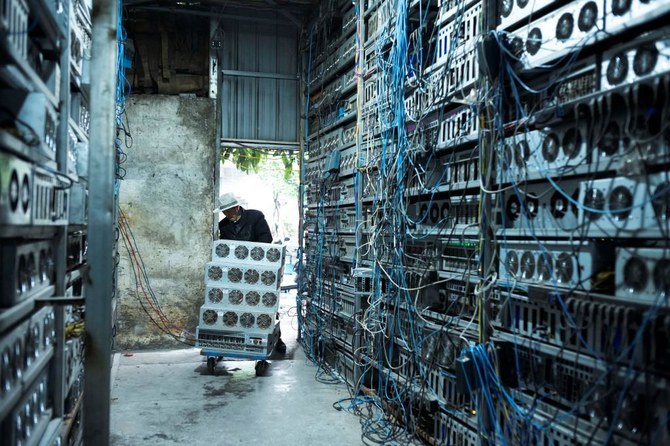
While crypto creation and trading have been illegal in China since 2019, further crackdowns this year by Beijing warned banks to halt related transactions and closed much of the country’s vast network of bitcoin miners.
Friday’s statement by the central bank sent the strongest yet signal that China is closed to crypto.
Bitcoin, the world’s largest digital currency, and other cryptos cannot be traced by a country’s central bank, making them difficult to regulate.
Analysts say China fears the proliferation of illicit investments and fundraising from cryptocurrency in the world’s second-biggest economy, which also has strict rules around the outflow of capital.
The crypto crackdown also opens the gates for China to introduce its own digital currency, already in the pipeline, allowing the central government to monitor transactions.
In June, Chinese officials said more than 1,000 people had been arrested for using the profits from crime to buy cryptocurrencies.
Several key Chinese provinces have banned the operation of cryptocurrency mines since the start of this year, with one region accounting for eight percent of the computing power needed to run the global blockchain — a set of online ledgers to record bitcoin transactions.
Bitcoin values tumbled in May on the back of a warning by Beijing to investors against speculative trading in cryptocurrencies.
“China’s ban on all cryptocurrency trading activity will have some short-term impact on currency valuation, but long-term implications are likely to be muted,” said Ganesh Viswanath Natraj, Assistant Professor of Finance at Warwick Business School.
“This ban will result in the migration of crypto investment opportunities to other hubs in Asia, such as Singapore’s launch of the DBS digital currency exchange earlier this month,” he added.

China’s central bank rules all crypto transactions are illegal
https://arab.news/v8wkw
China’s central bank rules all crypto transactions are illegal
- The global values of cryptocurrencies including Bitcoin have massively fluctuated over the past year partly due to Chinese regulations
- Bitcoin, the world’s largest digital currency, and other cryptos cannot be traced by a country’s central bank, making them difficult to regulate
Dubai Financial Market reports $288.6m profit for 2025 - up 159%
RIYADH: Dubai Financial Market reported net profit before tax of 1.06 billion dirhams ($288.6 million) in 2025, up 159 percent from a year earlier.
The improved performance was driven by sustained confidence in Dubai’s capital markets and a year of heightened trading activity, with momentum continuing through the fourth quarter.
The results coincided with the exchange marking 25 years since its establishment in 2000, highlighting its evolution into a more globally connected and institutionally active marketplace, according to a report by the Emirates News Agency.
For the full year ending Dec. 31, total consolidated revenues rose to 1.28 billion dirhams, while earnings before interest, tax, depreciation and amortization reached 1.13 billion dirhams, translating into an EBITDA margin of 88 percent.
The results come as Dubai pushes ahead with its D33 agenda to double the emirate’s economy by 2033 and deepen its position as a global financial hub.
The UAE central bank has pointed to solid capital markets momentum and low sovereign risk indicators in 2025, underscoring the confidence backdrop for higher trading activity.
Helal Al-Marri, chairman of DFM, said: “DFM’s performance in 2025 reflects the continued strength of Dubai’s capital markets and the confidence of global investors in the emirate’s economic vision.
“As we mark 25 years since the establishment of DFM, the exchange continues to play a central role within Dubai’s financial ecosystem, supporting transparency, liquidity, and long-term market development in line with the Dubai Economic Agenda D33.”
Fourth-quarter net profit before tax increased to 124.4 million dirhams from 110.6 million dirhams in the same period of 2024, reflecting sustained trading momentum toward year-end.
Market performance remained strong throughout the year, with the DFM General Index rising 17.2 percent and total market capitalization reaching 992 billion dirhams.
Average daily traded value climbed to 692 million dirhams, while total traded value amounted to 174 billion dirhams, marking the highest liquidity levels in more than a decade.
The average daily number of trades rose 31 percent year on year, driven by increased institutional and cross-border activity.
Hamed Ali, CEO of DFM and Nasdaq Dubai, said: “In 2025, DFM continued to build on the progress of recent years, supported by steady trading activity, growing international participation, and ongoing enhancements to our market infrastructure.”
He added: “Our focus throughout the year remained on improving market accessibility, supporting a broad range of investment activity, and ensuring the market continues to operate efficiently for both issuers and investors. As we mark 25 years of DFM, we remain committed to developing the market in line with Dubai’s long-term capital markets ambitions.”
Investor participation broadened further during the year, with 97,394 new participants joining the market, of which 84 percent were foreign.
Foreign investors accounted for 51 percent of total trading value, while institutional investors represented 71 percent of trading activity.
The total investor base reached 1.25 million, reinforcing DFM’s position as a destination for regional and international capital.
Capital-raising activity also expanded DFM’s sectoral footprint.
The exchange hosted Dubai Residential REIT, the region’s first publicly traded residential leasing real estate investment trust, which attracted subscriptions 26 times over and total demand of 56 billion dirhams.
It also saw the secondary public offering of Emirates Integrated Telecommunications Co., alongside the initial public offering of ALEC Holdings, the UAE’s largest construction-sector listing to date, which generated subscriptions of 30 billion dirhams, representing an oversubscription of 21 times.
Innovation and market development remained a focus in 2025, with the launch of a centralized securities lending and borrowing framework and further enhancements to digital platforms, including AI-enabled features on iVestor.
DFM also strengthened its international engagement through global roadshows and partnerships, including a memorandum of understanding with the Taiwan Stock Exchange aimed at supporting cross-border listings and investor outreach.
Looking ahead, the exchange said it remains focused on enhancing liquidity, expanding product offerings, and deepening global connectivity, supported by a strong financial position and a diversified investor base.