

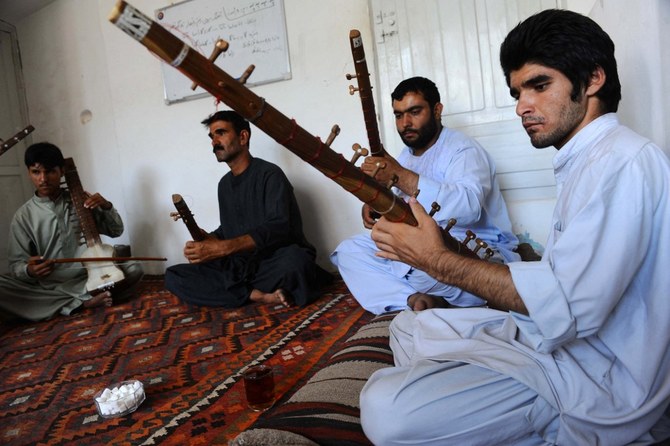

PESHAWAR: The day the Taliban entered the Afghan capital on August 15, Rafi Haneef knew he had to flee immediately.
The very next day, the harmonium player and dozens of his fellow musicians from Kabul crossed over into neighboring Pakistan through the Chaman border, fearing violence and persecution from a hard-liner group that banned most forms of music when it previously ruled Afghanistan in 1996-2001.
Since returning to power as US soldiers withdrew from the country last month, the Taliban have told Afghans, and the international community, that they will uphold rights and allow cultural activities — within the confines of Islamic law.
But Afghans artists have no hope they will play again under a Taliban government.
“The entire music industry collapsed the day the Taliban appeared in Kabul on August 15,” Haneef told Arab News in an interview this week from the Pakistani city of Peshawar in the country’s northwest. “Taliban consider music haram (forbidden), but we can’t live without music.”
Sadiq Sameer, a player of the lute-like instrument called the rubab, said he fled Afghanistan the day after the Taliban captured Kabul, leaving behind a ten-member family, including his six children. His cherished rubab is also lost in Kabul.
Sameer was a known figure in Afghanistan and a regular performer at private events and on major TV channels like ToloNews and Shamshad TV.
“That morning was the most terrible of my life when I left my family,” Sameer said. “Upon my family’s insistence, the next morning after the Taliban seized power in Kabul, I somehow managed to cross over the Chaman border and reached Peshawar after a 24-hour perilous journey.”
The concerns of Sameer’s family are not unfounded.
The dangers facing musicians in Afghanistan were brutally highlighted in the final months of the Taliban insurgency, when the group carried out targeted attacks on those it said had betrayed its vision of Islamic rule.
Since the Taliban captured power in Afghanistan, members of an all-female orchestra have either left the country or destroyed their instruments and gone into hiding. In Kandahar, the birthplace of the Taliban, the group issued a formal order against radio stations playing music and female announcers last month. International media has shown footage of armed Taliban fighters guarding the shuttered Afghanistan National Institute of Music.
There have been other changes that point to the austere tone of the new Taliban rulers.
Colorful signs outside beauty parlours have been whitewashed, traditional dress has replaced jeans and radio stations have switched from their normal menu of Hindi and Persian pop and call-in shows to somber patriotic music.
Even in Pakistan, things will not be easy for artists like Haneef who had to leave his instruments behind.
“I can’t do anything else except music because my family background is music,” Haneef said. “My father was a music teacher, and my brothers and cousins are all musicians.”
In Afghanistan he said he was able to earn a decent living by playing up to twenty wedding parties and other events a month.
“I fled Kabul for Peshawar with only two suits,” Haneef said. “Now I’m worried about how to feed my kids.”
Sameer echoed the sentiment, saying he had lived a “happy life” in Kabul as a performer and teacher of the rubab but was now “miserable” in Peshawar where he was temporarily staying at the house of a friend.
“How long can you stay as a guest with someone? I’m in deep trouble, worrying about my future and my family in Kabul.”
The only thing he had to look forward to was moving his family to Pakistan so they could “face all odds together.”
“My life is shattered and I’m at God’s mercy without any hope for a better tomorrow,” Sameer said.
The future looks grim indeed, since work won’t be easy to find in Pakistan, particularly in its northwest where the music industry has been badly hurt by years of militant violence and now the coronavirus pandemic.
In the early 2000s, after conservative religious parties sympathetic to the Taliban rode to power in the northwestern Khyber Pakhtunkhwa province, of which Peshawar is the capital, they banned music on public transportation and concerts at Nishtar Hall, Peshawar’s only theater venue. Landlords were forced to evict musicians from the Dabgari neighborhood in Peshawar’s old city, where they had lived for generations, and turned a blind eye to attacks on music shops.
At least thirteen prominent artists, particularly women Pashtun singers, were killed by Pakistan’s indigenous Taliban movement between 2008 and 2017, the heyday of the insurgency, according to a report published by a major Pakistani newspaper, The News. Most were killed in or near Peshawar city.
And now, the coronavirus pandemic has destroyed whatever was left of an already dying industry in the region.
Ajmal Khan, a director at the Khyber Pakhtunkhwa Directorate of Culture, said Afghan musicians would be eligible for a planned Rs500 million ($3 million) grant to support provincial artists.
“We will very soon release the grant to disburse among musicians,” Khan said. “We will also help facilitate Afghan musicians too.”
It was unclear when the grant would be distributed but civil society members were skeptical it would reach Afghan artists.
“I don’t think the KP government will extend a helping hand,” Rashid Khan, chief of the Hunari Tolana Welfare Society (HTWS), told Arab News.
The organization, which supports performers, is planning to seek help from the UN refugee agency (UNHCR) and the UN development agency (UNDP).
“We’re preparing a proposal,” Khan said, “to request UNHCR and UNDP to financially support our artist guests from Afghanistan.”


