

Philippines’ Duterte renews call to abolish kafala system

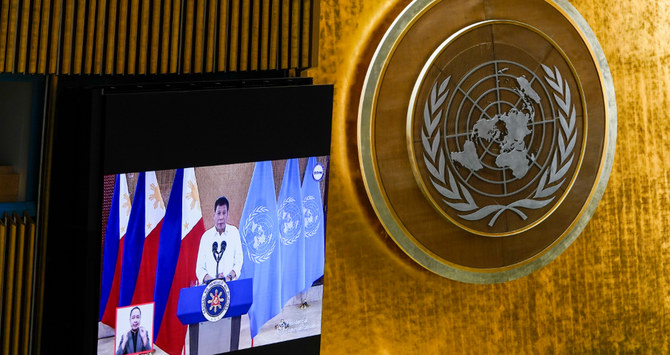
Philippine President Rodrigo Duterte is seen on a video screen as he virtually addresses the 76th Session of the United Nations General Assembly on Tuesday at UN headquarters. (AP)
Short Url
Updated 22 September 2021
Follow

Philippines’ Duterte renews call to abolish kafala system

  • While Saudi Arabia has scrapped the controversial labor laws, Duterte says millions of OFWs continue to work in ‘unjust’ and ‘inhumane’ conditions elsewhere

MANILA: Philippines President Rodrigo Duterte has renewed his call for the abolition of the kafala or sponsorship system in Gulf countries, saying it was “unjust” and permits the “exploitation” of millions of overseas Filipino workers (OFWs).

 In his speech at the 76th UN General Assembly on Wednesday, Duterte, who has advocated against the kafala system at the UN for much of his career, maintained that “nothing can justify its continued existence.”

The kafala gives employers in GCC countries plus Jordan and Lebanon almost complete control over migrant workers’ employment and immigration status and generally binds them to one employer.

 In 2009, Bahrain became the first GCC country to abolish the kafala system, followed by Saudi Arabia earlier this year.

 “Millions of Filipinos work abroad under the most difficult and inhumane circumstances. We call for the abolition of all structures that allow the exploitation and oppression of migrant workers,” Duterte said.

 “The kafala system is one such behemoth that chains the weak, the desperate, and the voiceless to an existence of unimaginable suffering. While reforms have been made, the kafala system must be dismantled — sooner rather than later — in the name of justice and basic decency,” he added.

 Under the controversial system, migrant workers must have a sponsor in the host country for a visa or worker’s permit to be issued.

 Duterte has previously said that the system led to “inhumane working conditions, nonpayment of wages, movement restrictions, healthcare denial, and sexual abuse of overseas Filipino workers.”

 In March, the Philippines welcomed the Kingdom’s move to end the notorious sponsorship system and replace it with new measures to ensure migrant workers in the private sector have improved job mobility and can switch jobs or leave Saudi Arabia without their employers’ consent.

The labor reforms will also allow OFWs to apply directly for government services, with all employment contracts documented online.

Dexter Garcia, a former OFW who spent a decade working as an office staff member with the Saudi Turf Company, returned to the Philippines in November last year, a few months before the Kingdom’s new laws became effective on March 14.

He said while he had “heard many stories of abuse, that was all in the past.”

“Before I left the Kingdom after my contract with my company ended last year, things were already starting to change. The Saudi government was already starting to relax the kafala,” he told Arab News.

According to the Department of Foreign Affairs, as of January 2020, there are an estimated 2,221,448 Filipinos in the Middle East.


Saudi ambassador becomes first foreign envoy to meet Bangladesh’s new PM

Updated 4 sec ago
Follow

Saudi ambassador becomes first foreign envoy to meet Bangladesh’s new PM

  • Tarique Rahman took oath as PM last week after landslide election win
  • Ambassador Abdullah bin Abiyah also meets Bangladesh’s new FM

Dhaka: Saudi Arabia’s ambassador to Dhaka became on Sunday the first foreign envoy to meet Bangladesh’s new Prime Minister Tarique Rahman since he assumed the country’s top office.

Rahman’s Bangladesh Nationalist Party made a landslide win in the Feb. 12 election, securing an absolute majority with 209 seats in the 300-seat parliament.

The son of former Prime Minister Khaleda Zia and former President and BNP founder Ziaur Rahman, he was sworn in as the prime minister last week.

The Saudi government congratulated Rahman on the day he took the oath of office, and the Kingdom’s Ambassador Abdullah bin Abiyah was received by the premier in the Bangladesh Secretariat, where he also met Bangladesh’s new foreign minister.

“Among the ambassadors stationed in Dhaka, this is the first ambassadorial visit with Prime Minister Tarique Rahman since he assumed office,” Saleh Shibli, the prime minister’s press secretary, told Arab News.

“The ambassador conveyed greetings and best wishes to Bangladesh’s prime minister from the king and crown prince of Saudi Arabia … They discussed bilateral matters and ways to strengthen the ties among Muslim countries.”

Rahman’s administration succeeded an interim government that oversaw preparations for the next election following the 2024 student-led uprising, which toppled former leader Sheikh Hasina and ended her Awami League party’s 15-year rule.

New Cabinet members were sworn in during the same ceremony as the prime minister last week.

Foreign Minister Khalilur Rahman is a former UN official who served as Bangladesh’s national security adviser during the interim government’s term.

He received Saudi Arabia’s ambassador after the envoy’s meeting with the prime minister.

“The foreign minister expressed appreciation for the Saudi leadership’s role in promoting peace and stability in the Middle East and across the Muslim Ummah. He also conveyed gratitude for hosting a large number of Bangladeshi workers in the Kingdom and underscored the significant potential for expanding cooperation across trade, investment, energy, and other priority sectors, leveraging the geostrategic positions of both countries,” the ministry said in a statement.

“The Saudi ambassador expressed his support to the present government and his intention to work with the government to enhance the current bilateral relationship to a comprehensive relationship.”

Around 3.5 million Bangladeshis live and work in Saudi Arabia. They have been joining the Saudi labor market since 1976, when work migration to the Kingdom was established during the rule of the new prime minister’s father.

Bangladeshis are the largest expat group in the Kingdom and the largest Bangladeshi community outside Bangladesh and send home more than $5 billion in remittances every year.