

Filipinos celebrate end of decades-old kafala system in Saudi Arabia

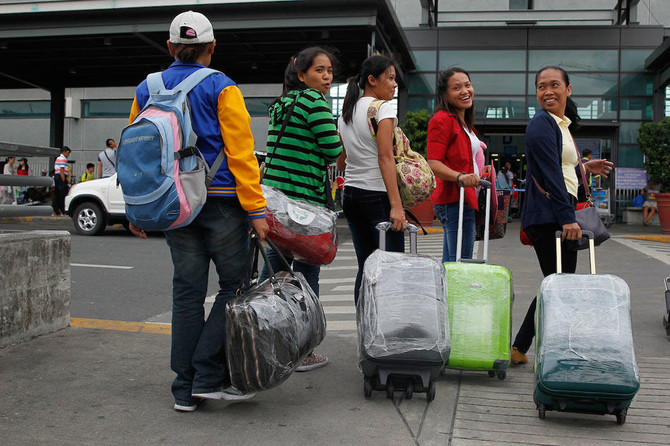
An alliance of overseas Filipino workers (OFW) celebrated the abolition of Saudi Arabia’s kafala sponsorship system on Sunday. (Reuters/File)
Short Url
Updated 14 March 2021
Follow

Filipinos celebrate end of decades-old kafala system in Saudi Arabia

  • Move will encourage transparency and freedom, migrant workers’ group says

MANILA: An alliance of overseas Filipino workers (OFW) celebrated the abolition of Saudi Arabia’s kafala sponsorship system on Sunday, rejoicing over the historic labor reforms that have given more “freedom” to millions of migrant workers in the Kingdom.

“Saudi Arabia has announced that it will end its notorious sponsorship or kafala system on March 14. Migrante-Kingdom of Saudi Arabia, together with all OFWs in the country, is glad and jubilant and is celebrating over this historic action,” Migrante International (MI) said in a statement late on Saturday.

The new measures, effective March 14, will ensure that migrant workers in the private sector have improved job mobility and can switch jobs or leave the Kingdom without their employers’ consent.

The move will also allow foreign workers to apply directly for government services, with all employment contracts documented online.

“The announcement will do away with the need for a sponsor or kafeel’s approval to transfer sponsorship, for a migrant worker to undergo sponsorship to receive exit and re-entry visas, and for migrants to become runaways or ‘huroob’ from their kafeels,” according to MI.

It added that the Kingdom was undertaking the initiative “to strengthen its private sector and make it more attractive to foreign talent,” as it seeks to diversify its internal economy, which has for long been dependent on oil.

“Migrante-KSA lauds Crown Prince Mohammed bin Salman who, in his Vision 2030, is undertaking economic reforms in the country and has boldly decided to let go of the kafala system,” the statement said.

Recruitment and migration expert Emmanuel Geslani told Arab News that ending the kafala system was a “liberation” for Filipino workers, as well as for workers of other nationalities, in the Kingdom.

As many as 10 million migrant workers are expected to benefit from the Kingdom’s Labor Reform Initiative, which is intended to foster “a competitive and fair working environment.”

“Abolition of this major restriction, which has been imposed on all foreign workers, will now free our OFWs from the abusive manners of some employers,” he said.

“It will create more liberal conditions, especially for our household service workers, who were susceptible to abuse from their employers,” Geslani added.

Geslani said there had been instances in which some employers used the system to hold workers “hostage” by withholding their exit visas unless payment was made by the Philippine embassy or the employee’s accredited recruiter.

“This was despite the termination of their contracts or contract disputes, which led some to run away,” he said, adding that the reforms were a win-win for all.

“The Saudi government also lifted the system to attract more highly skilled workers who were hesitant to work in the Kingdom due to the kafala system,” Geslani said.

According to MI, the kafala system had been in place for seven decades in the Kingdom.

“Many migrant workers, local and international NGOs, and even the UN have criticized it and have called for its reform,” MI said.

The Philippines has been advocating against the kafala system in the UN and international fora for years.

Earlier, it had officially partnered with Bahrain, one of the first countries to abolish the system in its labor reform movement through the Flexi Visa System, which allows undocumented workers to acquire regular immigration status without an employer sponsor.

The Philippines also pioneered the negotiation and international adoption of the Global Compact for Safe, Orderly and Regular Migration to protect Filipino migrant workers against exploitation and abuse and guarantee decent work, consistent with President Rodrigo Duterte’s policies for “no OFW to be a slave to anyone.”

Saudi Arabia has one of the highest numbers of Filipino migrant workers in the Middle East, with nearly 1 million OFWs deployed in the Kingdom.

There was a drop in number last year with the repatriation of many OFWs affected by the coronavirus disease (COVID-19) pandemic.


US, Ukraine hail ‘productive’ Miami talks but no breakthrough

Updated 6 sec ago
Follow

US, Ukraine hail ‘productive’ Miami talks but no breakthrough

  • Representatives from Ukraine, Russia, and Kyiv’s European allies, held separate talks hosted by US special envoy Steve Witkoff
  • Russia's delegation said recent proposed changes to Trump's “20-point plan”  to end the war were a non-starter

MIAMI, Florida: US and Ukrainian envoys issued a joint statement on Sunday that hailed “productive and constructive” talks in Miami but did not announce any apparent breakthrough in efforts to end the war with Russia.

Top representatives from both Ukraine and Russia, as well as Kyiv’s European allies, have been in southern Florida over the past several days for a series of separate talks hosted by US President Donald Trump’s special envoy, Steve Witkoff.
The meetings were the latest in a weeks-long diplomatic blitz over plans to end the war, after Washington last month presented a 28-point proposal widely seen as echoing the Kremlin’s demands.
It has since been redrafted following Ukraine and Europe’s involvement, though its contents have not been publicly disclosed.
“Over the last three days in Florida, the Ukrainian delegation held a series of productive and constructive meetings with American and European partners,” Witkoff and Ukraine’s top negotiator, Rustem Umerov, said in separate statements on X.
They said a bilateral US-Ukraine meeting focused on developing and aligning positions on “four key documents” — a “20-point plan,” a “Multilateral security guarantee framework,” a “US Security guarantee framework for Ukraine” and an “economic & prosperity plan.”
“Particular attention was given to discussing timelines and the sequencing of next steps,” they said, without announcing any further meetings.
National security advisers from Kyiv’s European allies “also joined the discussions to align on a shared strategic approach between Ukraine, the United States, and Europe,” the statements added.
Russian envoy Kirill Dmitriev was also in southern Florida and met with the US delegation, which included billionaire real estate developer Witkoff and Trump’s son-in-law Jared Kushner.
Witkoff on Sunday similarly said that the meetings with Dmitriev were “productive and constructive.”
Earlier, the Kremlin said recent proposed changes to the plan to end the war were a non-starter.
Dmitriev “should receive information about what has been developed by the Americans and Europeans” in the plan and report that back to Moscow later, Kremlin’s spokesman Dmitry Peskov told state TV.
Moscow, which invaded Ukraine in February 2022, sees Europe as pro-war and argues that its participation in the talks only hinders them.

War rages on 

While little is known of the latest peace plans, Kyiv is likely to be expected to surrender some territory — a prospect resented by many Ukrainians — in exchange for US security guarantees.
Though envoys from both Moscow and Kyiv were in town, the Kremlin had earlier ruled out three-way talks.
Ukrainian President Volodymyr Zelensky earlier described the talks as “constructive” and said they were “moving at a fairly rapid pace.”
He nevertheless cautioned that “much depends on whether Russia feels the need to end the war for real.”
He also hailed this week as “historic” for Ukraine, thanking Europe for pledging $100 billion of funding over the next two years.
Moscow’s troops have been steadily advancing at the eastern front in recent months. Putin on Friday hailed the Russian army’s territorial gains — and threatened more in the coming weeks.
Just over the week, “Russia has launched approximately 1,300 attack drones, nearly 1,200 guided aerial bombs, and 9 missiles of various types” against Ukraine, Zelensky said.
Most of them have pummeled the Black Sea region of Odesa, where relentless strikes wrought havoc on ports, bridges and energy facilities, killing eight people Saturday.
In the eastern Sumy region, Russian troops attempted a breakthrough in an area previously spared from an intense ground offensive. Russian forces forcibly moved 50 people from a local village, said Kyiv.
“Russian invaders have stolen five dozen civilian people, mostly elderly women, from a tiny Ukrainian village Grabovske, right across the state border in the Sumy region,” Foreign Minister Andriy Sybiga said.
Russia made no comment on the matter.