

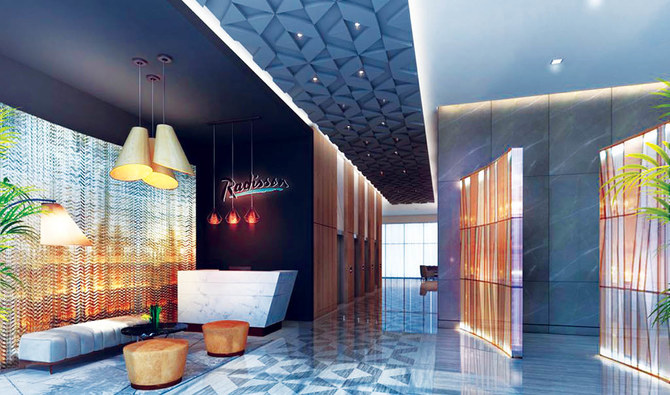
Thakher Makkah to host three new Radisson hotels

The new signings will add a total of 992 rooms and apartments, doubling the group’s portfolio in Makkah, a key target growth market in Saudi Arabia.
Short Url
Updated 22 September 2021
Follow

Thakher Makkah to host three new Radisson hotels

Radisson Hotel Group has announced the signing of three hotels within the Thakher Makkah megaproject, an urban development in the holy city. The Park Inn by Radisson Makkah Thakher City Tower West, the Park Inn by Radisson Makkah Thakher City Tower East and the Radisson Hotel Makkah Thakher City are set to open in Q4 2022. The new signings will add a total of 992 rooms and apartments, doubling the group’s portfolio in Makkah, a key target growth market in Saudi Arabia.

Elie Younes, executive vice president and chief development officer EMEA, Radisson Hotel Group, said: “We are delighted to announce this portfolio of three new hotels, as it not only accelerates our growing presence in Makkah, but also reaffirms our commitment toward the country and its future. The Thakher Makkah megaproject is designed to attract millions of pilgrims every year and will positively contribute to the country’s ambitious plan that aims to host 30 million Umrah visitors, as well as, hosting 6 million Hajj pilgrims by the year 2030. We remain committed to the country’s Vision 2030 and its initiatives to significantly increase the contribution of leisure and business tourism to the country’s economy. We would like to thank our business partners for their trust in our brands and teams as we look forward to an exciting and rewarding journey.”

Located within the Thakher Makkah megaproject, a mixed-use development comprising hotels, residential and retail units, the hotels are just a stone’s throw away from the holy site.

Abdulaziz Al-Aboudi, CEO of Thakher Development Co., said: “The keenness of international hotel companies to provide their services to the Thakher Makkah Project reflects the importance and value of the project as a prominent tourism destination in the holy city. Such cooperation gives an indication that we are on the right path to providing new distinctive hospitality and housing options, which is in line with Vision 2030. We are excited to announce the launch of further cooperation with Radisson Hotel Group, which we anticipate will be a fruitful endeavor.”

A combination of both hotel and residential options, the Radisson Hotel Makkah Thakher City will consist of 440 rooms and 206 branded residences, a lobby café, and an all-day dining restaurant. For leisure and recreation, the hotel will feature separate ladies and male gym facilities, while the meeting and event spaces will include five meeting rooms as well as three conference rooms.

Park Inn by Radisson Makkah Thakher City Tower West and Park Inn by Radisson Makkah Thakher City Tower East are designed to facilitate pilgrims’ stay and experience in the Kingdom. With clever use of color, contemporary design, and friendly and personalized services, guests can relax while fully embracing their pilgrimage.

Boasting 203 rooms, the Park Inn by Radisson Makkah Thakher City Tower West offers its guests a lobby cafe and an all-day dining restaurant. The upcoming Park Inn by Radisson Makkah Thakher City Tower East houses 143 rooms, a lobby lounge, and one restaurant.

The city of Makkah, situated 70 km southeast of Jeddah, is known as the holiest city in Islam. The main sources of economic activity in Makkah are the Hajj and Umrah pilgrimage, with millions flocking to Makkah each year for worship and devotion. Since the seventh century, Muslims all over the world have visited Makkah, the birthplace of Islam. It is a pilgrimage that marks their observance of one of the five pillars of Islam and the fulfillment of a once-in-a-lifetime ritual.

Preventive care: rethinking everyday health in Saudi Arabia

Updated 10 December 2025
Follow

Preventive care: rethinking everyday health in Saudi Arabia

In Saudi Arabia, a quiet revolution is reshaping the way people think about health. It is not happening in operating rooms or emergency wards — it is unfolding in homes, schools, and communities. It is imperative we ask ourselves: what if health began long before the doctor’s visit? What if the most powerful interventions were the ones we made every day — at home, at school and in our communities?

This philosophy is at the heart of Haleon’s work in Saudi Arabia, where the consumer healthcare company is helping redefine what it means to be healthy. It is not just about curing illness; it is about preventing it. It is not just about access; it is about empowerment. And it is not just about innovation; it is about inclusion.

Prevention as a national imperative

Saudi Arabia’s Vision 2030 and its Health Sector Transformation Program have placed preventive care at the center of the national strategy. This is not just policy — it is a paradigm shift. From chronic disease management to oral hygiene education, the Kingdom is investing in initiatives that help people stay healthy, not just get treated.

This shift is especially critical in a region where lifestyle-related conditions like diabetes, heart disease, and obesity are on the rise. By promoting healthier habits and early intervention, Saudi Arabia is not only improving individual outcomes, it is reducing long-term strain on hospitals and clinics.

From awareness to action

Health literacy remains one of the most overlooked barriers to better outcomes in the pursuit toward preventive health, with low health literacy associated with 2.8 times higher health costs per person. By focusing on everyday habits, Haleon is shifting the narrative from reactive care to proactive wellness.

Darśana Nair, general manager of Haleon Saudi Arabia, said: “When people understand their health, they’re empowered to protect it.”

This belief drives Haleon’s broader investment in wellness, including its Pain Management Institute, a resource hub for both professionals and patients navigating chronic pain. With 70 percent of its Saudi business dedicated to over-the-counter products, Haleon is championing accessible, preventive care that meets people where they are.

Inclusivity as a strategy

Haleon’s commitment to health equity is evident in its outreach; the company ensures that no community is left behind. Arabic-language materials and culturally tailored programs make health information more relevant and actionable, breaking down barriers and building trust.

Global roots, local impact

Headquartered in Jeddah, Haleon has built a workforce that is nearly 50 percent Saudi nationals and invested in local manufacturing, including the production of Panadol in the Kingdom. This localization strategy strengthens supply chains, supports job creation, and aligns with Saudi Arabia’s broader goals for industrial growth and economic resilience.

“Our collaboration with the Ministry of Investment to localize Panadol manufacturing is just one example of how we support job creation, industrial growth, and supply chain resilience,” said Nair. “By promoting prevention and self-care, we also help reduce the long-term burden on hospitals and make the healthcare system more sustainable for everyone.”

A new era of everyday health

Haleon’s work in Saudi Arabia is more than corporate strategy — it is a vision for the future. “We believe that better everyday health is possible for everyone,” Nair said. “Working alongside our partners and communities, we are proud to support Saudi Arabia’s vision for the future.”

  • The writer, Darsana Nair, is general manager at Haleon.
