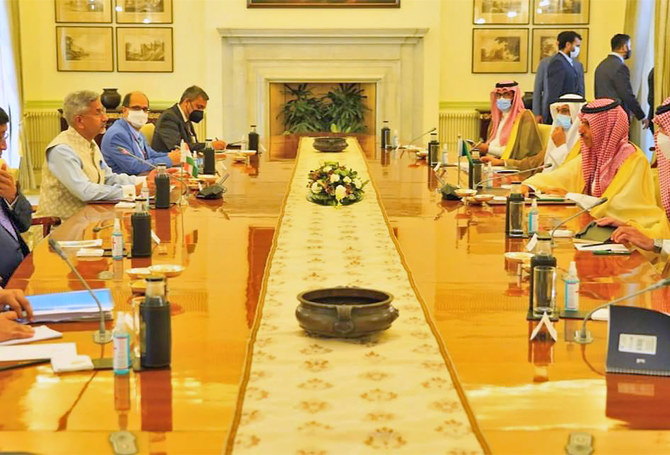

NEW DELHI: Saudi Foreign Minister Prince Faisal bin Farhan held talks with the Indian foreign minister in New Delhi on Sunday amid growing fears of a return to a repressive Taliban regime in Afghanistan.
The two men had what India’s Foreign Minister S. Jaishankar described as a “very useful exchange of views on Afghanistan” in a “cordial and productive meeting.”
Saudi Arabia's top Saudi diplomat arrived in New Delhi for a two-day visit on Saturday and is expected to call on Prime Minister Narendra Modi on Monday.
It was the first high-level visit by a Saudi minister to India since the COVID-19 outbreak and subsequent travel curbs early last year.
“(It) was a cordial and productive meeting with (the) Saudi foreign minister,” Jaishankar said in a Twitter post on Sunday after the meeting at Hyderabad House in New Delhi.
Prince Faisal’s visit comes amid the recent political changes in Afghanistan after the Taliban’s return to power last month, marking the first official interaction between the two allies.
“Very useful exchange of views on Afghanistan, the Gulf and the Indo-Pacific,” Jaishankar said.
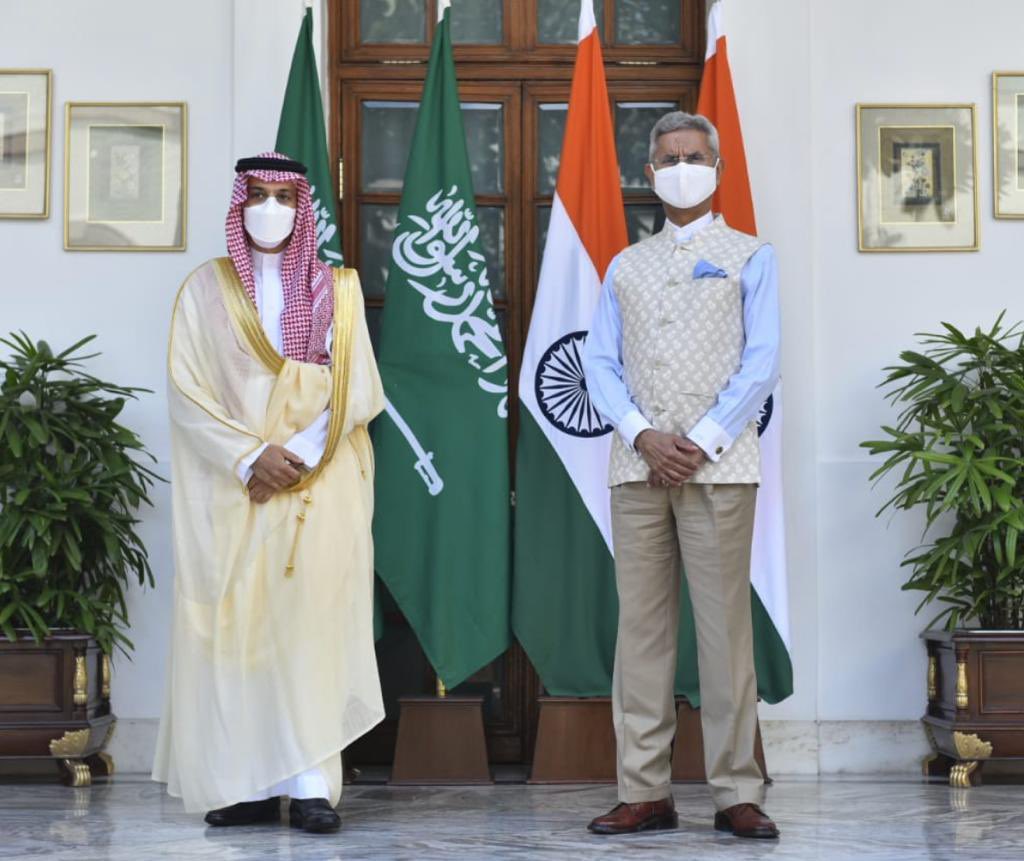
Saudi FM Prince Faisal bin Farhan and India’s FM Subrahmanyam Jaishankar meet in New Delhi. (Photo courtesy: @DrSJaishankar/Twitter)
New Delhi had previously cultivated a close relationship with Ashraf Ghani, the Afghan president who fled the country when the Taliban swept into Kabul on Aug. 15.
“Saudi Arabia and India have shared concerns as to whether Afghanistan will become a sanctuary for extremists because then it would become extremely dangerous for the neighborhood as a whole,” Talmiz Ahmad, former Indian Ambassador to Saudi Arabia, told Arab News.
“It’s natural that both the close partners would discuss Afghanistan. It reflects very close relations that India and Saudi Arabia have established with each other.
“We now have a strategic council at the apex level. Therefore, the relationship that began with cooperation on counterterrorism has now become a very strong and deep strategic partnership.”
Return to repression
Despite promises by the Taliban that their new administration would be different from their hard-line Islamist regime in the late 1990s, a series of rulings by their interim government has raised fears of a return to repression, particularly of women.
About two dozen female activists protested outside the former women’s ministry on Sunday after it was closed by the Taliban and replaced by the Ministry for Promotion of Virtue and Prevention of Vice, the group’s moral police.
Female staff said they had been trying to return to work at the ministry for several weeks, but had been told to go home.
“The Ministry of Women’s Affairs must be reactivated,” said Baseera Tawana, one of the protesters. “The removal of women means the removal of human beings.”
Another protester, Taranum Sayeedi, said: “The women of Afghanistan today are not the women of 26 years ago.”
The new Taliban mayor of Kabul on Sunday ordered female city employees to stay at home, except those whose work could not be done by men.
Marzia Ahmadi, a rights activist and government employee, demanded that the Taliban reopen public spaces to women. “It’s our right,” she said. “We want to talk to them. We want to tell them that we have the same rights as they have.”

Afghan activists demonstrate in front of the former Ministry of Women Affairs in Kabul on Sept. 19, 2021, to demand better rights for women. (Photo by Bulent Kilic / AFP)
Strategic partnership
The two officials also reviewed progress in implementing the Strategic Partnership Council Agreement, signed during PM Modi’s visit to Saudi Arabia in October 2019, and bilateral cooperation at multilateral forums such as the UN, the G20 and the Gulf Cooperation Council.
Jaishankar congratulated Prince Faisal for Saudi Arabia’s successful presidency of the G20 last year, at the pandemic’s peak, a statement by India’s Foreign Ministry said.
“Both sides discussed further steps to strengthen their partnership in trade, investment, energy, defense, security, culture, consular issues, health care and human resources,” it added.
The foreign ministers also agreed to “work closely” to deal with pandemic-related challenges, with Jaishankar thanking Saudi “for the support provided to the Indian community during the COVID-19 pandemic,” urging the Kingdom to relax travel restrictions for visitors from India further.
In July, Riyadh imposed a travel ban on 13 countries, including India, to curb the spread of the coronavirus and its new variants, but removed the UAE, Argentina and South Africa from the list and re-allowed citizens to travel to the three countries starting Sept. 8.
According to Indian foreign ministry data, more than 2 million Indians are living and working in the Kingdom, employed in various sectors of the Gulf state. However, the COVID-19 pandemic rendered thousands jobless, with a majority unable to return to work due to travel curbs.
Jaishankar urged an early resumption of direct flights to Saudi Arabia while both nations “agreed to work closely on all COVID-19 related challenges.”
In April and May, Saudi supplied more than 140 tons of medical oxygen to Indian to help the South Asian nation tide over a health crisis amid a deadly second wave of the coronavirus that claimed the lives of more than 400,000 in a country of 1.36 billion people.