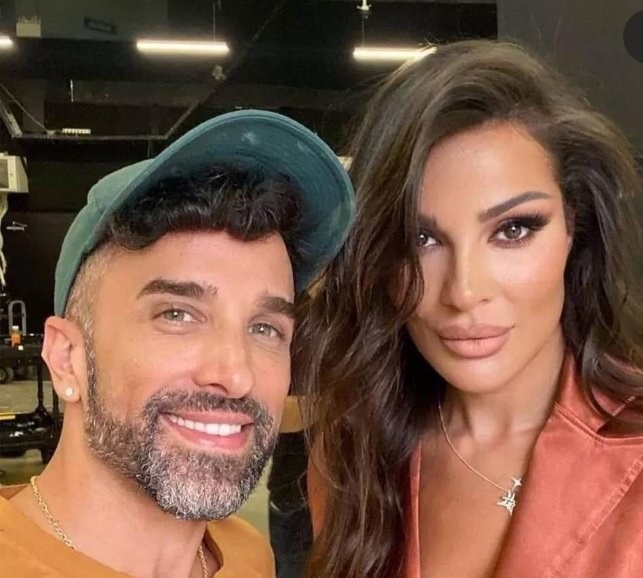

LONDON: A photograph of Lebanese actress Nadine Njeim apparently posing with an Israeli make-up artist in the UAE sparked a social media storm over the weekend.
“Lebanese model and actress Nadine Njeim is pictured with an Israeli make-up artist in UAE. Likely his customer. Is this another case of ‘Oh, I didn’t know’!?” Twitter user Lebanon News and Updates (@LebUpdate) wrote in a message posted on Twitter on Saturday alongside the photograph.
In a subsequent Tweet, he said: “It is confirmed that she was his customer, according to his TikTok video. It is obvious that famous people do not simply choose random makeup artists without some background research on his/her work and experience.”
Lebanese model and actress Nadine Njeim is pictured with an Israeli make-up artist in UAE. Likely his customer.
Is this another case of "Oh, I didn't know"!? pic.twitter.com/ur515m1Alc
— Lebanese News and Updates (@LebUpdate) September 18, 2021
The messages provoked a number of shocked and angry responses on Twitter.
I hate Hibzalla with all my being but Israel remains an enemy.
I fail to see how it's "cool" and such a "21st century kind of thing" to hang out, even outside Lebanon.
Especially for Nadine, she should've known better. Avoid, there are plenty of other fish in the sea. https://t.co/qf78CHi3Qg
— Rita Tohme (@TohmeRita) September 19, 2021
“Nadine Njeim they are asking for models in Tel Aviv,” a user called Mimo wrote.
@nadinenjeim Nadine Njeim they are asking for models in Tel Aviv. https://t.co/StjOqxfLk2
— Mimo (@Barbane49011781) September 18, 2021
Another, called Adam, simply tweeted three puking-face emojis, as others chimed in. Some critics predicted that Njeim, a former beauty queen who was crowned Miss Lebanon in 2004, would say she did not know the makeup artist was from Israel. But other people said so what if he is?
“I am so tired of this backward mentality and these people,” a Twitter user called Romy wrote. “When they’re not destroying Lebanon with their foreign allegiance and ideology they spend their time online on their iPhones stalking people to see if an Israeli breathed near them, and then bully them or get them in trouble.”
I am so tired of this backward mentality and these people.
When they’re not destroying Lebanon with their foreign allegiance &ideology
They spend their time online on their Iphones stalking people to see if an Israeli breathed near them,and then bully them or get them in trouble https://t.co/zryY4AXqe2— Romy (@romytweeting) September 19, 2021
Another, 961Iceberg, wrote: “Every time you walk into a hairdresser salon or makeup artist studio, make sure you ask them for a full-blown bio including birth certificate, passports, visas issued and associations with other humans on earth.”
Every time you walk into a hairdresser salon or makeup artist studio, make sure you ask them for a full blown bio including birth certificate, passports, visas issued and associations with other humans on earth. Some Lebanese are seriously fried! https://t.co/XLGNga7qrh
— 961iceberg (@961iceberg) September 19, 2021
Lebanon is technically still at war with Israel. The countries have no official ties and Lebanese citizens are forbidden from traveling there. In March, a Lebanese social-media activist who had served 10 months of a three-year prison sentence for “collaborating” with Israel was granted bail and released after appealing the verdict.
In 1993, just three years after the end of the Lebanese Civil War, and with Israel still occupying the south of a country, a photograph of Lebanese beauty queen Ghada Turk smiling alongside 17-year-old Tamara Porat, Miss Israel, caused public outrage in Lebanon and much criticism in the local media.
In 2015, a selfie taken during a Miss Universe pageant and posted by Miss Israel that included Miss Lebanon, Miss Japan and Miss Slovenia cause a “you do not represent Lebanon” hashtag to go viral. Two years later, Miss Lebanon Amanda Hanna, a dual citizen of Sweden and Lebanon, was stripped of her title a week after winning when it emerged she had previously visited Israel using her Swedish passport.
However, under President Michel Aoun the Lebanese government has engaged in border talks with the Israelis. And in 2020, Lebanon’s prosecutor general decided not to charge fugitive former Nissan boss Carlos Ghosn over a visit to Israel in 2008.
It is unknown whether Njeim, who obtained a UAE 10-year Golden Visa in May, has any another citizenship or passport, or what consequences she might face should she return to Lebanon.
The UAE, Bahrain, Sudan and Morocco signed agreements with Israel last year, dubbed the Abraham Accords, to normalize relations with Israel.