Danish embassy celebrates the Global Goals World Cup Saudi Arabia 2021 Initiative

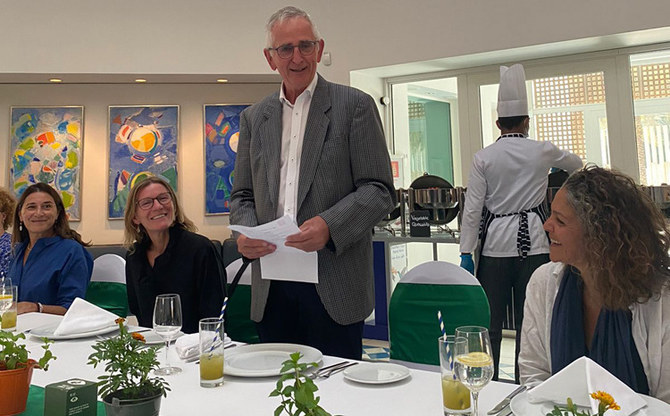
Denmark’s Ambassador to Saudi Arabia Ole E. Moesby makes an address at an embassy luncheon following the Global Goals World Cup (GGWCUP). (Photo: Lojien Ben Gassem)
Short Url
Updated 18 September 2021
Follow

Danish embassy celebrates the Global Goals World Cup Saudi Arabia 2021 Initiative

  • Twenty-eight teams from all over Saudi Arabia participated in the Global Goals World Cup (GGWCUP)
  • UN Goal 13 was chosen by the Danish embassy’s team, Green Tornado, who have been working on green initiatives in Riyadh

RIYADH: The Royal Danish Embassy in Riyadh recently celebrated the Global Goals World Cup (GGWCUP) initiative, a women football tournament taking place for the first time in Riyadh this year.

Twenty-eight teams from all over Saudi Arabia came to play this weekend at the tournament.

The Saudi sports minister and Sports for All Federation are the co-sponsors and organizers, along with Majken Gilmarti, the Danish co-founder and CEO at the GGWCUP.

The main goal of the tournament is to encourage women across the country to participate in sports and boost health.

Described as the social good world cup, the tournament is asking each team to apply one of the UN’s 17 Sustainable Development Goals.

Danish Ambassador Ole E. Moesby hosted the lunch gathering at the Embassy to discuss climate action, SDG 13, among guests and representatives from the UN and the GGWCUP.

Goal 13 was chosen by the Embassy’s female team called Green Tornado, who have been working on their green initiative over the previous months around Riyadh.   

Moesby highlighted Green Tornado’s hard work throughout the previous six months to achieve their goals.

“They have planted flowers and trees, they have collected garbage, and they have set an example of what you can get out of it and also being part of a team that's called Green Tornado,” Moesby told Arab News.

Gilmarti told Arab News that hosting the event for the first time in Saudi Arabia was magical: “Seeing and getting to work with the Sport for All Federation and their team is amazing. They are pro in how they are doing it, and they are open-minded to the whole approach.”

She added: “We create communities where everybody thrives and have a great life.”

Gilmarti said that the winning team in this year’s tournament will be playing in their annual global finals in Iceland.

“We play in November as part of the global forum, the women political leaders forum. So, we invite women, political leaders to get to know about the teams.”

Lamia Bahian, a board member of the Women’s Football Federation, told Arab News that her focus is developing women’s football in Saudi Arabia starting from ground zero, building a community that can support the sport.

“Now we have our regional training center, which is going to be activated. And two weeks from now, leagues will start very soon.” She said.

Bahian said it was “great to be part of that event and see it happening in your own eyes and on-ground, that’s a feeling that I don't think I can describe.”


Saudi Arabia advances in Universal Health Coverage index

Updated 12 December 2025
Follow

Saudi Arabia advances in Universal Health Coverage index

  • Life expectancy in Kingdom rose from 74 in 2016 to 79.7 in 2025

RIYADH: Saudi Arabia has made notable progress in the Universal Health Coverage Service Coverage Index, reinforcing its position among leading nations in global health indicators, according to the latest data released by the World Health Organization and the World Bank.

The Kingdom recorded a score of 83 points in the latest UHC update, marking a nine-point increase within two years and placing Saudi Arabia among countries classified as having high-level health service coverage.

The steady rise reflects sustained improvements over the past two decades and underscores the impact of the Kingdom’s Health Sector Transformation Program under Saudi Vision 2030.

The UHC Service Coverage Index is one of the internationally recognized Sustainable Development Goal indicators and measures access to essential health services across key areas, including preventive care, treatment, and system capacity.

Progress in the index is closely linked to broader development outcomes such as improved quality of life, reduced disease burden, and enhanced social well-being.

Saudi Arabia’s advancement has been driven by a strategic focus on preventive healthcare, strengthened primary care services, expanded early screening programs, and increased health system readiness.

The transformation has also been supported by rapid digitalization, including platforms such as Sehhaty and the Seha Virtual Hospital, which have expanded access to care and improved service efficiency nationwide.

These reforms have translated into measurable public health gains. Life expectancy in Saudi Arabia rose from 74 years in 2016 to about 79.7 in 2025, bringing the Kingdom close to its Vision 2030 target of 80 years and highlighting the effectiveness of preventive and treatment programs.

Health Minister Fahad Abdulrahman AlJalajel said the progress reflected the tangible outcomes of Vision 2030 and sustained leadership support.

He said: “The improvements we see today in international health indicators demonstrate the real impact of the Kingdom’s health transformation, which prioritizes prevention, primary care empowerment, and digital health solutions. Raising life expectancy to 79.7 years is the result of an integrated effort focused on improving people’s health and quality of life.”

Saudi Arabia’s progress in the UHC index further strengthens its standing among G20 countries and underscores the Kingdom’s commitment to building a more efficient, resilient, and sustainable health system, with people at the center of national development.