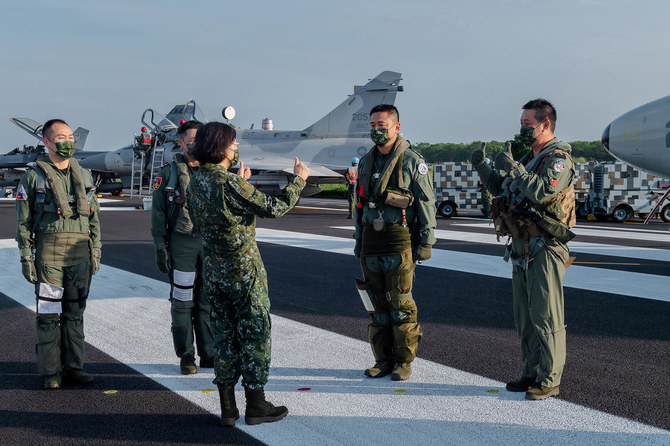
TAIPEI: Taiwan’s air force scrambled on Friday to warn away 10 Chinese aircraft that entered its air defense zone, Taiwan’s defense ministry said, the day after the island announced a $9 billion boost to military spending to counter the threat from China.
Chinese-claimed Taiwan has complained for a year or more of repeated missions by China’s air force near the democratically governed island, often in the southwestern part of its air defense zone close to the Taiwan-controlled Pratas Islands.
The latest Chinese mission involved 6 J-16 and 2 J-11 fighters plus one anti-submarine and one reconnaissance aircraft, the Taiwan ministry said.
Taiwan sent combat aircraft to warn away the Chinese aircraft, while missile systems were deployed to monitor them, the ministry said.
The Chinese fighters flew in an area close to the Pratas, while the anti-submarine and reconnaissance aircraft flew into the Bashi Channel that separates Taiwan from the Philippines, according to a map that the ministry issued.
Warships, early warning aircraft and bombers were deployed on Friday in patrols and drills aimed at improving the joint combat capabilities of China’s military in the area, a spokesman for China’s Eastern Theater Command said in a statement on Saturday.
The incident came a day after Taiwan proposed boosting military spending by $8.7 billion over the next five years, including on new missiles, warning of an urgent need to upgrade weapons in the face of a “severe threat” from China.
The Chinese patrols and drills also coincided a transit by a US destroyer in the Taiwan Strait on Friday, which the US Navy called a “routine” passage through international waters.
The Eastern Theater Command, which overseas Chinese military in eastern China, said on Saturday in a separate statement that the USS Barry was monitored on its entire course.
Speaking on Friday, Taiwan Premier Su Tseng-chang said the government had to take the threat from China seriously.
“The Chinese Communists plot against us constantly,” he said.
Taiwan’s defense spending “is based on safeguarding national sovereignty, national security, and national security. We must not relax. We must have the best preparations so that no war will occur,” he added.
China’s government, for its part, criticized Taiwan Foreign Minister Joseph Wu on Friday for comments this week in which he said Taiwan was a “sea fortress” blocking China’s expansion into the Pacific.
Wu’s “aim is to deceive public opinion, to rope in and collude with anti-China foreign forces,” China’s Taiwan Affairs Office said in a statement.


China enters Taiwan air defense zone a day after military budget boost
https://arab.news/29ged
China enters Taiwan air defense zone a day after military budget boost

- Speaking on Friday, Taiwan Premier Su Tseng-chang said the government had to take the threat from China seriously


26 Doctors without Borders workers remain unaccounted for in South Sudan a month after attacks
- A hospital in the town of Lankien was bombed by government forces, MSF said
- “We have lost contact with them amid ongoing insecurity”
NAIROBI: More than two dozen Doctors Without Borders workers remain unaccounted for a month after attacks in South Sudan, the medical charity said.
Two facilities belonging to the group, known by French acronym MSF, were attacked on Feb. 3 in Jonglei State, northeast of the capital, Juba, where violence has displaced an estimated 280,000 people since December.
A hospital in the town of Lankien was bombed by government forces, MSF said, while another medical facility in the town of Pieri was raided by “unknown assailants.” Both were located in opposition-held areas.
Staff working at the two facilities fled alongside much of the local population into deeply rural areas where armed clashes and aerial bombardments were ongoing.
MSF said in a statement on Monday that “26 of 291 of our colleagues working in Lankien and Pieri remain unaccounted for.
“We have lost contact with them amid ongoing insecurity,” it said.
The lack of communication with its staff could be linked to the limited network connectivity in much of the state. Staff members who had been contacted described “destruction, violence and extreme hardships.”
Fighting escalated sharply in December, when opposition forces captured a string of government outposts in north central Jonglei. In January, the government responded with a counteroffensive that recaptured most of the area it had lost.
Displaced people in Akobo, an opposition-held town near the Ethiopian border, described horrific violence by government fighters. Many described not being able to find food or water as they walked for days to reach safety.
The attacks on MSF facilities in Lankien and Pieri are part of an uptick in violence on humanitarian staff, supplies and infrastructure, aid groups say. MSF facilities have been attacked 10 times in the last 12 months.
“This violence has taken an unbearable toll not only on health care services, but on the very people who kept them running,” said Yashovardhan, MSF head of mission in South Sudan, who only uses one name.
“Medical workers must never be targets,” he said. “We are deeply concerned about what has happened to our colleagues and the communities we serve.”