

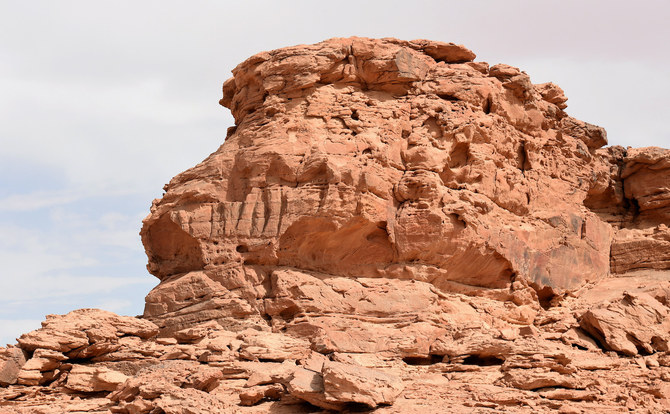
Camel carvings in Saudi Arabia thought to be world’s oldest large-scale animal reliefs

The researchers behind the new study believe that the life-size carvings of the camels are between 7,000-8,000 years old. (AFP)
Short Url
Updated 15 September 2021
Follow

Camel carvings in Saudi Arabia thought to be world’s oldest large-scale animal reliefs

DUBAI: A recent study has revealed that a series of camel sculptures in Saudi Arabia that were first discovered in 2018 are likely to be the oldest surviving large-scale animal reliefs in the world. 

The researchers behind the new study, published in the Journal of Archaeological Science, believe that the life-size carvings of the camels are between 7,000-8,000 years old. 
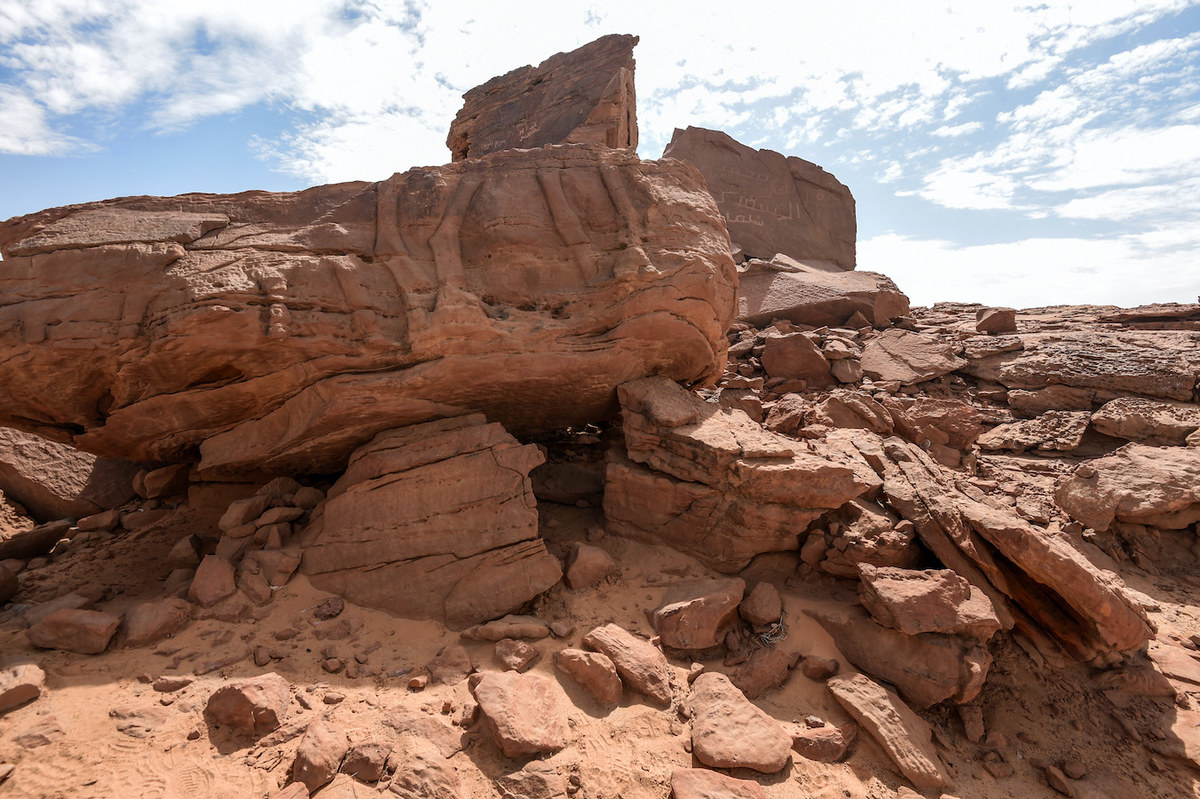


The figures were found in the northern province of Al-Jouf. (AFP)

This means that the sculptures are older than ancient landmarks like Egypt’s Pyramids of Giza, which are 4,500 years old, and England’s Stonehenge, which is 5,000 years old. 

The figures, which include other animals such as a donkey, were found in the northern province of Al-Jouf. 
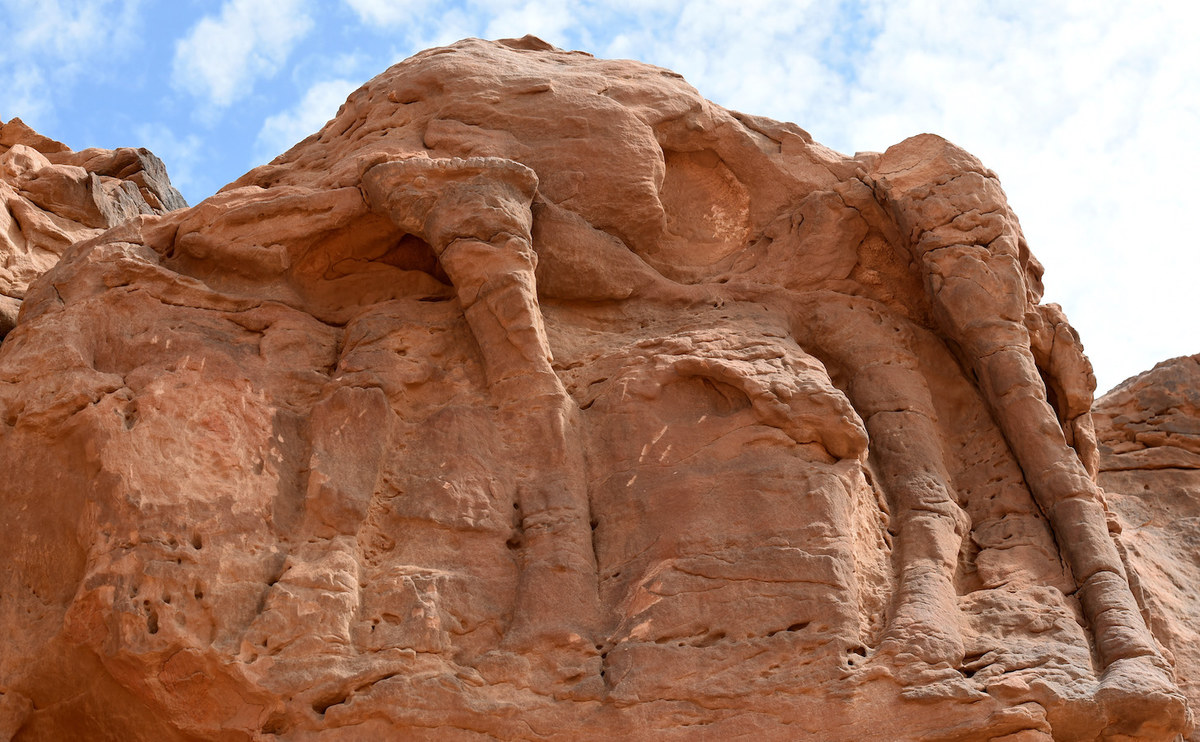


The new study shows that the sculptures are older than ancient landmarks like Egypt’s Pyramids of Giza, which are 4,500 years old. (AFP)

According to the researchers, “Neolithic arrowheads and radiocarbon dates attest occupation between 5200 and 5600 BCE.

“This is consistent with measurements of the areal density of manganese and iron in the rock varnish. The site was likely in use over a longer period and reliefs were re-worked when erosion began to obscure detailed features. By 1000 BCE, erosion was advanced enough to cause first panels to fall, in a process that continues until today,” the text says, according to a report by the BBC.  

The research was done by the Saudi Ministry of Culture, Max Planck Institute for the Science of Human History, French National Centre for Scientific Research and King Saud University.


Sotheby’s to bring coveted Rembrandt lion drawing to Diriyah

Updated 18 January 2026
Follow

Sotheby’s to bring coveted Rembrandt lion drawing to Diriyah

DUBAI: Later this month, Sotheby’s will bring to Saudi Arabia what it describes as the most important Rembrandt drawing to appear at auction in 50 years. Estimated at $15–20 million, “Young Lion Resting” comes to market from The Leiden Collection, one of the world’s most important private collections of 17th-century Dutch and Flemish art.

The drawing will be on public view at Diriyah’s Bujairi Terrace from Jan. 24 to 25, alongside the full contents of “Origins II” — Sotheby’s forthcoming second auction in Saudi Arabia — ahead of its offering at Sotheby’s New York on Feb. 4, 2026. The entire proceeds from the sale will benefit Panthera, the world’s leading organization dedicated to the conservation of wild cats. The work is being sold by The Leiden Collection in partnership with its co-owner, philanthropist Jon Ayers, the chairman of the board of Panthera.

Established in 2006, Panthera was founded by the late wildlife biologist Dr. Alan Rabinowitz and Dr. Thomas S. Kaplan. The organization is actively engaged in the Middle East, where it is spearheading the reintroduction of the critically endangered Arabian leopard to AlUla, in partnership with the Royal Commission for AlUla.

“Young Lion Resting” is one of only six known Rembrandt drawings of lions and the only example remaining in private hands. Executed when Rembrandt was in his early to mid-thirties, the work captures the animal’s power and restless energy with striking immediacy, suggesting it was drawn from life. Long before Rembrandt sketched a lion in 17th-century Europe, lions roamed northwest Arabia, their presence still echoed in AlUla’s ancient rock carvings and the Lion Tombs of Dadan.

For Dr. Kaplan, the drawing holds personal significance as his first Rembrandt acquisition. From 2017 to 2024, he served as chairman of the International Alliance for the Protection of Heritage, of which Saudi Arabia is a founding member.

The Diriyah exhibition will also present, for the first time, the full range of works offered in “Origins II,” a 64-lot sale of modern and contemporary art, culminating in an open-air auction on Jan. 31 at 7.30 pm.