

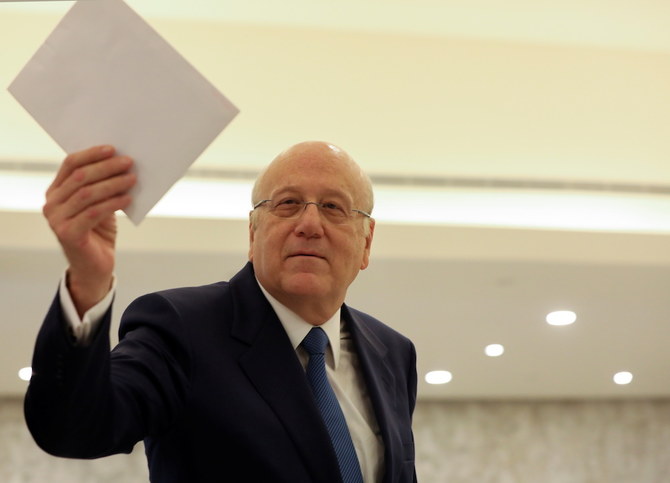

DUBAI: Lebanese Prime Minister Najib Mikati told Al-Sharq on Friday that the four files at the top of his government’s agenda were “confronting the COVID-19 pandemic, the reconstruction of the Beirut port, general reforms and parliamentary elections.”
In an exclusive interview, the new prime minister told Al-Sharq: “We have eight months of hard work to achieve what can be achieved.” Mikati said that “talks with the International Monetary Fund (IMF)” would be one of his government’s tasks.
“We will start addressing international bodies and funds in order to be open once again to other countries after a break in the recent period,” he said.
Reconnecting with the “Arab entourage”
Asked about the first Arab figure Mikati would communicate with after the announcement of the formation of the new government, he said: “We will work to reconnect with our Arab entourage. I will contact everyone, especially the GCC countries, to stop the recession in Lebanon.”
“We need quick actions and I will ask for the help of my brothers in the Arab and GCC countries. We are keen to coordinate and cooperate with all Arab countries and we cannot but have a close relationship with them.”
Mikati added: “I am fully aware of the remarks of some Arab countries, but Lebanon can only be their safe country and I promise them that.”
Politicians’ responsibility
On the obstacles he faced in the formation of the government, Mikati said: “Whoever wishes to disrupt the government shall stay out of it.”
“I assure that no party has the (blocking) third, whether it is persuasive or otherwise. I know the structure of my government very well and we will be working as one team.”
Asked about his economic reform program, he said: “This plan is ready, however, I can only present it after the cabinet’s approval.”
“We have a rescue plan and will work on achieving it. It includes eight essential clauses for reforms.”
On the selection of the new minister of finance, Youssef Khalil, given that he is widely considered to be one of the architects of the controversial financial engineering program at the Lebanese central bank (Banque du Liban), Mikati said: “The minister of finance has the expertise in all financial matters. He will not be making decisions alone, but we fully trust him to make change.”
Mikati said that “the real responsibility lies with politicians who did not undertake any reforms. They were bickering and blaming the central bank, thus BDL is not the only one responsible for the current crisis.”
Reforms take time
Mikati said that he would “work on stopping Lebanon’s free fall.” He said that his country “needs everything” and that “change in Lebanon might need time to yield results.”
“We need to work seriously in order to fill the gap, following 13 months of political disruption,” he said, noting that “every Lebanese is well aware of the current crisis that requires solutions.”
On International Monetary Fund aid, Mikati said: “We hope to make progress in talks with the IMF.”
He pointed out the need to implement the fund’s conditions, which included “the liberalization of the exchange rate and stopping the lifting of subsidies.”
Mikati said that he would “work on a satisfactory agreement with the IMF, provided that it is good for Lebanon.”
“We will work on what can be rescued of Lebanon and solve the crises as soon as possible. I am not asking for a grace period of three months or 100 days, but I am asking to start working immediately in order to fix the living conditions in the country.”
Mikati said that the next parliamentary elections would be held on time. “No one can object to the elections that must take place on time and without hesitation,” he said.


