
BEIRUT: Lebanese leaders on Friday agreed to form a 24-minister government led by Najib Mikati after a 13-month vacuum.
The breakthrough followed intense pressure exerted by the French on Thursday night while consulting with the Iranian and US sides.
Mikati said: “We are now on a plane making an emergency landing. Everyone must fasten their seatbelts and hope that we can soon change the course of this plane. The situation is difficult and our money has dried up, and there is no money for us to keep subsidies.
“Let’s put politics aside and work for the people. No one will disrupt our work and whoever wants to do so can see themselves out. We have a lot of work to do. Let us raise the morale of the people; a gentle word can be merciful.”
Mikati wept in front of the journalists, saying: “The situation is difficult. We will work with hope and determination and will contact all international bodies to secure the basic life necessities. We are here to serve the country as a whole; not one group without the other. I will knock on the doors of Arab countries because we need to rebuild the burned bridges. Lebanon belongs to this Arab world.
“I hope we can put an end to the current collapse, address the people’s demands and bring prosperity back to Lebanon. The government is made up of experts with political affiliations. We have a deadline until the May elections to accomplish our mission.”
Mikati said that the former prime ministers gave him their confidence. “I work under the umbrella of the Taif Agreement, and what they care about the most is forming a government.”
Asked whether the government would hold parliamentary elections, Mikati said: “I most certainly pledge to hold the elections on time, on May 8, as well as the municipal elections.”
Addressing the possibility of the government communicating with Syria, Mikati said: “This government is here to serve Lebanon’s best interests; we will communicate with anyone except Israel.”
Immediately after the government was announced, the Lebanese pound exchange rate dropped to less than 15,000 Lebanese pounds to the dollar on the black market. On Friday morning, it was trading at 18,400 Lebanese pounds to the dollar.
A well-informed source told Arab News: “Several factors have accelerated forming the government. Among them is the change taking place in the region and the international community’s insistence on preventing a total collapse in Lebanon. The internal factor was Mikati’s behavior and how he managed to round the edges throughout the whole process.
“The international community has exerted so much pressure because a government needs to be formed in order for it to negotiate with the International Monetary Fund and donor countries.”
The source said: “Given the French pressure, a government was supposed to be formed on Sept. 5. Yet, some Lebanese leaders tried to buy some time to insist on certain demands, but the pressures increased and they understood that they were now forced to form the government.”
“We’re still not clear on the assurances President Michel Aoun got to finally agree after insisting on obtaining the blocking third in the government. But this will be discussed later on, not today.”
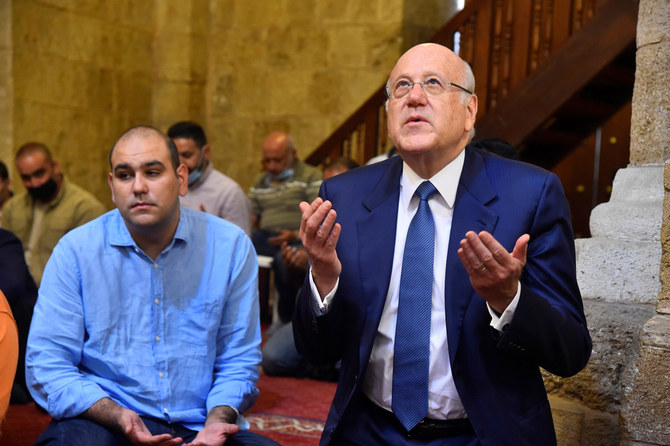
Mikati headed to the Baabda Palace after performing Friday prayers at the Al-Omari Mosque in downtown Beirut and waved the government formation paper at journalists as he walked in, indicating that the mission had been accomplished.
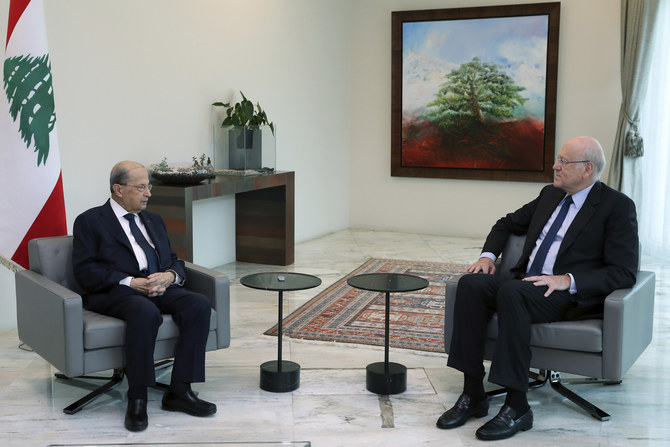
The 19th meeting was held between Mikati and Aoun, and parliament Speaker Nabih Berri joined them half an hour later.
The obstacles impeding the formation process remained unresolved until the last 15 minutes but were eventually removed. Those obstacles were related to the Ministry of Economy and naming the two Christian ministers; it was agreed that they would be from outside the parties’ share and approved by both Aoun and Mikati.
After the meeting, Berri said: “Very good work.”
Mikati’s government is the first of its kind in Lebanon. It includes four judges and only one woman, while the previous government included six female ministers.
The judges are Abbas Al-Halabi for the Ministry of Education, affiliated with the head of the Progressive Socialist Party Walid Jumblatt; Henry Khoury for the Ministry of Justice, former State Shoura Council head and close to Aoun; Bassam Al-Mawlawi for the Ministry of Interior, former head of the Criminal Court in the North, affiliated with Mikati; and Mohammed Mortada for the Ministry of Culture, affiliated with Hezbollah.
Senior central bank official Youssef Khalil took over the Ministry of Finance and former ambassador to the US Abdallah Bouhabib took charge of the Ministry of Foreign Affairs.
Firas Abiad, director of Rafik Hariri University Hospital, affiliated with former PM Saad Hariri, was named health minister.
Nasser Yassin, AUB professor of policy and planning, was named environment minister.
Amin Salam, affiliated with Mikati, was named economy minister.
Saade Shami was named deputy premier and is affiliated with the Syrian Social Nationalist Party, an ally of Hezbollah.
Maurice Slim was named defense minister, Najla Riachi state minister for administrative reform, Jonny Korm communications minister, and Walid Nassar tourism minister.
The Ministry of Energy was given to Walid Fayyad, affiliated to Aoun, the Ministry of Labor to Mustafa Bayram, the Ministry of Agriculture to Abbas Hajj Hassan, and the Ministry of Works to Ali Hamiya.
George Kordahi was assigned the Ministry of Information, George Debakian the Ministry of Industry, and Hector Hajjar the Ministry of Social Affairs.