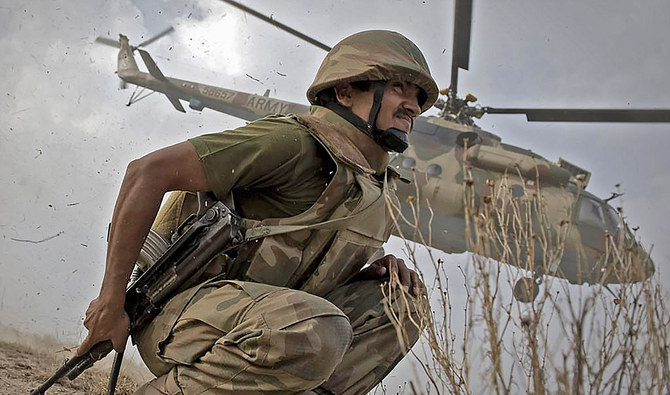
KARACHI: Pakistani officials say the country suffered over $150 billion in economic losses in the last 20 years after siding with the United States as a frontline state in the wake of the September 11, 2001, attacks in New York and Washington.
According to a report released by Brown University at the beginning of this month, the cost of the post-911 conflict exceeded $8 trillion for Washington and led to 929,000 deaths in conflict zones.
The report said that 423,000 people were killed in Afghanistan and Pakistan alone, adding that the United States had to pay about $2.31 trillion for its war in the two countries.
According to Pakistan’s parliament, the country’s lost over $152 billion due to the prolonged conflict in Afghanistan that spanned about two decades, though experts say the emerging situation in the war-torn country has thrown up a new set of challenges after the withdrawal of international forces.
“Pakistan has suffered around $152 billion in economic losses since the war on terror began 20 years ago,” Aliya Hamza Malik, parliamentary secretary for commerce and investment, told Arab News on Thursday without sharing further details.
In an opinion piece published by The Washington Post last June, Prime minister Imran Khan said the cost of war for his country had gone beyond $150 billion.
“Our country has suffered so much from the wars in Afghanistan,” he said. “More than 70,000 Pakistanis have been killed. While the United States provided $20 billion in aid, losses to the Pakistani economy have exceeded $150 billion.”
Painting a dismal picture of the situation in Pakistan since the beginning of the conflict, the prime minister said: “Tourism and investment dried up. After joining the US effort, Pakistan was targeted as a collaborator, leading to terrorism against our country from the Tehreek-e-Taliban Pakistan and other groups.”
The spokesperson of Pakistani military’s media wing, Major General Babar Iftikhar, said in January this year the economic losses of his country caused by the war on terror amounted to $126 billion.
Pakistan tried to officially quantify the cost of the war by mentioning it under a separate head in the Economic Survey until 2017-18, though it stopped recording the figure in its more recent publications.
According to the Pakistan Economic Survey of 2017-18, the country had incurred a cost of $126.79 billion due to the loss of physical infrastructure, foreign investment and industrial output along with monetary compensation paid to the victims of the conflict.
However, experts believe the number of losses presented by various administrations and private organizations are largely speculative.
“There is no real data as the loss is notional,” Husain Haqqani, a scholar at the US-based Hudson Institute and Pakistan’s former ambassador to Washington, told Arab News. “If ‘X’ had not happened, our economy would have made Y amount. Therefore, Y is the loss we suffered due to ‘X’ is a notional estimate.”
“There are also those who argue Pakistan benefited economically from 9/11: more aid, IMF financing without fulfilling conditions, NATO transit costs and fees,” Haqqani added.
However, Imtiaz Gul, chairman of the Center for Research and Security Studies, described the losses as “immeasurable.”
“The actual losses inflicted on Pakistan after 9/11 are immeasurable since it is not always possible to quantify the opportunities that were missed by the country each passing day,” he said.
“Pakistan was viewed as a bad guy,” he continued, “which kept investors and financers away from the country. Therefore, we can only compute the real loss by looking at the economic impact of the negative perception built over the years which refuses to die.”
Gul noted that Pakistan had not received any major investment from a western country in the last two decades even when the US and others praised Islamabad for its support during the conflict.
He added the only state that tried to fill that void was China that invested in mega infrastructure and power generation projects.
Experts maintain the country suffered about 3 percent of the GDP on an annual basis in the last two decades.
“We lost tens of thousands of lives, our infrastructure was destroyed and social fabric ruined,” Sajid Amin Javed, senior economist at the Sustainable Development Policy Institute, told Arab News. “Estimates show that Pakistan lost almost 3 percent of its GDP every year.”
However, US officials maintain Pakistan accrued several benefits by participating in the conflict. In one of his tweets in 2018, former American president Donald J Trump maintained that Washington had given over $33 billion to the country.
“The United States has foolishly given Pakistan more than 33 billion dollars in aid over the last 15 years, and they have given us nothing but lies & deceit, thinking of our leaders as fools,” he said on the social media platform.
The Pakistani prime minister acknowledged that his country had received $20 billion in his opinion piece, though he added that its losses far exceeded that number.
Security analysts say much of the money flowing into Pakistan were reimbursements for services provided to the US under the coalition support fund.
“Nearly 80 percent of the money the US claimed to have provided to Pakistan came under the coalition support fund,” Gul said. “These were basically reimbursements made to the country.”
He added: “The US did not provide anything new to Pakistan but gave us used C130s, Cobra helicopters and a lot of AK47 rifles.”
Faced with a huge security deficit and rampant suicide bombings, Pakistan launched several clear-and-hold military operations in the tribal areas adjoining Afghanistan in recent years and carried out intelligence-based counterterrorism operations in its urban centers under the National Action Plan.
With the withdrawal of international forces from neighboring Afghanistan, Pakistani analysts seem to be cautiously optimistic about the future stability of their country and the region.
“I think geopolitically Pakistan may benefit from a relatively stable situation in Afghanistan that is likely to allow it to reach out to Kabul along with other countries like Russia and China to start some economic revival and rehabilitation plan,” Gul said.
Economists said, however, the country’s financial losses were far from over since there was still a lot of uncertainty related to the emerging situation in Afghanistan.
“The worrying part is that the costs of 9/11 are seemingly not over yet,” Javed said. “If factional fighting begins in Afghanistan, Pakistan may continue to incur significant economic cost in the coming days.”


![]()

Officials say ‘war on terror’ caused over $150 billion in losses for Pakistan since 9/11
Short Url
https://arab.news/2y3gx
Officials say ‘war on terror’ caused over $150 billion in losses for Pakistan since 9/11
- Economists warn Pakistan may continue to incur huge financial losses in the absence of political and economic stability in Afghanistan
- Analysts say conflict in Afghanistan led to missed opportunities while pointing out Pakistan did not get western investments in two decades
Latest updates




© 2026 SAUDI RESEARCH & PUBLISHING COMPANY, All Rights Reserved And subject to Terms of Use Agreement.