CONAKRY: Guinean putschists were awaiting decisions from the West Africa bloc ECOWAS on Wednesday, with regional leaders convening a crisis meeting on the coup that toppled president Alpha Conde at the weekend.
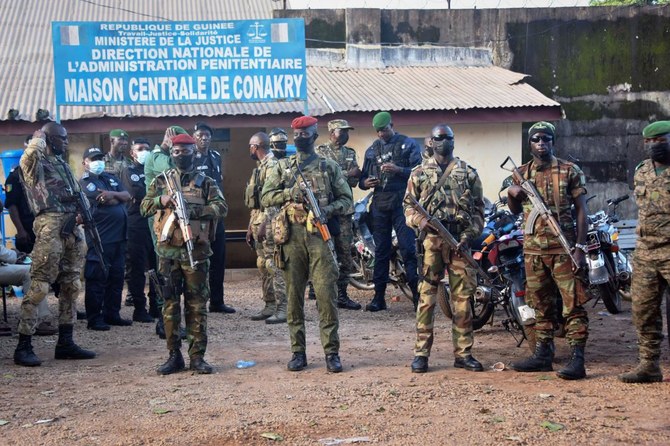
Special forces led by Lt. Col. Mamady Doumbouya seized power in the mineral-rich but impoverished West African country on Sunday and arrested the president, sparking international condemnation.
Conde, 83, had come under increasing fire for perceived authoritarianism, with dozens of opposition activists arrested after a violently disputed election last year.
But the putsch in Guinea has sparked fears of democratic backsliding across West Africa — where military strongmen are an increasingly familiar sight.
It has drawn parallels with its neighbor Mali: the Sahel state has suffered two coups since August last year led by Col. Assimi Goita, who was also a special forces commander.
West African leaders were to hold an extraordinary virtual crisis summit convened by the Economic Community of West African States (ECOWAS).
When faced with a similar discussion on Mali last year, ECOWAS imposed economic sanctions on the country, but lifted them after Mali’s ruling military committed to restoring civilian rule.
Doumbouya, hours after taking power in Conakry, appeared on television and accused the Conde government of “endemic corruption” and of “trampling on citizens’ rights.”
He has pledged to open talks on forming a new government, but it is not yet clear when, or under what form, these may take place.
“The government to be installed will be that of national unity and will ensure this political transition,” Doumbouya tweeted on Tuesday.
The same day, the military released about 80 political opponents of Conde who had been detained under his rule.
Ismael Conde, one of the detainees, told AFP upon his release that he was praying for a “new era for Guinea.”
The opposition activist had once been a member of Conde’s political party, but he defected and was then jailed for suggesting that the president had to be driven out by force.
“We are leaving invigorated to continue the struggle for a free and democratic Guinea,” Ismael Conde said.
Public discontent in Guinea had been brewing for months over a flatlining Covid-hit economy and the leadership of Conde, who became the first democratically elected president in 2010 and was re-elected in 2015.
But last year, Conde pushed through a new constitution that allowed him to run for a third term in October 2020.
The move sparked mass demonstrations in which dozens of protesters were killed. Conde won the election but the political opposition maintained that the poll was a sham.
No deaths have been officially reported in the putsch, although reports in Guinean media have suggested that between a dozen and 20 people were killed.
AFP was unable to independently confirm the reports.
The military coup was met with jubilation in some parts of Conakry, where hundreds residents turned out on the streets to applaud passing soldiers.
Cellou Dalein Diallo, the country’s main opposition leader, has backed the military regime — although he called for the army to uphold the rule of law.
In Bambeto, an opposition stronghold in Conakry, resident Abdoul Gadiri Diallo told AFP on Tuesday that he supports Doumbouya.
“He is going to straighten out this country very well, we are counting on him,” he said.
Doumbouya is in his early forties and was trained at France’s Ecole de Guerre military academy. He was also a member of the French Foreign Legion.
Guinea has spent decades under authoritarian rule since its independence from France in 1958. The latest coup is the third in the country’s history.


![]()

West African bloc holds crisis meeting after Guinea coup
Short Url
https://arab.news/bsr2r
West African bloc holds crisis meeting after Guinea coup
- When faced with a similar discussion on Mali last year, ECOWAS imposed economic sanctions
- Guinea has spent decades under authoritarian rule since its independence from France in 1958


Latest updates


© 2026 SAUDI RESEARCH & PUBLISHING COMPANY, All Rights Reserved And subject to Terms of Use Agreement.