CONAKRY: Lt. Col. Mamady Doumbouya, the leader of the latest coup in Guinea, is a highly educated, combat-hardened soldier who once served in France’s Foreign Legion.
Doumbouya’s special forces on Sunday seized Alpha Conde, the West African state’s 83-year-old president — a former champion of democracy accused of taking the path of authoritarianism.
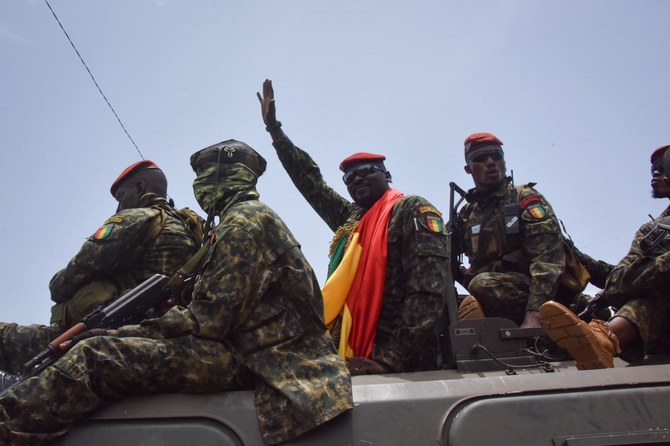
Sporting a red beret and sunglasses, Doumbouya announced the dissolution of the constitution, whose changes had enabled Conde to secure a bitterly contested third term in office.
Later, draped in the national flag but minus the dark glasses, Doumbouya pledged to oversee an “inclusive, peaceful transition.”
“There have been many deaths for nothing, many wounded, many tears,” he said, referring to Conde’s bloody crackdown on protests.
In an insight into his thinking, Doumbouya invoked Ghana’s late firebrand leader, Jerry Rawlings, who took power through a coup in 1981 before overseeing a shift to democracy.
“If the people are crushed by their elites, it is up to the army to give the people their freedom,” said Doumbouya, quoting Rawlings.
The man who has stepped into the spotlight is a career officer in his early forties who earned a master’s degree in defense and industrial dynamics at Paris’s Pantheon-Assas University.
He trained at France’s Ecole de Guerre military academy and was a member of the fabled Foreign Legion.
In his career, he has taken part in missions to Afghanistan and the deeply troubled Central African Republic.
His unit, the Special Forces Group, had only just been created when in 2018 its balaclava-clad men marched at a 60th anniversary parade overseen by the president whom they would topple three years later.
Doumbouya is from Kankan in eastern Guinea, and like Conde is from the Malinke ethnic group, also called the Mandinka.
He is married to a Frenchwoman and has three children, according to Guinean media.
“We are not here to have fun with power, we are not here to play, we are going to learn from all the mistakes which have been made,” he said on the French TV channel France 24, referring to past coups that have left deep scars on the nation.
The former head of the 2008-09 military junta, Captain Dadis Camara, had a fleeting turn in the limelight marked by bizarre TV appearances that became nicknamed the “Dadis Show.”
In September 2009, troops massacred opposition supporters at a stadium in the capital Conakry. At least 157 were killed, while 109 women were raped.
On Sunday, Doumbouya declared: “We are no longer going to entrust politics to one man, we are going to entrust politics to the people.”
Doumbouya hit out at corruption and waste, and vowed to restore peace in a country battered by crackdown after crackdown.
But diplomats and local media said an underlying trigger for the coup may have been a showdown with the government over the defense ministry’s control over the special forces.


Guinea’s new strongman: combat-hardened ex-Legionnaire
https://arab.news/gwvj3
Guinea’s new strongman: combat-hardened ex-Legionnaire

- Doumbouya invoked Ghana’s late firebrand leader, Jerry Rawlings, who took power through a coup in 1981 before overseeing a shift to democracy
- Doumbouya trained at France’s Ecole de Guerre military academy and was a member of the fabled Foreign Legion


Ukraine says Russia launched a major aerial attack before Kyiv’s talks with US
- The bombardment targeted critical infrastructure and residential areas across eight regions of Ukraine, Zelensky said
- Dozens of people, including children, were injured, officials said
KYIV: Russia launched a barrage of 420 drones and 39 missiles at Ukraine overnight, President Volodymyr Zelensky said Thursday, as US and Ukrainian envoys held more talks in Geneva on ending the war that is now in its fifth year.
The bombardment, which included 11 ballistic missiles, targeted critical infrastructure and residential areas across eight regions of Ukraine, Zelensky said. Dozens of people, including children, were injured, officials said, though authorities did not immediately publish a confirmed total.
Zelensky said late Wednesday he had spoken by phone with US President Donald Trump and thanked him for his “efforts and engagement” in pursuing peace negotiations.
The US-brokered talks between Moscow and Kyiv are continuing but are deadlocked on the issue of the future of Ukrainian territory that Russia claims as its own.
Zelensky has pushed for a summit with Russia’s President Vladimir Putin, saying a face-to-face meeting could be decisive in unlocking an agreement, but the Kremlin has rebuffed that proposal beyond inviting the Ukrainian president to Moscow, which Zelensky refused.
Trump representatives Steve Witkoff and Jared Kushner, who were also discussing nuclear negotiations with Iran in Geneva before turning to the war in Europe, met with Rustem Umerov, the head of Ukraine’s National Security and Defense Council. They also joined Trump’s call with Zelensky.
The envoys were to discuss economic support and the recovery of Ukraine, ways of attracting investment to the country, and frameworks for long-term cooperation, Umerov said on X.
Also, the meeting would look at preparations for the next round of trilateral negotiations involving Russia and consider possible further exchanges of prisoner, according to Umerov.
Washington is looking to keep momentum in its yearlong push to stop the fighting and overcome deep enmity between the warring countries.
Ukrainian and European officials have accused Putin of feigning interest in peace negotiations, hoping to avoid punitive US measures such as additional sanctions while pressing forward with the invasion.
Thursday’s talks between the American and Ukrainian envoys were to address details of a possible postwar recovery plan for Ukraine and discuss preparations for an upcoming trilateral meeting with Moscow officials, perhaps next week, according to Zelensky.
He said he has also tasked Umerov with discussing a possible prisoner exchange.
Russia returned 1,000 bodies of fallen soldiers to Ukraine, and got back 35 bodies of its fallen troops, Vladimir Medinsky, the head of the Russian delegation at previous talks with Ukraine, said Thursday. He did not say when the exchange happened.
Ukraine’s Coordination Headquarters for the Treatment of Prisoners of War later confirmed the return, though it referred to “bodies which, according to preliminary information provided by the Russian side, may belong to Ukrainian defenders.”
Russia struck gas infrastructure in the Poltava region and electrical substations in the Kyiv and Dnipropetrovsk regions, Zelensky said. Emergency crews responded in five other regions, as well as in the capital.
Ukraine’s air defenses shot down most of the Russian missiles, Zelensky said, crediting Western partners for timely delivery of additional air defense interceptors. Ukraine needs foreign help to sustain its fight against Russia’s bigger forces.
Ukrainian Foreign Minister Andrii Sybiha urged allied countries to provide more military aid.
“When the whole world demands Moscow to finally stop this senseless war, Putin bets on more terror, attacks and aggression,” Sybiha said in a post on the Ministry of Foreign Affairs website.
The Russian Defense Ministry said its air defenses shot down 17 Ukrainian drones overnight over a number of Russian regions, as well as the Black and Azov Seas.
Ukraine’s domestically developed long-range drones have struck oil refineries, fuel depots and military logistics hubs deep inside Russia.
Meanwhile, Russia continued to push allegations of a purported plot by European nations to provide Kyiv with a nuclear bomb, without providing any evidence.
The Kremlin-controlled lower house of the Russian parliament on Thursday unanimously approved an address urging the United Nations and European lawmakers to prevent the alleged plan.
It followed a statement on Tuesday by the Russian foreign intelligence service alleging that France and the UK were planning to covertly transfer nuclear weapons or components of a “dirty bomb” device.
British and French officials said the claim was a lie.


