
GENEVA: The secretary-general of the Muslim World League has praised the World Health Organization at a Swiss conference for its efforts in combating the COVID-19 pandemic.
The event, hosted by the WHO in Geneva, also included the director-general of the organization, Tedros Adhano, and former prime minister of Norway Kjell Bondevik.
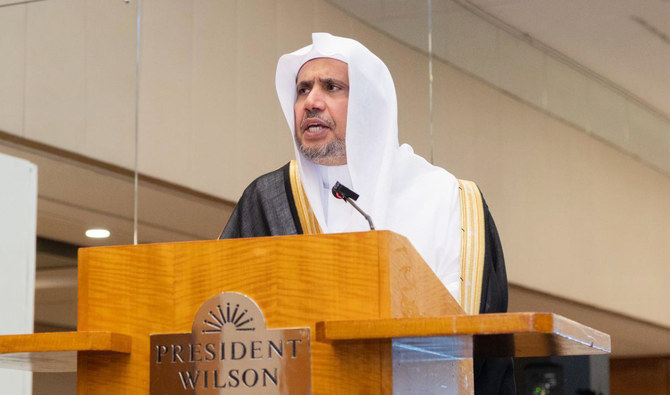
Sheikh Dr. Mohammed bin Abdul Karim Al-Issa said: “In the time of COVID-19, the World Health Organization has become the global peacemaker from the danger of a deadly enemy that has targeted our world without exception.”
He hailed the WHO’s “outstanding efforts” in reducing suffering amid the pandemic, labeling them as “efforts to achieve world peace.” Through careful monitoring of the situation and practical guidance, the WHO followed through on the maxim “there is no peace like the safety of people’s lives,” Al-Issa said.
He added: “The lethality of this pandemic has been greatly alleviated, and the exhaustion of health facilities has been reduced.” The organization led countries of the world with “high efficiency” to “defeat our common enemy, which has exhausted and frightened our world more than it has been exhausted and frightened by many wars,” Al-Issa said.
The MWL secretary-general praised the granting of the Bridge Maker Award in Norway to the director-general of the WHO, adding that the organization has “increased its struggle for our physical and psychological peace. It is an icon of peace in the time of COVID-19.”
In the time of COVID-19, the World Health Organization has become the global peacemaker from the danger of a deadly enemy that has targeted our world without exception.
Dr. Mohammed bin Abdulkarim Al-Issa
Al-Issa said: “Societies around the world would not have been able to cooperate in the battle against the pandemic except through awareness among individuals and institutions, which was encouraged through deliberate programs and effective laws in light of the advice and guidance of the WHO.”
He also discussed the importance of immunization, especially in developing countries, saying that vaccine hesitancy can be addressed through influential figures and effective laws.
Al-Issa proposed the creation of a universal health passport authorized by the WHO so that countries around the world could forbid entry to travelers who have not received vaccines.
In his opening speech at the Geneva International Solidarity Conference to confront the COVID-19 pandemic, Al-Issa also reviewed the efforts of the MWL since the beginning of the pandemic, starting from its headquarters in Makkah.
He said that these efforts included “material aid in direct coordination with governments, as well as medical equipment for health institutions and food aid for vulnerable groups.”
The MWL “worked to spread preventive awareness for more than 30 countries around the world, without discriminating in this humanitarian work for any religious or political reasons,” Al-Issa added.
“We are continuing our efforts, which we see as our duty,” he said.
Bondevik moderated the event, and stressed the role religious leaders play in dealing with the pandemic, especially through improving vaccine uptake.
Tedros Adhano said: “This pandemic will end when we all decide to put an end to it, because the decision is in the hands of all of us.
“Several regions and countries are witnessing a sharp rise in cases of infection and death due to COVID-19, and the reason is the high rate of social contact and movement, the absence of coordinated health and social measures, the emergence of rapidly transmitting mutations and inequality in the availability of vaccines.”
Secretary-General of the World Council of Churches Prof. Ioan Sauca called for dialogue and cooperation at the global level to help combat the pandemic. He said that the main lesson learned from the crisis is “a greater understanding of our common fragility” and “destiny as one humankind.”
Jagan Chapagain, secretary-general of the International Federation of Red Cross and Red Crescent Societies, said: “There is no way to confront these crises except through a united front that includes religious institutions, the public sector and society as a whole.”