

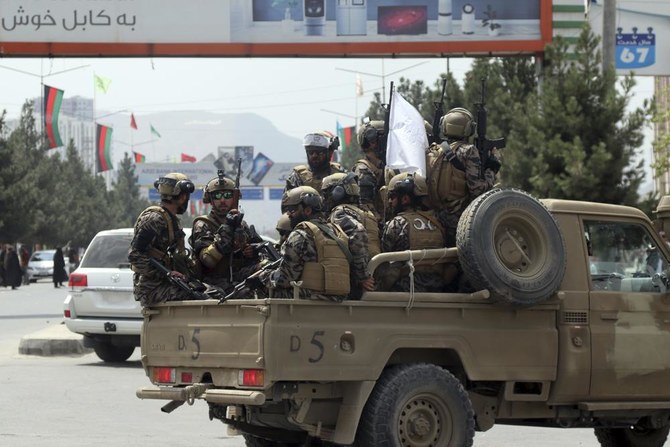

KABUL: The Taliban on Tuesday declared Afghanistan a “free and sovereign” nation and vowed to maintain “good relations” with the rest of the world following the departure of the last US troops from Kabul airport.
The group took control of the capital’s airport after the US on Monday ended its 20 years of occupation, cementing the Taliban’s return to power after their ouster in 2001.
Celebratory gunfire echoed around Hamid Karzai International Airport as Taliban spokesman Zabihullah Mujahid hailed Washington’s withdrawal as an “historic moment,” while pledging to bring security to the war-torn country.
Speaking to reporters at Kabul airport on Tuesday, he said: “We do not have any doubt that the Islamic Emirate of Afghanistan is a free and sovereign nation. America was defeated.”
And he promised Afghans that the group would “protect our freedom, independence, and Islamic values.”
The Taliban took control of Kabul in a lightning offensive two weeks ago, toppling the government in a bloodless siege as President Ashraf Ghani fled the country.
Since then, thousands of people camped outside the US-controlled airport with diplomats, foreign aid workers, and civilians desperate to leave the country ahead of the Aug. 31 deadline set by US President Joe Biden for American forces to pull out.
Scenes of deadly chaos ensued with hordes of people in and around the facility trying to board flights, amid fears the Taliban would reinstate their harsh and repressive style of governance as they did during their previous rule from 1996 to 2001, before being toppled in a US-led invasion.
Chaotic evacuation measures by the US and its allies saw more than 123,000 people leave Kabul up until Monday when US troops reportedly destroyed more than 70 aircraft, dozens of armored vehicles, and disabled air defenses.
Several were killed as security officials fired on the tarmac to control crowds thronging to the airport in the past two weeks, while nearly 180 died in a suicide attack claimed by Daesh-Khorasan on Thursday.
Since returning to power, the Taliban have vowed to form an “all-inclusive government,” respect women’s rights, forgive those who fought them, and ensure Afghanistan did not become a haven for terrorists.
The assurances, however, have done little to allay civilians’ fears, with many feeling that while Washington had left the country, Afghanistan now faced many new challenges.
Mohammad Ibrahim, a 35-year-old shopkeeper in Kabul, told Arab News: “There is nothing special about today. Banks are not working, we have no money, and there is no government to respond to the needs of Afghan citizens.”
He pointed out his concerns over the “critical state” of the economy and its impact on his livelihood. “Earlier, I would sell at least 5,000 goods per day, but now I can sell only 500.”
Others recalled the “tragic and horrible moments” of the past 20 years, and worried about “black days” ahead.
Nearly 2,500 US troops and an estimated 240,000 Afghans have lost their lives in America’s longest conflict, according to the Costs of War Project at Brown University.
These included nearly 50,000 Afghan civilians, more than 400 aid workers, and 72 journalists, with fears mounting over the state of minorities in the nation of 38 million people that for two decades had survived on billions of dollars in foreign aid.
Ali Reza Husseini, a 24-year-old resident of the Taimany area of Kabul, told Arab News: “For the public, nothing has changed, still we are in fear. We believe that minority rights will not be given by the Taliban.”
The situation was “delicate and problematic” for Afghan journalists too, with 72 killed in the past and “dozens looking to escape by any means, with the help of smugglers.”
Mumtaz Haidari, 55, a media rights activist, told Arab News: “No one would stay here. We know that our entrances are shut, and there is no hope, so we are looking for the alternatives to flee by land and become an immigrant in neighboring countries.”
On Monday, the Taliban told Arab News they were “committed” to allowing Afghans with valid documents to travel out of the country but urged them “to stay and work for the nation’s development.”
Experts, however, said the next few days would be the true litmus test for Afghanistan’s new rulers.
Abdul Waheed Farzayee, 34, a political analyst based in Kabul, told Arab News: “Today is the first day that Afghanistan is without foreign forces present. We are hopeful that the Taliban would fulfill their commitments given to Afghan citizens.”
He added that while the US’ departure from Afghanistan was “a reality,” the Taliban needed to form a new government “with the presence of all political players in the country.”
Qais Zaheer, an international expert based in Kabul, told Arab News that Washington’s exit had thrown the country into “mass political and military chaos.”
He said: “We have no government, and there is a political-economic gap. We hope that in the upcoming days we will have a government. But still there are some doubts on the Taliban’s policies.”


