

Jordanian COVID-19 curfews removed from midnight

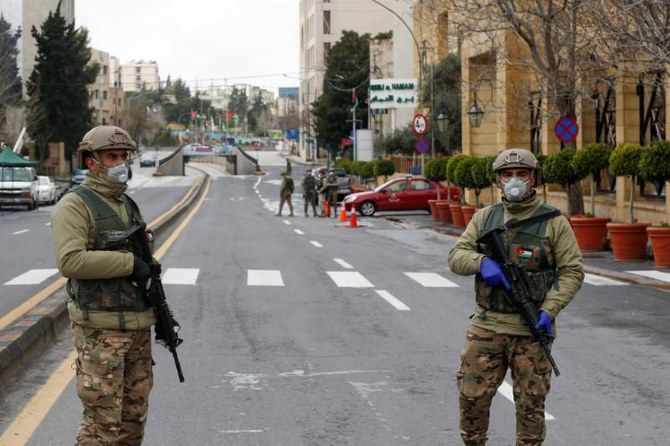
Jordanian soldiers stand guard at a check point after the start of a nationwide curfew, amid concerns over the coronavirus disease (COVID-19) spread, in Amman, Jordan, March 21, 2020. (Reuters)
Short Url
Updated 01 September 2021
Follow

Jordanian COVID-19 curfews removed from midnight

  • Third phase in Amman’s antivirus plans greeted with joy by business owners
  • Citing improvement in the epidemiological situation, the government has also announced that most sectors will be allowed to work in full capacity at all times

AMMAN: Jordanians will say farewell to the partial curfew on Tuesday night, ending more than one-and-a-half years of coronavirus disease (COVID-19) lockdowns.

In April last year, Jordan imposed a nationwide lockdown, including a night curfew, as per the COVID-19 containment measures.  

The government has recently announced a set of procedures for the third phase of the plan to return to normalcy, including ending all curfews and resuming in-class education at schools and universities.

Citing improvement in the epidemiological situation, the government has also announced that most sectors will be allowed to work in full capacity at all times.

The government has also referred to the availability of COVID-19 vaccines and the increase in the inoculated population as another major encouraging reason to reopen the country.

Over 4 million of the kingdom’s 10 million population have received the second jab.

The measures will come into effect from Sept. 1.

The Ministry of Education Secretary-General for Administrative and Financial Affairs Najwa Qbeilat said that more than 2 million students will resume in-class education on Wednesday.

The official told the Jordan news agency, Petra, that a set of health measures will be in place at all the Kingdom’s 3,971 public schools, including social distancing and mandatory facemasks.

 The government has begun a three-phase plan to gradually reopen closed sectors dubbed “safe summer.”

The first and second phases began on June 1 and July 1 respectively, opening more sectors and adjusting curfew hours to midnight for businesses and 1:00 a.m. for the public.

The end of the nighttime curfew was such “great news” for Amer Badran, owner of Aristotle café in Amman’s Luweibdeh neighborhood.

“It is summer time and people love to stay out until late hours at night. Having to close at midnight was really bad for our business,” said Badran, recalling the days when his café was still open until 3 a.m."

Mohammad Fadel said was also happy to have the curfew canceled forever: “Curfew was not effective in containing COVID-19. The virus does not go to bed at midnight.”


Israeli approval of West Bank land registration draws outrage

Updated 33 min 53 sec ago
Follow

Israeli approval of West Bank land registration draws outrage

  • Israel’s government has approved a process to register land in the West Bank, drawing condemnation

JERUSALEM: Israel’s government has approved a process to register land in the West Bank, drawing condemnation from Arab nations and critics who labelled it a “mega land grab” that would accelerate annexation of the Palestinian territory.
Israel’s foreign ministry said the measure would enable “transparent and thorough clarification of rights to resolve legal disputes” and was needed after unlawful land registration in areas controlled by the Palestinian Authority.
But Egypt, Qatar and Jordan criticized the move as illegal under international law.
In a statement, the Egyptian government called it a “dangerous escalation aimed at consolidating Israeli control over the occupied Palestinian territories.”
Qatar’s foreign ministry condemned the “decision to convert West Bank lands into so-called ‘state property’,” saying it would “deprive the Palestinian people of their rights.”
The Palestinian Authority called for international intervention to prevent the “de facto beginning of the annexation process and the undermining of the foundations of the Palestinian state.”
Israeli anti-settlement watchdog Peace Now called Sunday’s measure a “mega land grab.”
According to public broadcaster Kan, land registration will be reopened in the West Bank for the first time since 1967 — when Israel captured the territory in the Middle East war.
The Israeli media reported that the process will take place only in Area C, which constitutes some 60 percent of West Bank territory and is under Israeli security and administrative control.
Palestinians see the West Bank as foundational to any future Palestinian state, but many on Israel’s religious right want to take over the land.
Last week, Israel’s security cabinet approved a series of measures backed by far-right ministers to tighten control over areas of the West Bank administered by the Palestinian Authority under the Oslo accords in place since the 1990s.
Those measures, which also sparked international backlash, include allowing Jewish Israelis to buy West Bank land directly and allowing Israeli authorities to administer certain religious sites in areas under the Palestinian Authority’s control.
Excluding Israeli-annexed east Jerusalem, more than 500,000 Israelis live in West Bank settlements and outposts, which are illegal under international law.
Around three million Palestinians live in the territory.