

Aviation industry looks to reduced-crew long-haul flights for cost savings

Whilst not seeking to eradicate cockpit crew altogether, Project Connect and other systems could reduce numbers. (AFP/File Photo)
Short Url
Updated 02 September 2021
Follow

Aviation industry looks to reduced-crew long-haul flights for cost savings

  • Engineers push the limits of automation as pandemic-induced slump bites
  • Opinion is divided on the wisdom of having fewer pilots on long-haul flights

DUBAI: Machines have revolutionized the customer experience in banks and other financial businesses, supermarkets experiment with unmanned tills and stores, while computers and robots help surgeons perform delicate procedures in operating theaters around the world.

The question then arises: Could a computer fly hundreds of passengers in an aircraft at a cruising altitude of 35,000 feet for hours on end, plus handle the landing and take-off?

Computers have long helped pilots through sophisticated auto-pilot and navigational technologies. But pilots actively fly the aircraft at critical points and are on standby throughout a flight.

Now, much as the focus may be on the implications and safety of the driverless car and lorry, studies are underway to determine whether machines can take the place of pilots in the skies.

To be precise, the studies are not looking at whether pilots can be phased out completely but at how many cockpit crew members are needed for a long-haul flight.


A flight crew from Cathay Pacific Airways, wearing protective masks, walk in the international terminal after arriving on a flight from Hong Kong at Los Angeles International Airport (LAX) on February 28, 2020. (AFP/File Photo)

Nadine Itani, an aviation strategy consultant and head of the Middle East Aviation Research Center, defines “a long-haul flight as one that goes beyond six hours,” adding:  “Usually, long-haul flights require a stop somewhere, so you are connecting two points, either directly or through a transit or a stop.”

Airbus and Hong Kong-based Cathay Pacific are examining a new system known as Project Connect, whereby a reduced cockpit crew of just two pilots fly a long-haul aircraft. Instead of the three or four pilots currently needed to be physically present on all long-haul commercial flights, only one pilot would be in the cockpit at a time with the two taking turns for rest breaks.

Cathay Pacific, in which Swire Group and Air China are the largest shareholders, confirmed that it was working on reduced-crew studies but said that it had no commitment or intention to be the first operator to launch such a program.

Lufthansa of Germany also said it had worked on the program but added that it currently had no plans to introduce it.

Itani pointed out that single-pilot operations were already the norm on small planes with up to nine passengers, private jets, and military aircraft. What was being tested was the ability to apply the same concept to large commercial aircraft and for flights lasting more than six or seven hours long. She added that the requisite computer technology was not currently available to guarantee the safety of aircraft.


Nearly 25,000 pilots were furloughed due to the coronavirus disease (COVID-19) pandemic, but 75 percent of them had returned to their jobs as flight activity had picked up recent months. (AFP/File Photo)

She said: “When we speak of machines, machines have high margins of error and this might lead to accidents, which imposes a risk on safety.

“This is the main challenge that is putting this project back. Until today the research shows that there is no 100 percent secure and safe machine-led or machine-piloted aircraft.”

The reduced-crew concept also has to convince a rigorous array of regulators. Bodies such as the International Civil Aviation Organization, the Federal Aviation Administration in the US, and the EU Aviation Safety Agency would need to approve it, Itani added.

Other experts agreed that single-pilot operations were some way off.

Michael Wette, partner and head of transportation and services for India, the Middle East, and Africa at Oliver Wyman, a consultancy with offices in Dubai and other cities and clients in Riyadh and Jeddah, told Arab News: “Most of the pilots’ organizations and the airline managers we speak to are very skeptical about these independent flying computers.
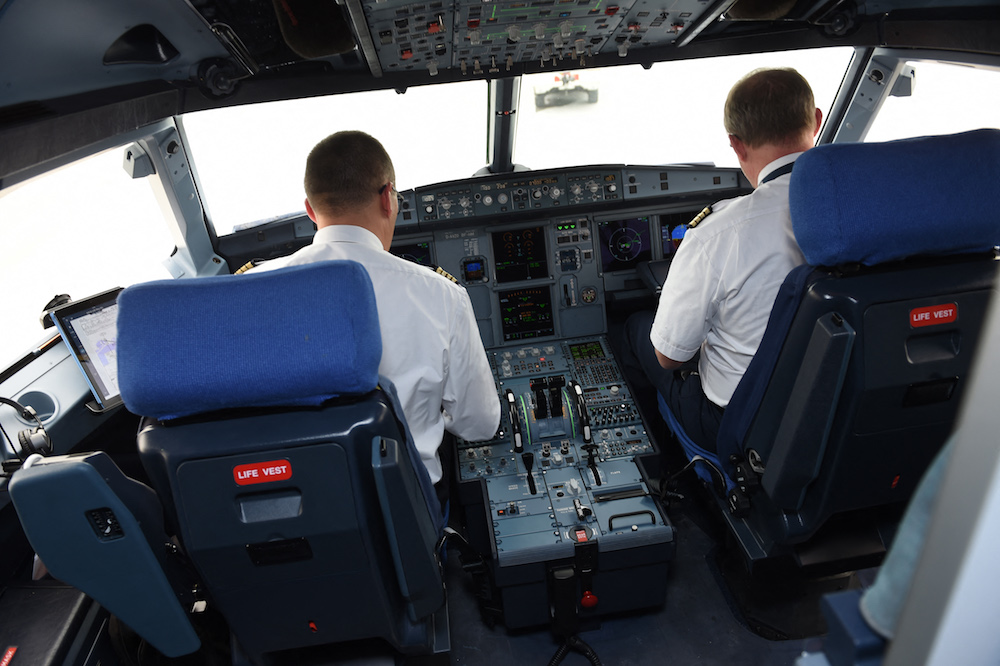


Computers have long helped pilots through sophisticated auto-pilot and navigational technologies. But pilots actively fly the aircraft at critical points and are on standby throughout a flight. (AFP/File Photo)

“In this, the security aspect of it is the biggest hurdle and issue. The safety of passengers is until today ensured through the professional training and the experience of the pilots, especially when it comes to non-standard situations,” he said.

While there was currently a surplus of pilots, a shortage was expected again soon and Wette noted that technical studies such as Project Connect would likely continue as they had been conducted for some time.

He added that nearly 25,000 pilots were furloughed due to the coronavirus disease (COVID-19) pandemic, but 75 percent of them had returned to their jobs as flight activity had picked up recent months. However, others were still on extended leave and almost 10,000 pilots had taken early retirement packages and left the job market due to the global health crisis.

Project Connect was not new. Itani said the US National Aeronautics and Space Administration started researching the possibility of single pilots flying commercial aircraft in 2012. The pressure to reduce costs had, however, intensified over recent years.

At the best of times, the aviation industry worked on very low-profit margins. It was continually trying to come up with ideas to minimize the cost of operating aircraft by limiting crew salaries and accommodation, training, and recruitment expenses.


Nadine Itani (L), an aviation strategy consultant and head of the Middle East Aviation Research Center and Michael Wette (R), partner and head of transportation and services for India, the Middle East, and Africa at Oliver Wyman. (Supplied)

Crew costs were estimated to be around 25 percent of running an aircraft and were the biggest expense after fuel, Itani added.

The reduced-crew concept had gained new urgency since the start of the COVID-19 pandemic. The aviation industry had been badly affected. Entire fleets of passenger planes have been grounded, dozens of airlines have filed for bankruptcy, and thousands of pilots are believed to have been laid off.

And travel has not returned to pre-pandemic levels. Today’s global average of flight hours supplied was approximately at 65 percent of pre-pandemic levels, and that included the Gulf region, said Wette. Most travel at present was for leisure or family emergency, not business.

Airbus pointed out that its studies were based on a minimum of two operating crew per flight, and that tests were being conducted in conjunction with regulatory authorities and airline partners.

An Airbus spokesperson told Arab News that safety was a top priority for the giant European aircraft manufacturer and that the new technologies were “not fully mature” and “based on technology availability and maturity, the first potential application of autonomous technologies might be single-pilot operations and only during the cruise phase.”


Cathay Pacific, in which Swire Group and Air China are the largest shareholders, confirmed that it was working on reduced-crew studies but said that it had no commitment or intention to be the first operator to launch such a program. (AFP/File Photo)

The spokesperson said: “With safety and social acceptance being top priorities, Airbus’ mission is not to move ahead with autonomy but to explore autonomous technologies alongside technologies in materials, electrification, connectivity, and more.”

There was also the question of infrastructure. Single pilots in cockpits needed to communicate with the ground in case of emergencies and safety hazards and airports needed to upgrade their radio communications and ground operations, said Itani.

Usually, decisions were taken by collaboration among pilots in cockpits, but when there was just one pilot in control, the pilot required another party to communicate with, apart from a machine.

No Arab airline or Middle East carrier has joined Project Connect but, as sizeable international operators, they are likely to be watching closely. At the current stage, the single-pilot operations system is being tested on Airbus A350 jets.


No Arab airline or Middle East carrier has joined Project Connect but, as sizeable international operators, airlines like Emirates are likely to be watching closely. (AFP/File Photo)

Qatar Airways was the launch customer of the Airbus A350 and has major expansion plans. It is also a part of the Oneworld Alliance of which Cathay Pacific is a member. However, Singapore Airlines is now the biggest customer of A350 planes in terms of its fleet.

Itani said: “Middle Eastern carriers and Middle East airports play a significant role in connecting the east and the west through airports such as Doha, Dubai, and very soon, Madinah and Jeddah.”

If and when the single-pilot operations system wins approval, and the green light is given by the various authorities concerned, airports in the Middle East region as well as Middle Eastern carriers will have a “considerable and important role to play,” she added.

--------------------

Twitter: @jumanaaltamimi


Vision 2030 propelling Saudi Arabia’s global reputation

Updated 11 sec ago
Follow

Vision 2030 propelling Saudi Arabia’s global reputation

  • Bold initiatives are positioning the Kingdom as a regional trailblazer in sustainability

RIYADH: Saudi Arabia’s Vision 2030 program, aimed at revolutionizing the Kingdom’s economic and social landscape, has propelled the nation’s global reputation on a large scale, experts told Arab News. 

Launched in 2016, the program is a comprehensive guide to position Saudi Arabia as a powerhouse of business, tourism and non-oil activities, both regionally and globally. 

Speaking to Arab News, Thomas Kuruvilla, managing partner of Arthur D. Little Middle East & India, said that Saudi Arabia’s Vision 2030 is the cornerstone of the Kingdom’s transformation driving diversification, investment in non-oil sectors, and reshaping its global reputation. 

“Vision 2030 is not an end point but a launchpad. The foundations being laid today from renewable energy, automotive, and tourism to digital infrastructure and advanced industries are designed to endure and evolve well beyond 2030. The Kingdom’s leadership has already signaled that future frameworks will build on this momentum, ensuring that transformation continues into the decades ahead,” said Kuruvilla. 

He added: “Vision 2030 has firmly established Saudi Arabia as a reforming nation on the world stage. Saudi Arabia is creating an economic and social model that looks past 2030, one that aims to deliver sustainable growth, global competitiveness, and opportunity for generations to come.” 

Elie Farhat, chief of external affairs for Georgetown University’s McDonough School of Business espoused similar views and said Saudi Arabia has actively courted foreign investment, tourism, and partnerships with global universities and businesses. 

“Saudi Arabia has become a market and society that is perceived as both investable and engaging. International organizations are setting up regional headquarters in Riyadh, universities are establishing partnerships, and businesses now openly discuss Saudi Arabia as a gateway to the future of the Middle East,” said Farhat. 

In October, Saudi Arabia’s Investment Minister Khalid Al-Falih, while speaking at the Fortune Global Forum Conference in Riyadh, said the Vision 2030 program is progressing steadily, with 85 percent of the targets outlined in the initiative completed or on track by the end of 2024. 

Al-Falih also added that the number of international firms licensed to establish their regional headquarters in Riyadh has reached 675.

The regional HQ program offers a 30-year corporate tax exemption, withholding tax relief, and regulatory support, reflecting efforts to position the Kingdom as a regional business hub and attract multinational corporations to the capital.

Some of the noted firms that have established regional bases in Riyadh include Northern Trust, IHG Hotels & Resorts, PwC, and Deloitte. Laura Hernandez Gonzalez, managing director of Globant for the Middle East and North Africa, said Vision 2030 has turned diversification from an aspiration into a reality, adding that programs like the regional HQ initiative and the transformation of Riyadh into a true financial hub are convincing multinationals to set up real operations, not just representative offices.

“From the technology side, the Kingdom’s commitment to AI, cloud, and sovereign digital infrastructure is equally important. It signals not only ambition, but the capacity to build future-ready capabilities at scale,” said Gonzalez. 

She added: “This is how the Kingdom is changing global perceptions: from an energy powerhouse to a hub of innovation, capital and talent.” 

Earlier in December, Rachid Boulaouine, Middle East and Saudi Arabia director at Business France, told Al-Eqtisadiah that French companies operating in Saudi Arabia are expected to increase by 30 percent to 40 percent as more small and medium-sized enterprises move to establish a presence in the Kingdom. 

The changing global image

Kuruvilla said that Saudi Arabia’s pivot toward renewable energy and sustainability is not just symbolic, but it represents a decisive strategic shift in the Kingdom’s development model. 

Bolstering renewable energy capacity is critical for Saudi Arabia as it aims to generate 130 gigawatts of clean energy by 2030 and achieve net-zero emissions by 2060.

Kuruvilla said that flagship projects such as Neom — a futuristic city designed to run entirely on renewable energy — and the world’s largest green hydrogen plant highlight Saudi Arabia’s determination to lead in climate innovation. 

This is how the Kingdom is changing global perceptions: from an energy powerhouse to a hub of innovation, capital and talent.

Laura Hernandez Gonzalez, managing director of Globant for the Middle East and North Africa

“These initiatives are positioning the Kingdom as a regional trailblazer in sustainability and earning recognition as a nation “at the forefront of the clean-energy revolution,” with few global peers matching its scale and ambition,” said the Arthur D. Little official. 

He added: “Such bold moves are strengthening Saudi Arabia’s standing among international partners that prioritize climate action, demonstrating alignment with global sustainability imperatives rather than resistance.” 

According to Farhat, it is the young generation in Saudi Arabia guided by Vision who are playing a crucial role in elevating the Kingdom’s global reputation. 

“Saudis — particularly younger generations — have opened up to the world with a readiness to learn, build, and lead for 2030. The world, in turn, has opened up to Saudi Arabia, seeing it as a dynamic partner to invest in,” said Farhat. 

Saudi Arabia’s tourism growth

Gonzalez said that the global narrative about Saudi Arabia has shifted decisively, with international travelers increasingly considering the Kingdom as a favorite destination. 

She added that the growth in tourism numbers is one of the clearest proof points that Vision 2030 is delivering, also indicating the Kingdom’s growing appeal among the international public. 

“Ranking among the top three globally for growth in international tourist arrivals, surpassing 100 million visits in 2023, and contributing over 10 percent of the gross domestic product in 2025 are extraordinary achievements in such a short period,” said Gonzalez. 

She added: “Today, when I speak with investors, partners, or peers, Saudi Arabia is framed around opportunity, innovation, and delivery.” 

Kuruvilla said that the growth in tourism has signaled to the world that Saudi Arabia is no longer just an oil-rich nation, but a fast-emerging must-visit destination. 

HIGHLIGHT

The regional HQ program offers a 30-year corporate tax exemption, withholding tax relief, and regulatory support, reflecting efforts to position the Kingdom as a regional business hub and attract multinational corporations to the capital.

The Arthur D. Little official added that media coverage has reinforced this narrative, with tourism and entertainment mentions up 60 percent in 2024, underscoring the Kingdom’s growing appeal to global travelers. 

“International surveys echo this sentiment: a recent multi-country poll found 59 percent of respondents were interested in visiting Saudi Arabia — a figure unimaginable only a decade ago,” said Kuruvilla. 

Saudi Arabia passed its 2030 target of 100 million visitors in 2023, and the following year it welcomed 115.9 million tourists.

Having already reached its goal, the Kingdom raised its target to 150 million annual visitors by 2030.

In November, the Saudi Conventions and Exhibitions General Authority announced record growth in the Kingdom’s business events infrastructure, reporting a 32 percent year-on-year increase in capacity across 923 accredited venues.

The authority added that this expansion reflects significant investment aligned with Vision 2030’s tourism and event sector priorities, driving a 320 percent increase in exhibition space since 2018 to a total of 300,520 sq. meters.

Sports and technology

According to Kuruvilla, Saudi Arabia is cultivating an image as a global hub for business, technology, and innovation by hosting high-profile international events like the Future Investment Initiative, the LEAP tech conference, and the World Defense Show. 

He said that these events draw thousands of investors, entrepreneurs, and industry leaders to the Kingdom, showcasing opportunities beyond oil. 

“The cumulative effect of these marquee gatherings and the establishment of such innovation-driving entities is a narrative that Saudi Arabia is open for business and eager to lead in future industries – a notable departure from its old image of insularity,” said Kuruvilla. 

He added: “These gatherings are translating into tangible partnerships and long-term investment opportunities, solidifying Saudi Arabia’s reputation as a hub for innovation and global business exchange.” 

According to Gonzalez, events like FII and LEAP in Saudi Arabia prove the Kingdom’s execution capacity, as well as showing the nation’s capability to “convene the world, compress partnership cycles, and set the agenda on innovation, defense, and finance.” 

Highlighting the importance of sporting events, Kuruvilla told Arab News that sports have become a cornerstone of Saudi Arabia’s effort to bolster its global reputation. 

“From hosting Formula 1 races and high-profile boxing matches to purchasing stakes in English Premier League football clubs, the Kingdom has invested heavily in sports as an avenue for soft power. The pinnacle of this strategy is Saudi Arabia securing the rights to host the 2034 FIFA World Cup — a coup that instantly thrusts the country into the international spotlight,” said Kuruvilla. 

Adding to this momentum, Saudi Arabia has also positioned itself at the forefront of digital sports by hosting the Esports World Cup in Riyadh in 2024 and 2025, with record-breaking prize pools and participation from the world’s top gaming titles. 

“By associating with beloved sports and athletes, Saudi Arabia is effectively rebranding itself, especially to younger global audiences, as a vibrant and welcoming destination. Superstars like Cristiano Ronaldo playing for Saudi clubs – and posting about life in the Kingdom – further humanize Saudi Arabia’s image abroad,” added the Arthur D. Little official.