Three journalists detained and a radio station shut in South Sudan

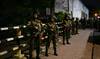
The security officers had suspected the station wanted to “air something to do with the call by the people’s coalition for protest.” (File/AFP)
Short Url
Updated 28 August 2021
Follow

Three journalists detained and a radio station shut in South Sudan

  • Security officials briefly detained three journalists in South Sudan and shut down their radio station in connection with a demonstration planned by activists

JUBA: Security officials briefly detained three journalists in South Sudan and shut down their radio station Friday in connection with a demonstration planned by activists next week, a rights group and a media union said.
A coalition of civil society groups has urged citizens to hold nationwide protests on Monday, in defiance of the authorities, and called on the country’s leadership to step down.
Security officials stormed the compound of Jonglei FM, an independent radio station in eastern Jonglei state, and took three senior journalists, into custody, before confiscating their phones and closing down their operations, the head of a local rights group told AFP.
“They took three staff of this radio station; one is the station manager, another is the program manager and the other one is the editor-in-chief,” said Bol Deng Bol, executive director of Intrepid South Sudan.
Patrick Oyet, the chairman of the Union of Journalists of South Sudan (UJOSS), told AFP the detainees were released later in the day but the radio station remained inoperational.
The security officers had suspected the station wanted to “air something to do with the call by the people’s coalition for protest,” said Patrick.
“This is a wrong procedure and as UJOSS we really condemn this procedure the security have taken,” said Patrick.
Activist Bol said the incident amounted to “an attack” on media freedom.
“We get all information through radio stations, this is the main means for people to be served with information they want. So attacking this media house, shutting them down is an attack that we condemn,” Bol said.

There was no immediate comment on the incident from security officials.
News of the detentions came only weeks after two prominent activists were arrested for joining a call by the People’s Coalition for Civil Action (PCCA) urging a peaceful public uprising to seek political change.
Earlier this month the PCCA issued a declaration saying they have “had enough” after 10 years of independence marked by armed conflict, escalating insecurity, hunger and political instability.
South Sudan is ranked 139th out of 180 countries by press freedom watchdog Reporters Without Borders, which said that ten journalists had lost their lives in the country since 2014.
The world’s newest nation has struggled with civil war, famine and chronic political and economic crisis since celebrating its hard-fought independence from Sudan in 2011.
The 2018 cease-fire and power-sharing deal between former foes Kiir and Machar was just the latest accord signed by the two men whose rivalry ignited a brutal civil war that cost the lives of almost 400,000 people.
Their truce still largely holds but it is being sorely tested, as politicians bicker over power and promises for peace go unmet.



Grok faces more scrutiny over deepfakes as Irish regulator opens EU privacy investigation

Updated 17 February 2026
Follow

Grok faces more scrutiny over deepfakes as Irish regulator opens EU privacy investigation

  • The regulator says Grok has created and shared sexualized images of real people, including children. Researchers say some examples appear to involve minors
  • X also faces other probes in Europe over illegal content and user safety

LONDON: Elon Musk’s social media platform X faces a European Union privacy investigation after its Grok AI chatbot started spitting out nonconsensual deepfake images, Ireland’s data privacy regulator said Tuesday.
Ireland’s Data Protection Commission said it notified X on Monday that it was opening the inquiry under the 27-nation EU’s strict data privacy regulations, adding to the scrutiny X is facing in Europe and other parts of the world over Grok’s behavior.
Grok sparked a global backlash last month after it started granting requests from X users to undress people with its AI image generation and editing capabilities, including putting females in transparent bikinis or revealing clothing. Researchers said some images appeared to include children. The company later introduced some restrictions on Grok, though authorities in Europe weren’t satisfied.
The Irish watchdog said its investigation focuses on the apparent creation and posting on X of “potentially harmful” nonconsensual intimate or sexualized images containing or involving personal data from Europeans, including children.
X did not respond to a request for comment.
Grok was built by Musk’s artificial intelligence company xAI and is available through X, where its responses to user requests are publicly visible.
The watchdog said the investigation will seek to determine whether X complied with the EU data privacy rules known as GDPR, or the General Data Protection Regulation. Under the rules, the Irish regulator takes the lead on enforcing the bloc’s privacy rules because X’s European headquarters is in Dublin. Violations can result in hefty fines.
The regulator “has been engaging” with X since media reports started circulating weeks earlier about “the alleged ability of X users to prompt the @Grok account on X to generate sexualized images of real people, including children,” Deputy Commissioner Graham Doyle said in a press statement.
Spain’s government has ordered prosecutors to investigate X, Meta and TikTok for alleged crimes related to the creation and proliferation of AI-generated child sex abuse material on their platforms, Spanish Prime Minister Pedro Sánchez said on Tuesday.
“These platforms are attacking the mental health, dignity and rights of our sons and daughters,” Sánchez wrote on X.
Spain announced earlier this month that it was pursuing a ban on access to social media platforms for under-16s.
Earlier this month, French prosecutors raided X’s Paris offices and summoned Musk for questioning. Meanwhile, the data privacy and media regulators in Britain, which has left the EU, have opened their own investigations into X.
The platform is already facing a separate EU investigation from Brussels over whether it has been complying with the bloc’s digital rulebook for protecting social media users that requires platforms to curb the spread of illegal content such as child sexual abuse material.