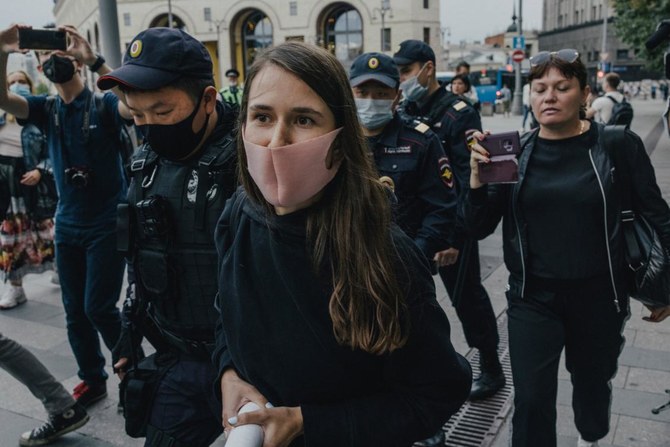
MOSCOW: Several Russian media outlets on Friday published an open letter to President Vladimir Putin and other top officials demanding an end to the “state campaign” against independent journalism.
The outcry comes after Russia slapped several media outlets and individual journalists with the “foreign agent” label that requires them to carry out tedious administrative procedures and clearly indicate their status on everything they publish.
Independent journalism in Russia is facing mounting pressure, especially in the run-up to parliamentary polls in September.
The letter was signed by the Meduza news website, Dozhd TV channel — both of which have been declared foreign agents this year — Forbes Russia and around half a dozen local media outlets.
“We, journalists and editors of Russian and Russian-language media, demand an immediate end to the state campaign against the independent press,” the open letter said.
It added that these labels “directly violate” the constitution, media laws and freedom of speech.
The status either leads to the media’s closure or creates “discriminatory conditions” that restrict the work of journalists, the letter said.
But the Kremlin on Friday swiftly rejected the letter’s demands, saying authorities were simply applying the law.
“The law should exist and will exist,” Putin’s spokesman Dmitry Peskov told reporters.
That was because “NGOS and journalists are often used” by foreign states interfering in “the affairs of our country,” he said.
He did say, however, that how the law is being enforced “should be discussed.”
Organizations or individuals declared “foreign agents” must disclose sources of funding and label all their publications, including social media posts, with the tag or face fines.
The status is a deterrent for advertisers, a key source of revenue for many independent media.
In July, the investigative outlet Proekt, which reported on the wealth of Russia’s elites, was declared an “undesirable organization,” de-facto banning its work in the country under the threat of fines or jail time.
Russia has also blocked the websites of two media outlets and one human rights group linked to self-exiled Kremlin critic Mikhail Khodorkovsky.
Legislation behind the term “foreign agent,” which has Soviet-era undertones, was originally passed in 2012 to cover NGOs.
It was expanded to include media organizations in 2017 after Kremlin-funded RT.


![]()

Russian journalists demand end to crackdown on media
Short Url
https://arab.news/2jp4u
Russian journalists demand end to crackdown on media
- Russian media outlets publish an open letter to President Vladimir Putin demanding an end to the “state campaign” against independent journalism
- This comes after Russia slapped several media outlets and individual journalists with the “foreign agent” label


Latest updates




© 2026 SAUDI RESEARCH & PUBLISHING COMPANY, All Rights Reserved And subject to Terms of Use Agreement.