

Afghan journalists granted access to the UK after media appeal

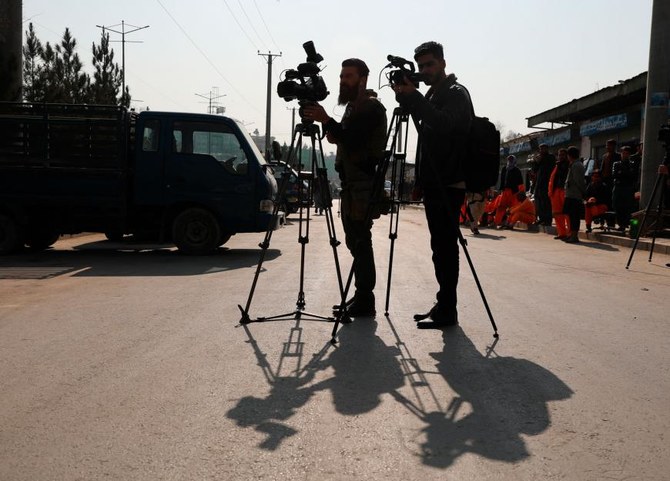
Last week, leading British media organizations and newspapers drafted an open letter to Prime Minister Boris Johnson urging him to provide protection to media workers in Afghanistan. (AP/File Photo)
Short Url
Updated 24 August 2021
Follow

Afghan journalists granted access to the UK after media appeal

  • Foreign Secretary Dominic Raab agreed to issue visa waivers for the Afghan journalists for the risks they have taken to defend human rights

LONDON: The UK government granted access to the country to over 200 Afghan journalists who worked with British media companies on Sunday, after an appeal by a coalition of top newspapers and broadcasters. 

Foreign Secretary Dominic Raab agreed to issue visa waivers for the Afghan journalists for the risks they have taken to defend human rights and pursue media freedom through their work. 

“We must protect those brave Afghan journalists who have worked so courageously to shine a light on what is really going on in Afghanistan,” Raab said. “That’s why we have granted these journalists and their media staff visa waivers to come to the UK.”

The resettlement scheme, which sits outside of current UK immigration laws, will apply to the Afghan journalists themselves and also their immediate family such as partners and dependent children under 18.

It is, however, unclear when the journalists and their families will be able to relocate to the UK given the situation in Afghanistan. 

Last week, leading British media organizations and newspapers drafted an open letter to Prime Minister Boris Johnson urging him to provide protection to media workers in Afghanistan under threat from the Taliban. 

The letter was signed by every major newspaper, including the Observer, the Guardian and the Times, plus broadcasters Sky News and ITN. 

Similar appeals emerged from the US and Germany, with major newspapers also urging their governments to provide protection for Afghan journalists and reporters who have provided essential services from Afghanistan over the past 20 years. 

German news organizations including Der Spiegel, dpa International, Deutsche Welle and Frankfurter Allgemeine Zeitung drafted an open letter addressing Chancellor Angela Merkel and Foreign Minister Heiko Maas urging them to create an emergency visa program to provide safety for Afghan journalists. 

Meanwhile on Monday, the Committee to Protect Journalists called on G7 leaders to prioritize, and take immediate action to guarantee safety for, Afghan journalists and media workers.

In an open letter, the CPJ urged the G7 to coordinate support for journalists and press freedom within the UN system, and help Afghan journalists still working in the country.


DCO and Arab News partner to combat digital misinformation, explore AI’s impact on media

Updated 06 February 2026
Follow

DCO and Arab News partner to combat digital misinformation, explore AI’s impact on media

KUWAIT CITY: The Digital Cooperation Organization (DCO) and the international Saudi newspaper Arab News have signed a Letter of Engagement aimed at strengthening knowledge and expertise exchange on the impact of artificial intelligence in the media sector, as well as leveraging expert insights to develop best practices to combat online misinformation amid accelerating technological advancements.

DCO said this step aligned with its efforts to strengthen collaboration with international media institutions to support responsible dialogue around digital transformation and contribute to building a more reliable, inclusive, and sustainable digital media environment.

Commenting on the agreement, Deemah AlYahya, Secretary-General of the Digital Cooperation Organization, said: “At a moment when AI is reshaping how truth is produced, distributed, and trusted, partnership with credible media institutions is essential.”

She added that “working with Arab News allows us to bridge technology and journalism in a way that protects integrity, strengthens public trust, and elevates responsible innovation. This collaboration is about equipping media ecosystems with the tools, insight, and ethical grounding needed to navigate AI’s impact, while ensuring digital transformation serves people and their prosperity.”

Faisal J. Abbas, Editor-in-Chief of Arab News, emphasized that the partnership enhances media institutions’ ability to keep pace with technological shifts, noting that engagement with representatives of DCO Member States enables deeper understanding of emerging technologies and regulatory developments in the digital space.

He added: “DCO’s commitment to initiatives addressing online content integrity reflects a clear dedication to supporting a responsible digital environment that serves societies and strengthens trust in the digital ecosystem.”

The Letter of agreement was signed on the sidelines of the Fifth DCO General Assembly held in Kuwait City under the theme “Inclusive Prosperity in the Age of AI”, alongside the second edition of the International Digital Cooperation Forum, held from 4–5 February, which brought together ministers, policymakers, business leaders, entrepreneurs, and civil society representatives from more than 60 countries to strengthen international cooperation toward a human-centric, inclusive, and sustainable digital economy.