

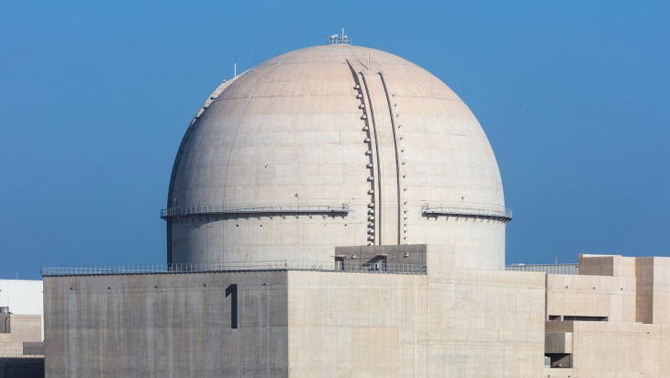
UAE starts Unit 2 of Barakah Nuclear Power Plant

Unit 2's start-up comes within 12 months of the start-up of Unit 1, and within four months of commercial operations of Unit 1. (Supplied)
Short Url
Updated 27 August 2021
Follow

UAE starts Unit 2 of Barakah Nuclear Power Plant

  • Unit 2 will be connected to the national electricity grid in the coming months

RIYADH: The Emirates Nuclear Energy Corporation said its operating and maintenance subsidiary, Nawah Energy Company has successfully started up Unit 2 of the Barakah Nuclear Energy Plant, located in Abu Dhabi’s Al Dhafra Region, Abu Dhabi Media Office said in a statement on Friday.

In the coming months, Unit 2 will be connected to the national electricity grid and the nuclear operators will continue with a process of gradually raising the power levels, known as Power Ascension Testing.

When fully operational, the four units of the plant will produce 5.6 GW of electricity while preventing the release of more than 21 million tons of carbon emissions every year, equivalent to removing 3.2 million cars from the roads annually, and equivalent to those emissions from charging 7.3 billion smartphones daily.

The process will be continuously monitored and tested until maximum electricity production is reached, while adhering to all regulatory requirements and the highest international standards of safety, quality and security, the statement said.

This milestone has been achieved within 12 months of the start-up of Unit 1, and within four months of commercial operations of Unit 1.

“We have reached another major milestone in the delivery of the UAE Peaceful Nuclear Energy Program today, as part of our journey to power the UAE with clean, abundant 24/7 electricity,” said ENEC CEO Mohamed Ibrahim Al Hammadi.

“With the start-up of Unit 2, we are now almost halfway to achieving our goal of supplying up to a quarter of our nation’s electricity needs and enabling sustainable growth and in parallel, achieving UAE climate change targets,” he said.

The Plant is the largest single source of electricity in the UAE through the commercially operating Unit 1 of Barakah.


Saudi POS spending rises 4.5% to $3.8bn in late February: SAMA 

Updated 4 sec ago
Follow

Saudi POS spending rises 4.5% to $3.8bn in late February: SAMA 

RIYADH: Saudi Arabia’s point-of-sale spending rose 4.5 percent to SR14.5 billion ($3.8 billion) in the week ending Feb. 28, even as the number of transactions declined.

According to the latest data from the Saudi Central Bank, also known as SAMA, the total number of transactions fell 4.6 percent to 210.53 million during the period.

Freight transport and postal services recorded the largest jump, surging 50.4 percent to SR121.35 million. Apparel and clothing followed with a 44.2 percent gain to SR1.9 billion. 

Personal care transactions grew 21.7 percent, while books and stationery advanced 8.3 percent. Hotel receipts also increased 11.1 percent to SR376.26 million. 

Pharmacies and medical supplies registered a 23.5 percent rise to SR254.51 million, while medical services edged up 10.2 percent to SR531.56 million. 

Food and beverage purchases declined 11.4 percent to SR2.33 billion, though the segment still accounted for the largest share of POS activity. Restaurants and cafes followed with a 1.8 percent drop to SR1.22 billion. 

The Kingdom’s key urban centers reflected the broader trend. Riyadh, which accounted for the largest share of POS activity, recorded a 2.5 percent increase to SR4.86 billion, compared with SR4.75 billion the previous week. Transactions in the capital totaled 65.7 million, down 5.9 percent week on week. 

In Jeddah, transaction values climbed 5.6 percent to SR2 billion, while Dammam posted a 1.6 percent uptick to SR689 million. 

Weekly POS figures tracked by SAMA offer insight into consumer behavior and the continued expansion of digital payments across Saudi Arabia. 

The data also highlights the expanding reach of POS infrastructure, extending beyond major retail hubs to smaller cities and service sectors, supporting broader digital inclusion initiatives.  

The growth of digital payment technologies aligns with Saudi Arabia’s Vision 2030 objectives, promoting electronic transactions and contributing to the Kingdom’s broader digital economy.