UAE licenses second unit of Barakah nuclear power plant

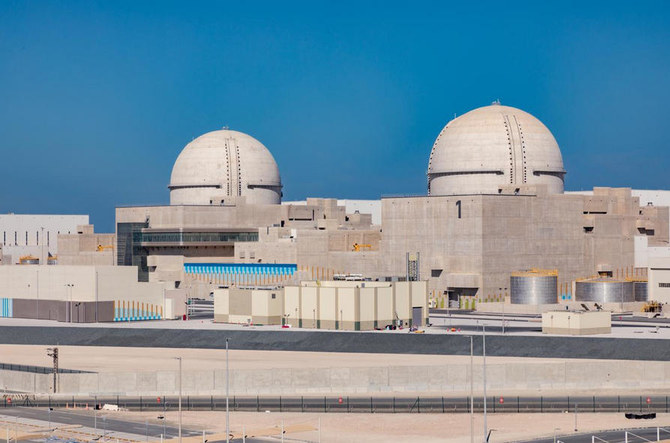
The plant is the first nuclear power station in the Arab world. (Supplied)
Short Url
Updated 09 March 2021
Follow

UAE licenses second unit of Barakah nuclear power plant

  • Barakah to supply one quarter of peak demand
  • Nuclear joins gas and solar power projects

DUBAI: The nuclear regulator in UAE has issued an operating license for the second unit of the Barakah nuclear power plant, an official from the regulator said on Tuesday.
The plant in the Al Dhafrah region of Abu Dhabi, one of the seven emirates making up the UAE and the nation’s capital, is the first nuclear power station in the Arab world and part of the Gulf oil producer’s efforts to diversify its energy mix.
Barakah’s Unit 1 was connected to the national power grid in August and in December reached 100 percent of reactor power capacity during testing.
Unit 1’s commercial operations are expected to start this year, Hamad Al Kaabi, deputy chairman of Federal Authority for Nuclear Regulation (FANR) and the UAE’s representative at the International Atomic Energy Agency (IAEA), told journalists.
The project has faced delays, some related to training staff as the country builds a nuclear industry from scratch.
Construction on Unit 1 began in 2012 and the plant was expected to start up in 2017, but FANR did not grant a license to the operator Nawah Energy Company until February 2020.
Nawah first applied to FANR for licenses for the two units in 2015.
When completed Barakah, which is being built by Korea Electric Power Corp. (KEPCO), will have four reactors with 5,600 megawatts (MW) of total capacity — equivalent to around 25 percent of the UAE’s peak demand.
Construction of Unit 3 is 94 percent complete and Unit 4 is 87 percent complete, Kaabi said.
Asked about security at the plant, Kaabi said measures were in place to protect the site from physical and cyber threats. He did not provide details.


Saudi stock market opens its doors to foreign investors

Updated 06 January 2026
Follow

Saudi stock market opens its doors to foreign investors

RIYADH: Foreigners will be able to invest directly in Saudi Arabia’s stock market from Feb. 1, the Kingdom’s Capital Market Authority has announced.

The CMA’s board has approved a regulatory change which will mean the capital market, across all its segments, will be accessible to investors from around the world for direct participation.

According to a statement, the approved amendments aim to expand and diversify the base of those permitted to invest in the Main Market, thereby supporting investment inflows and enhancing market liquidity.

International investors' ownership in the capital market exceeded SR590 billion ($157.32 billion) by the end of the third quarter of 2025, while international investments in the main market reached approximately SR519 billion during the same period — an annual rise of 4 percent.

“The approved amendments eliminated the concept of the Qualified Foreign Investor in the Main Market, thereby allowing all categories of foreign investors to access the market without the need to meet qualification requirements,” said the CMA, adding: “It also eliminated the regulatory framework governing swap agreements, which were used as an option to enable non-resident foreign investors to obtain economic benefits only from listed securities, and the allowance of direct investment in shares listed on the Main Market.”

In July, the CMA approved measures to simplify the procedures for opening and operating investment accounts for certain categories of investors. These included natural foreign investors residing in one of the Gulf Cooperation Council countries, as well as those who had previously resided in the Kingdom or in any GCC country. 

This step represented an interim phase leading up to the decision announced today, with the aim of increasing confidence among participants in the Main Market and supporting the local economy.

Saudi Arabia, which ‌is more than halfway ‍through an economic plan ‍to reduce its dependence on oil, ‍has been trying to attract foreign investors, including by establishing exchange-traded funds with Asian partners in Japan and Hong Kong.