

Nine dead after blasts at Kazakhstan arms depot

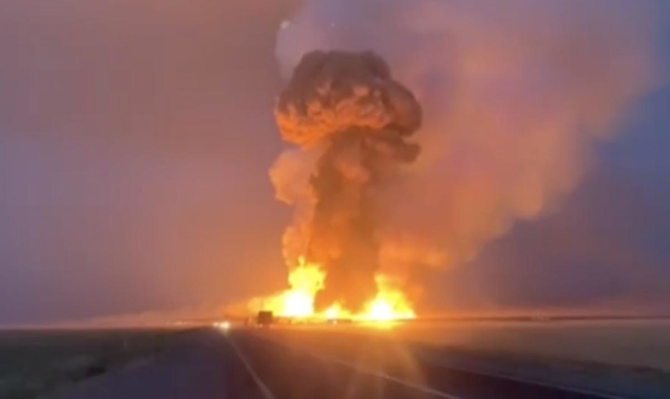
Screengrab of amateur footage of the blast. (File/Internet)
Short Url
Updated 27 August 2021
Follow

Nine dead after blasts at Kazakhstan arms depot

  • Authorities evacuated hundreds of people from the nearby area

NUR-SULTAN: Nine people have died in explosions at an arms depot in southern Kazakhstan, authorities in the Central Asian country said Friday.

The blasts began Thursday at a defense ministry ammunitions depot in the southern region of Jambyl, leaving scores injured and nearby villages evacuated by authorities.

“Unfortunately, four military servicemen died,” said defense minister Nurlan Ermekbayev, noting that attempts to contact several other serviceman after the blasts at the facility had failed.

A separate defense ministry statement said that a fifth person had been killed.

The Jambyl regional government said that of more than 90 who received treatment for injuries, 28 remained in hospital with six in serious condition.

On Thursday, President Kassym-Jomart Tokayev had said on Twitter that the injured were soldiers and emergency services workers.

And local authorities said that they were evacuating people from the villages closest to the site of the accident.

On Friday, the defense ministry said that a fire broke out at an ammunitions depot in Jambyl and “quickly spread to storage facilities where engineering ammunition is stored.”

Several explosions followed, the defense ministry said.

“The explosions stopped over time, but the fire continues,” the statement added.

A video shared on the Telegram messaging app Thursday showed a column of smoke billowing from a fire before a powerful explosion sent flames shooting out.

The defense ministry noted that some of the munitions stored at the Soviet-era depot had been transferred from another depot in the adjacent Turkestan region, where three lethal explosions took place in the last decade.


NATO wants ‘automated’ defenses along borders with Russia: German general

Updated 24 January 2026
Follow

NATO wants ‘automated’ defenses along borders with Russia: German general

  • That zone would act as a defensive buffer before any enemy forces advanced into “a sort of hot zone,” said Lowin
  • The AI-guided system would reinforce existing NATO weapons and deployed forces, the general said

FRANKFURT: NATO is moving to boost its defenses along European borders with Russia by creating an AI-assisted “automated zone” not reliant on human ground forces, a German general said in comments published Saturday.
That zone would act as a defensive buffer before any enemy forces advanced into “a sort of hot zone” where traditional combat could happen, said General Thomas Lowin, NATO’s deputy chief of staff for operations.
He was speaking to the German Sunday newspaper Welt am Sonntag.
The automated area would have sensors to detect enemy forces and activate defenses such as drones, semi-autonomous combat vehicles, land-based robots, as well as automatic air defenses and anti-missile systems, Lowin said.
He added, however, that any decision to use lethal weapons would “always be under human responsibility.”
The sensors — located “on the ground, in space, in cyberspace and in the air” — would cover an area of several thousand kilometers (miles) and detect enemy movements or deployment of weapons, and inform “all NATO countries in real time,” he said.
The AI-guided system would reinforce existing NATO weapons and deployed forces, the general said.
The German newspaper reported that there were test programs in Poland and Romania trying out the proposed capabilities, and all of NATO should be working to make the system operational by the end of 2027.
NATO’s European members are stepping up preparedness out of concern that Russia — whose economy is on a war footing because of its conflict in Ukraine — could seek to further expand, into EU territory.
Poland is about to sign a contract for “the biggest anti-drone system in Europe,” its defense minister, Wladyslaw Kosiniak-Kamysz, told the Gazeta Wyborcza daily.
Kosiniak-Kamysz did not say how much the deal, involving “different types of weaponry,” would cost, nor which consortium would ink the contract at the end of January.
He said it was being made to respond to “an urgent operational demand.”