

Pakistan issues visa-on-arrival to ‘foreigners’ from Afghanistan, gets Taliban assurance against attacks

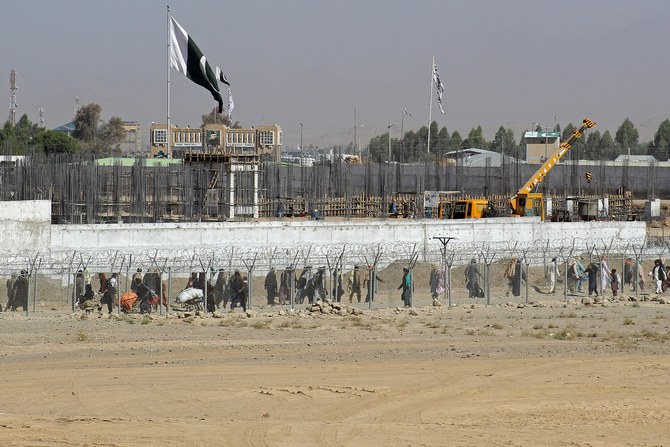
Afghan and Pakistani nationals walk through a security barrier to cross the border at the Pakistan-Afghanistan border crossing point in Chaman on August 22, 2021, following the Taliban stunning takeover of Afghanistan. (AFP)
Short Url
Updated 23 August 2021
Follow

Pakistan issues visa-on-arrival to ‘foreigners’ from Afghanistan, gets Taliban assurance against attacks

  • Interior minister says Pakistan’s border crossings with Afghanistan open but Afghan refugees not allowed in
  • Says Afghan Taliban have assured Islamabad won’t let Pakistani Taliban use Afghanistan soil against Pakistan

ISLAMABAD: Pakistan’s Interior Minister Sheikh Rashid Ahmed said on Monday his government was issuing one month visas-on-arrival to all foreigners traveling from Kabul to Islamabad, adding that the Afghan Taliban had assured his country they would not allow the outlawed Pakistan Taliban to use Afghan soil for attacks against Pakistan.

The Pakistan Taliban, or Tehreek-e-Taliban Pakistan, is a separate militant group from the one in Afghanistan. The group has claimed responsibility for several past attacks in Pakistan, including the 2014 deadly attack on a Peshawar school that killed 154 people, mostly schoolchildren, and an attack on Nobel Laureate Malala Yousafzai. 

Ahmed said Islamabad was playing an “important role” in the evacuation of foreigners, including Americans, from Afghanistan since the Taliban takeover on August 15.

The US and other western countries have been struggling to fly out their citizens from Afghanistan as chaos and panic have gripped the war-torn nation. 

“Our border crossings with Afghanistan remain open, but we aren’t allowing Afghan refugees in,” the interior minister said while addressing a press conference in Islamabad. 

The South Asian nation has so far processed the immigration of 1,277 foreigners and allowed 874 people to enter Pakistan through the Torkham border, the minister said, adding that around 500 people were in transit in Pakistan. 

“We are issuing a one-month visas on arrival to foreigners including World Bank and IMF officials to facilitate their evacuation [from Kabul],” he said, adding that the Pakistani embassy in Kabul had issued visas to 4,000 people who wanted to flee the country after the Taliban takeover. People identified as being COVID-19 positive were being quarantined at border camps, the minister said.

Ahmed said Pakistan was enhancing its capacity at the Kabul embassy to issue more visas in case of an emergency but added that Islamabad was not responsible for chaos and anarchy at the Kabul airport: “This is not our responsibility, to bring people [from different parts of Afghanistan] to the Kabul airport.”

About the presence of the Pakistan Taliban in Afghanistan, he confirmed that some TTP members such as Maulvi Faqeer Mohammad had been released from prison by the Taliban after their takeover of Kabul. 

“We have contacted people there [in Afghanistan] over the issue, and the Taliban have assured us that they won’t let the TTP use Afghanistan soil [against Pakistan],” the minister said. 

About attacks on Chinese nationals working on projects in Pakistan, Ahmed said the Pakistan army was looking after the security of at least 40 companies working on the China-Pakistan Economic Corridor (CPEC), and all other institutions were working to formulate a strategy to provide fool-proof security to both the projects and workers. 


IMF hails Pakistan privatization drive, calls PIA sale a ‘milestone’

Updated 10 January 2026
Follow

IMF hails Pakistan privatization drive, calls PIA sale a ‘milestone’

  • Fund backs sale of national airline as key step in divesting loss-making state firms
  • IMF has long urged Islamabad to reduce fiscal burden posed by state-owned entities

KARACHI: The International Monetary Fund (IMF) on Saturday welcomed Pakistan’s privatization efforts, describing the sale of the country’s national airline to a private consortium last month as a milestone that could help advance the divestment of loss-making state-owned enterprises (SOEs).

The comments follow the government’s sale of a 75 percent stake in Pakistan International Airlines (PIA) to a consortium led by the Arif Habib Group for Rs 135 billion ($486 million) after several rounds of bidding in a competitive process, marking Islamabad’s second attempt to privatize the carrier after a failed effort a year earlier.

Between the two privatization attempts, PIA resumed flight operations to several international destinations after aviation authorities in the European Union and Britain lifted restrictions nearly five years after the airline was grounded following a deadly Airbus A320 crash in Karachi in 2020 that killed 97 people.

“We welcome the authorities’ privatization efforts and the completion of the PIA privatization process, which was a commitment under the EFF,” Mahir Binici, the IMF’s resident representative in Pakistan, said in response to an Arab News query, referring to the $7 billion Extended Fund Facility.

“This privatization represents a milestone within the authorities’ reform agenda, aimed at decreasing governmental involvement in commercial sectors and attracting investments to promote economic growth in Pakistan,” he added.

The IMF has long urged Islamabad to reduce the fiscal burden posed by loss-making state firms, which have weighed public finances for years and required repeated government bailouts. Beyond PIA, the government has signaled plans to restructure or sell stakes in additional SOEs as part of broader reforms under the IMF program.

Privatization also remains politically sensitive in Pakistan, with critics warning of job losses and concerns over national assets, while supporters argue private sector management could improve efficiency and service delivery in chronically underperforming entities.

Pakistan’s Cabinet Committee on State-Owned Enterprises said on Friday that SOEs recorded a net loss of Rs 122.9 billion ($442 million) in the 2024–25 fiscal year, compared with a net loss of Rs 30.6 billion ($110 million) in the previous year.