

Afghan influencers go dark on social media as Taliban return

Prominent influencers have gone dark or fled, while residents and activists are scrambling to scrub their digital lives. (File/AFP)
Short Url
Updated 20 August 2021
Follow

Afghan influencers go dark on social media as Taliban return

  • Social media influencers in Afghanistan go dark online after the Taliban takeover of the country
  • Millions of Afghan youngsters, in particular women and religious minorities, fear that what they once put online could now put their lives in danger

HONG KONG: Sadiqa Madadgar’s social media looked much like any other successful young Afghan influencer’s until Taliban militants stormed into Kabul and upended her dreams.
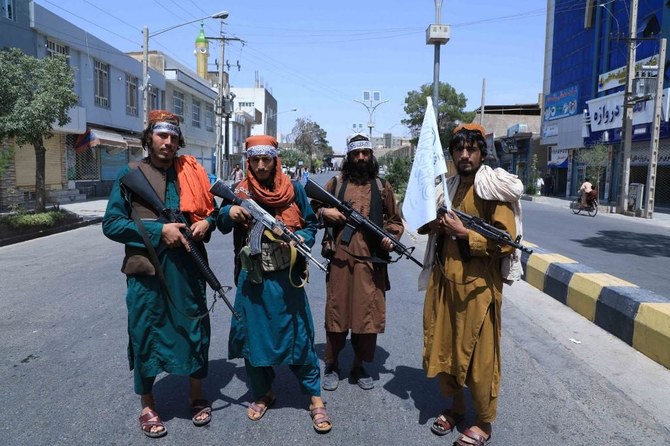
The return of the hard-line Islamist group has sent a shockwave through Afghanistan’s social media. Prominent influencers have gone dark or fled, while residents and activists are scrambling to scrub their digital lives.
A former contestant on the reality singing competition “Afghan Star,” Madadgar amassed a huge following with her stunning vocals and down to earth, girl next door persona.
A devout Muslim who wears a headscarf, she spent her days uploading videos that transfixed Afghan youngsters, winning her 21,200 subscribers on YouTube and 182,000 followers on Instagram.
In one video, she giggles as she struggles to cut open a watermelon. On another, the 22-year-old is singing a haunting folk tune in a cafe while a friend plays guitar.
On a recent trip to the city of Kandahar — the Taliban’s spiritual birthplace — she filmed herself sharing a pizza with girlfriends.
On Saturday, Madadgar posted her first overtly political post on Instagram.
“I don’t like to express my pain online but I’m sick of this,” she wrote. “My heart is in pieces when I look at the soil, my homeland which is being destroyed slowly before my eyes.”
The following day, Taliban militants seized Kabul, and Madadgar stopped posting.

Millions of Afghan youngsters — in particular women and religious minorities — fear that what they once put online could now put their lives in danger.
Few can forget the first time the Taliban imposed their ultra-conservative version of Islamic law on Afghanistan between 1996-2001.
Women were excluded from public life, girls could not attend school, entertainment was banned and brutal punishments were imposed — such as stoning to death for adultery.
Ayeda Shadab was a fashion icon for many young Afghan women with 290,000 followers on Instagram and 400,000 on TikTok. Each day she would model the latest outfits that were stocked in her upscale Kabul boutique.
In one of the most recent videos from her range, she posed in an asymmetrical sheer ball gown as Dua Lipa’s infectious dance track “Levitating” played in the background.
But she had no illusions about what a Taliban regime would mean for fashionable women entrepreneurs like her.
“If the Taliban take Kabul, people like me will no longer be safe,” she told German broadcaster ZDF in a recent interview. “Women like me who don’t wear a veil, who work, they can’t accept them.”
She was so terrified of the Taliban’s return that she had to flee, telling followers recently that she had relocated to Turkey.
Other prominent celebrities and influencers who remained in the country have scrambled to follow in her footsteps.
Aryana Sayeed, one of Afghanistan’s most prominent pop stars, posted a selfie on Wednesday taken on a US military evacuation flight headed to Doha.
“I am well and alive after a couple of unforgettable nights,” she wrote. “My heart, my prayers and my thoughts will always be with you.”

Others have not been so lucky.
Zaki Anwari was a promising footballer who played for Afghanistan’s youth team and often posted fashionable self-portraits on social media.
On Thursday, Afghanistan’s sports federation confirmed the 19-year-old was one of those who fell to his death after trying to cling to a US plane airlifting people out of Kabul.
Following recommendations from activists, journalists and civil society groups, Facebook announced new security measures allowing users in Afghanistan to quickly lock their accounts.
The company, which also owns WhatsApp and Instagram said it had also set up a special operations center “to respond to new threats as they emerge.”
US advocacy group Human Rights First has published advice in Pashto and Dari on how Afghans can delete their digital histories — something they also offered for activists in Hong Kong and Myanmar.
“What we heard from activists in Afghanistan were similar requests prompted by fears of being targeted when a new power took over the country’s security,” Brian Dooley, an adviser to the group told AFP.
Raman Chima, from digital rights advocacy group Access Now, which has also published guides, warns even relatively mundane online content could be dangerous given the Taliban’s harsh interpretation of sharia law.
“They may be targeted for retribution, for being accused of being infidels, or being un-Islamic in the views of not just the Taliban but other religious extremist groups in the country,” he told AFP.


A look back at how Arab News marked its 50th anniversary

Updated 31 December 2025
Follow

A look back at how Arab News marked its 50th anniversary

  • In a year crowded with news, the paper still managed to innovate and leverage AI to become available in 50 languages
  • Golden Jubilee Gala, held at the Diplomatic Quarter in Riyadh, now available to watch on YouTube

RIYADH: In 2025, the global news agenda was crowded with headlines concerning wars, elections and rapid technological change.

Inside the newsroom of Arab News, the year carried additional weight: Saudi Arabia’s first English-language daily marked its 50th anniversary.

And with an industry going through turmoil worldwide, the challenge inside the newsroom was how to turn a midlife crisis into a midlife opportunity. 

For the newspaper’s team members, the milestone was less about nostalgia than about ensuring the publication could thrive in a rapidly changing and evolving media landscape.

“We did not want just to celebrate our past,” said Faisal J. Abbas, editor-in-chief of Arab News. “But more importantly, we were constantly thinking of how we can keep Arab News relevant for the next five decades.”

Faisal J. Abbas, editor-in-chief of Arab News. (Supplied)

The solution, he added, came down to two words: “Artificial intelligence.”

For the Arab News newsroom, AI was not a replacement for journalism but as a tool to extend it.

“It was like having three eyes at once: one on the past, one on the present, and one on the future,” said Noor Nugali, the newspaper’s deputy editor-in-chief.

Noor Nugali, deputy editor-in-chief of Arab News. (Supplied)

One of the first initiatives was the 50th anniversary commemorative edition, designed as a compact historical record of the region told through Arab News’ own reporting.

“It was meant to be like a mini history book, telling the history of the region using Arab News’ archive with a story from each year,” said Siraj Wahab, acting executive editor of the newspaper.

The issue, he added, traced events ranging from the outbreak of the Lebanese civil war in 1975 to the swearing-in of Donald Trump, while also paying homage to former editors-in-chief who shaped the newspaper’s direction over five decades.

The anniversary edition, however, was only one part of a broader strategy to signal Arab News’ focus on the future.

To that end, the paper partnered with Google to launch the region’s first AI-produced podcast using NotebookLM, an experimental tool that synthesizes reporting and archival material into audio storytelling.

The project marked a regional first in newsroom-led AI audio production.

The podcast was unveiled during a special 50th anniversary ceremony in mid-November, held on the sidelines of the Arab Media Forum, hosted by the Dubai Future Foundation. The event in the UAE’s commercial hub drew regional media leaders and officials.

Remarks at the event highlighted the project as an example of innovation in legacy media, positioning Arab News as a case study in digital reinvention rather than preservation alone.

“This is a great initiative, and I’m happy that it came from Arab News as a leading media platform, and I hope to see more such initiatives in the Arab world especially,” said Mona Al-Marri, director-general of the Government of Dubai Media Office, on the sidelines of the event.

“AI is the future, and no one should deny this. It will take over so many sectors. We have to be ready for it and be part of it and be ahead of anyone else in this interesting field.”

Behind the scenes, another long-form project was taking shape: a documentary chronicling Arab News’ origins and its transformation into a global, digital-first newsroom.

“While all this was happening, we were also working in-house on a documentary telling the origin story of Arab News and how it transformed under the current editor into a more global, more digital operation,” said Nugali.

The result was “Rewriting Arab News,” a documentary examining the paper’s digital transformation and its navigation of Saudi Arabia’s reforms between 2016 and 2018. The film charted editorial shifts, newsroom restructuring and the challenges of reporting during a period of rapid national change.

The documentary was screened at the Frontline Club in London, the European Union Embassy, Westminster University, and the World Media Congress in Bahrain. It later became available on the streaming platform Shahid and onboard Saudi Arabian Airlines.

The grand slam of the anniversary year was the Golden Jubilee of Arab News gala, held in late September in Riyadh’s Diplomatic Quarter. (AN photo)

It was also nominated for an Association for International Broadcasting award.

In early July, a special screening of the documentary took place at the EU Embassy in Riyadh. During the event, EU Ambassador to Saudi Arabia Christophe Farnaud described the film as an “embodiment” of the “incredible changes” that the Kingdom is undergoing.

“I particularly appreciate … the historical dimension, when (Arab News) was created in 1975 — that was also a project corresponding to the new role of the Kingdom,” Farnaud said. “Now the Kingdom has entered a new phase, a spectacular phase of transformation.”

Part of the documentary is narrated by Prince Turki Al-Faisal, the former Saudi ambassador to the US, who in the film delves into the paper’s origins.

Prince Turki Al-Faisal, the former Saudi ambassador to the US. (AN photo)

The grand slam of the anniversary year was the Golden Jubilee of Arab News gala, held in late September in Riyadh’s Diplomatic Quarter.

Hosted by the Dean of Diplomatic Corps in Saudi Arabia and Ambassador of Djibouti to Riyadh Dya-Eddine Said Bamakhrama, the evening featured a keynote address by Prince Turki, who spoke about Arab News’ founding under his father, the late King Faisal, and its original mission to present the Kingdom to the English-speaking world.

The Dean of Diplomatic Corps in Saudi Arabia and Ambassador of Djibouti to Riyadh Dya-Eddine Said Bamakhrama (far left). (AN photo)

Arab News was established in Jeddah in 1975 by brothers Hisham and Mohammed Ali Hafiz under the slogan to give Arabs a voice in English while documenting the major transformations taking place across the Middle East.

The two founders were honored with a special trophy presented by Prince Turki, Assistant Media Minister Abdullah Maghlouth, Editor-in-Chief Abbas, and family member and renowned columnist Talat Hafiz on behalf of the founders. 

During the gala, Abbas announced Arab News’ most ambitious expansion yet: the launch of the publication in 50 languages, unveiled later at the World Media Congress in Madrid in cooperation with Camb.AI.

The grand slam of the anniversary year was the Golden Jubilee of Arab News gala, held in late September in Riyadh’s Diplomatic Quarter. (AN photo)

The Madrid launch in October underscored Arab News’ aim to reposition itself not simply as a regional paper, but as a global platform for Saudi and Middle Eastern perspectives.

The event was attended by Princess Haifa bint Abdulaziz Al-Mogrin, the Saudi ambassador to Spain; Arab and Spanish diplomats; and senior editors and executives.

As the anniversary year concluded, Arab News released the full video of the Golden Jubilee Gala to the public for the first time, making the event accessible beyond the room in which it was held.

For a newspaper founded in an era of typewriters and wire copy, the message of its 50th year was clear: longevity alone is not enough. Relevance, the newsroom concluded, now depends on how well journalism adapts without losing sight of its past.