Pakistan announces visa relaxation for international journalists stranded in Afghanistan

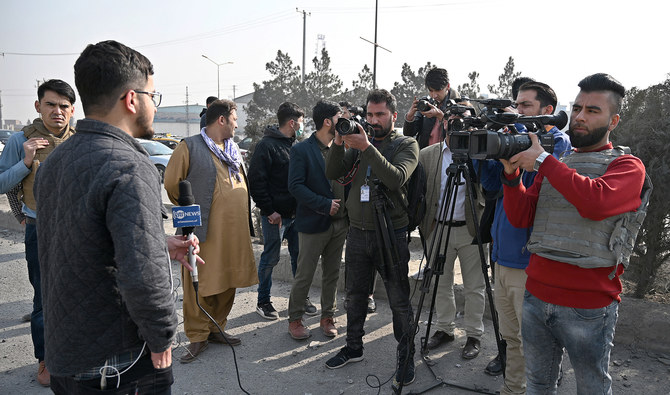
Journalists reports at the site of a bomb blast in Kabul, Afghanistan, on February 2, 2021. (AFP/File)
Short Url
Updated 16 August 2021
Follow

Pakistan announces visa relaxation for international journalists stranded in Afghanistan

  • The country's interior minister says his government will issue visas to foreign media workers in the war-battered country 'on a priority basis'
  • Pakistan's national security advisor also urged Afghan factions to expedite the peace process to reach a negotiated settlement

ISLAMABAD: Pakistan's interior minister Sheikh Rashid Ahmed announced on Friday his country had decided to relax its visa policy for international journalists and media workers stranded in Afghanistan to help them exit the war-battered country amid a deteriorating security situation.
"International journalists and media workers who intend to leave Afghanistan via Pakistan are urged to apply for a Pakistani visa," said a statement issued by his office. "The Interior Ministry will issue visas to these international journalists and workers on a priority basis."
The ministry added the announcement of visa relaxation by the Pakistani government was made in view of the safety of journalists working in Afghanistan.
Pakistan's neighboring state in the northwest has witnessed significant escalation in insurgent violence since the United States announced to pull out its troops earlier this year.
The Taliban launched a military campaign against the administration in Kabul, capturing several key districts and border crossings in Afghanistan.
According to some intelligence assessments, the insurgent faction could seize Afghanistan's capital within a matter of months.
The Afghan authorities have accused Pakistan of supporting the Taliban, though Pakistani officials deny the allegation and say they are interested in a politically negotiated settlement in the neighboring state.
Pakistan's national security advisor Moeed Yusuf emphasized the need to expedite the peace process in Afghanistan during a media interaction in Islamabad on Friday.
"Trust me, if they sit down, they will be able to come out with some sort of settlement and we will respect whatever Afghans decide," he was quoted by the Associated Press.
"History will judge us very badly and poorly if we don't put all efforts behind (this) for a political settlement" on the Afghan crisis, he added.
Yusuf also defended his country's position, saying it was beyond Pakistan's capacity to become a "guarantor for peace" in Afghanistan.
"Everybody needs to respect what Afghans decide politically," he said.


Pakistan, China to sign multiple MoUs at major agriculture investment conference today

Updated 18 January 2026
Follow

Pakistan, China to sign multiple MoUs at major agriculture investment conference today

  • Hundreds of Chinese and Pakistani firms to attend Islamabad event
  • Conference seen as part of expanding CPEC ties into agriculture, trade

KARACHI: Islamabad and Beijing are set to sign multiple memorandums of understanding (MoUs) to boost agricultural investment and cooperation at a major conference taking place in the capital today, Monday, with hundreds of Chinese and Pakistani companies expected to participate.

The conference is being billed by Pakistan’s Ministry of National Food Security and Research as a platform for deepening bilateral agricultural ties and supporting broader economic engagement between the two countries.

“Multiple memorandums of understanding will be signed at the Pakistan–China Agricultural Conference,” the Ministry of National Food Security said in a statement. “115 Chinese and 165 Pakistani companies will participate.”

The conference reflects a growing emphasis on expanding Pakistan-China economic cooperation beyond the transport and energy foundations of the flagship China-Pakistan Economic Corridor (CPEC) into agriculture, industry and technology.

Under its first phase launched in 2015, CPEC, a core component of China’s Belt and Road Initiative, focused primarily on transportation infrastructure, energy generation and connectivity projects linking western China to the Arabian Sea via Pakistan. That phase included motorways, power plants and the development of the Gwadar Port in the country's southwest, aimed at helping Pakistan address chronic power shortages and enhance transport connectivity.

In recent years, both governments have formally moved toward a “CPEC 2.0” phase aimed at diversifying the corridor’s impact into areas such as special economic zones, innovation, digital cooperation and agriculture. Second-phase discussions have highlighted Pakistan’s goal of modernizing its agricultural sector, attracting Chinese technology and investment, and boosting export potential, with high-level talks taking place between planning officials and investors in Beijing.

Agri-sector cooperation has also seen practical collaboration, with joint initiatives examining technology transfer, export protocols and value-chain development, including partnerships in livestock, mechanization and horticulture.

Organizers say the Islamabad conference will bring together government policymakers, private sector investors, industry associations and multinational agribusiness firms from both nations. Discussions will center on investment opportunities, technology adoption, export expansion and building linkages with global buyers within the framework of Pakistan-China economic cooperation.