

Hospitals fill up as Bangladesh reopens despite deadliest virus surge

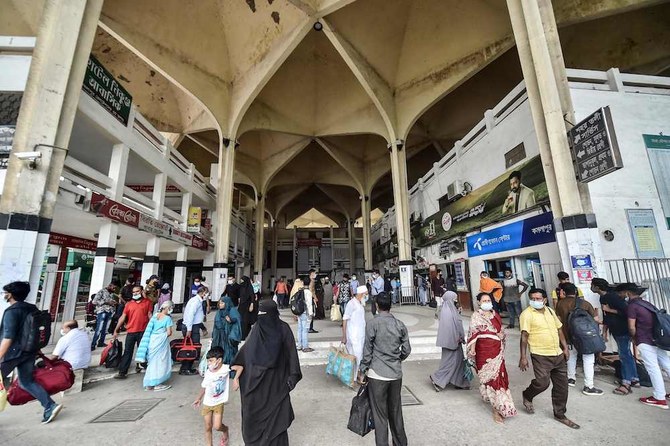
Commuters wait to board a train at Kamalapur Railway Station, after the government ordered the lifting of a lockdown imposed as a preventive measure against Covid-19, Dhaka, August 11, 2021. (AFP)
Short Url
Updated 13 August 2021
Follow

Hospitals fill up as Bangladesh reopens despite deadliest virus surge

  • Offices, banks, shops, restaurants and malls were allowed to reopen, more than a week after garment factories, the number one industry in Bangladesh, resumed operations
  • The easing of lockdown, however, comes as the country is running out of hospital beds to treat the ill, whose numbers are increasing

DHAKA: Bangladesh’s strained health care system is reeling under the country’s third and deadliest wave of the coronavirus, doctors say.

They fear that worse is to come as the government has lifted much of its lockdown to save the economy.

About 60 percent of the country’s nearly 24,000 virus-related deaths and more than half of its total infections have been recorded since the beginning of April. A lockdown imposed late in July aimed to stop the spread fueled by the delta variant but was eventually lifted on Wednesday.

Offices, banks, shops, restaurants and malls were allowed to reopen, more than a week after garment factories, the number one industry in Bangladesh, resumed operations, despite mounting pressure on the country’s health infrastructure.

But government officials and advisers say that the country had no choice but to reopen.

The economic fallout of the pandemic has already pushed more than 24.5 million Bangladeshis into poverty, according to an April study by the BRAC Institute of Governance and Development (BIGD), increasing the country’s rate of poverty to more than 40 percent from 20 percent before the outbreak.

“Any country in the world couldn’t continue a lockdown at a stretch for a longer period considering the livelihood of the people,” Dr. A.S.M. Alamgir, principal scientific officer of the Institute of Epidemiology Disease Control and Research (IEDCR), told Arab News on Friday.

“We also had to remove the lockdown restrictions to ease the people’s suffering.”

The easing of lockdown, however, comes as the country is running out of hospital beds to treat the ill, whose numbers are increasing. Out of the country’s 16,000 COVID-19 beds, more than a third are in Dhaka. Health Minister Zahid Maleque said on Thursday that no more beds were available.
 
“Of the 6,000 coronavirus beds in the capital, both public and private, not a single one is empty,” he told reporters. “If the virus continues to spread, the country will face significant issues.”

A 1,000-bed COVID-19 field hospital opened in Dhaka last week is already filling up.

“Around 100 of our beds are already occupied. The number is increasing every day,” Dr. Nazmul Karim, additional director of Bangabandhu Sheikh Mujib Medical University, which runs the facility, told Arab News.  

Intensive care units (ICUs) in Dhaka, which has the highest infection rate in the country, have been overrun, forcing some hospitals to turn away emergency patients.

“We receive patients from across the country, the pressure on our hospital is always very high,” said Nazmul Haque, director of Dhaka Medical College, the country’s largest government-run health facility.

“At the moment we don’t have any vacancy in ICU or in general wards. We are asking the patients’ relatives to go to some other places.”

The pandemic is also taking a toll on doctors and healthcare workers.

“Every day our doctors and nurses are also getting infected with COVID-19,” Haque said.

Some of the staff have died as well. According to the Bangladesh Medical Association, more than 180 doctors have lost their lives to COVID-19 since April 2020.

Health experts have warned of the imminent risk when the government ignored their advice and eased its earlier restrictions in mid-July to allow millions of people to return to their hometowns for the Eid Al-Adha holiday. The move led to a surge in infections.

The new relaxation in restrictions is raising similar concerns, as only 5 million people out of the country’s population of 167 million have been fully vaccinated.

Prof. Dr. Benazir Ahmed, former director of the Center for Disease Control, told Arab News that the country’s infection rate, which is currently more than 20 percent, should be at least four times lower.

“We are not in a comfortable situation unless the infection rates come down below 5 percent,” he said. “It’s a very risky decision at this moment.”


US moves to counter China in Bangladesh, plans to pitch defense alternatives

Updated 3 sec ago
Follow

US moves to counter China in Bangladesh, plans to pitch defense alternatives

DHAKA: The United States is concerned about China’s ​expanding presence in South Asia and is planning to offer Bangladesh’s next government US and allied defense systems as alternatives to Chinese hardware, Washington’s ambassador to Dhaka told Reuters. Bangladesh votes in a general election on Thursday after a Gen Z-led uprising toppled India-allied premier Sheikh Hasina in August 2024. She has since taken refuge in New Delhi, allowing China to deepen its influence in Bangladesh as India’s presence wanes. China recently signed a defense agreement with Bangladesh to build a drone factory near the India border, worrying foreign diplomats. Bangladesh is also in talks with Pakistan to buy JF-17 Thunder fighter jets, a multi-role combat ‌aircraft jointly developed with ‌China.
“The United States is concerned about growing Chinese influence in South ​Asia ‌and ⁠is committed ​to ⁠working closely with the Bangladeshi government to clearly communicate the risks of certain types of engagement with China,” US Ambassador Brent T. Christensen said in an interview on Tuesday.
“The US offers a range of options to help Bangladesh meet its military capability needs, including US systems and those from allied partners, to provide alternatives to Chinese systems,” he said without offering further details.
The Chinese foreign ministry did not immediately respond to a request for comment.
Christensen also said that President Donald Trump’s administration would “like to see a good relationship between Bangladesh and India ⁠to support stability in the region.” New Delhi-Dhaka relations have nosedived since ‌Hasina fled, badly affecting visa services and cricket ties between the ‌two neighbors.

COMMERCIAL DIPLOMACY IS PRIORITY
Christensen said many US businesses were looking ​at potentially investing in Bangladesh but would want ‌the next government to show early and clear signs that it is “open for business.”
“Commercial diplomacy is one ‌of our top priorities, and we look forward to working with the new government to build on progress made with the interim government, particularly in strengthening commercial, economic, and security ties,” he said.
Energy producer Chevron has been in Bangladesh for decades but not many other US companies are visible in the densely populated country of 175 million people, ‌as high taxes and difficulties repatriating profits have created some hurdles.
There are no Starbucks or McDonald’s outlets in Bangladesh.
The envoy said Washington would ⁠work with “whichever government is elected ⁠by the Bangladeshi people.” The race is between two coalitions led by former allies, the Bangladesh Nationalist Party (BNP) and the Islamist Jamaat-e-Islami, with opinion polls suggesting the BNP holds an advantage.

AID FOR ROHINGYA REFUGEES
Regarding the 1.2 million Rohingya refugees sheltered in Bangladesh, the ambassador said the United States remained the largest contributor to humanitarian operations.
“The US remains the largest contributor to the Rohingya refugee response and continues robust health programming in Bangladesh,” he said, noting a recent $2 billion worldwide funding framework signed with the United Nations to improve the effectiveness of such assistance, including in Bangladesh.
He urged other international donors to take on a greater share of the burden.
“The US cannot sustain the bulk of the effort alone. International partners need to increase their support for the Rohingya response,” he said. In recent years, the UN refugee agency has ​been struggling to raise sufficient funds to support ​the Rohingya community, leading to cuts in their rations and the closure of some schools for them.