

Pakistan’s Sialkot airport first to install rapid COVID-19 testing for UAE passengers 

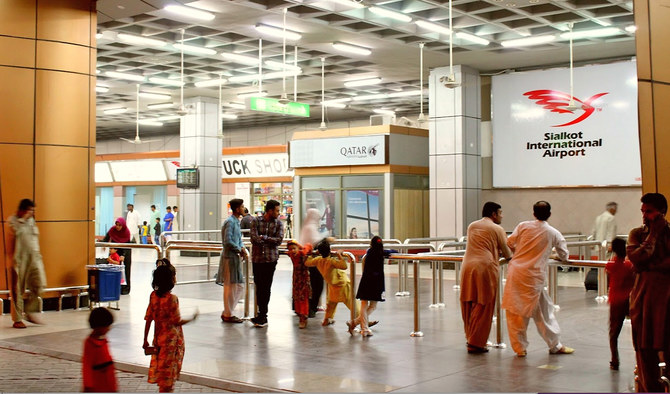
People stand by an exit at Sialkot International Airport in Sialkot, Pakistan, on November 5, 2017. (Photo courtesy: Online)
Short Url
Updated 10 August 2021
Follow

Pakistan’s Sialkot airport first to install rapid COVID-19 testing for UAE passengers 

  • Airport manager says 122 passenger had traveled to Dubai with reports of rapid PCR tests
  • Says the facility had been operational since Monday night and passengers had to pay for their own tests

ISLAMABAD: Pakistan’s Sialkot International Airport has become the first airport in the country to install a Rapid PCR (polymerase chain reaction) testing facility for passengers traveling to the United Arab Emirates (UAE), an airport official said on Tuesday.
UAE lifted a ban on transit passenger traffic from India, Pakistan, Nigeria and other countries from August 5, with the National Emergency and Crisis Management Authority (NCEMA) saying passengers traveling from countries where flights had been suspended would be able to transit through its airports as long as they presented negative rapid PCR tests taken 72 hours prior to departure.
However, the Pakistan Civil Aviation Authority (PCAA) has said the country does not have the resources to conduct rapid PCR tests and only rapid antigen testing (RAT) was currently available at its airports.
“We have arranged a rapid PCR testing facility at our airport with the help of a city lab and research center,” Nisar Ahmad, a manager at Sialkot International Airport, told Arab News, adding that the facility had been operational since Monday night, and passengers had to pay for their own tests. 
“Under this arrangement, 122 passengers traveled to Dubai on a FlyDubai flight with reports of rapid PCR tests,” Ahmed said.


A rapid PCR (polymerase chain reaction) testing facility for passengers can be seen at Sialkot International Airport, Pakistan, on August 9, 2021. (Courtesy: Sialkot International Airport)

A spokesperson for the Pakistan Civil Aviation Authority, Saad bin Ayub, said the authority was “working on different options” to fulfill the requirements of the UAE government and had written a letter to the ministry of foreign affairs requesting them to use diplomatic channels to convince the UAE government to accept rapid antigen, instead of Rapid PCR, tests. 
“The response we have got from MoFA is that the UAE government requires only the rapid PCR,” he added. 
The UAE embassy in Islamabad said rapid PCR test results were mandatory for all nationalities and destinations.
“Yes, rapid PCR is mandatory for all nationalities and destinations,” the embassy told Arab News in a statement.


Pakistan leaders wish Saudi King Salman well after hospital admission for tests

Updated 16 January 2026
Follow

Pakistan leaders wish Saudi King Salman well after hospital admission for tests

  • Pakistani PM and President express concern, pray for the King's swift recovery
  • The official Saudi media has not shared the nature of the King’s visit to the hospital

ISLAMABAD: Pakistan’s prime minister and president on Friday expressed concern over the health of Saudi Arabia’s King Salman bin Abdulaziz, offering prayers and well wishes after state media said he had been admitted to hospital in Riyadh for medical examinations.

The Saudi Press Agency reported the King was undergoing medical tests at King Faisal Specialist Hospital in Riyadh, with no further information regarding the nature of the visit or his medical condition.

In a post on X, Prime Minister Shehbaz Sharif said Pakistanis held the Saudi King in high regard and were praying for his recovery.

“Deeply concerned by the news that Custodian of The Two Holy Mosques His Majesty King Salman bin Abdulaziz Al Saud is admitted in hospital for medical tests,” he said. “The people of Pakistan hold His Majesty in the highest esteem. We join our Saudi brothers and sisters in praying for His Majesty’s swift and complete recovery.”

President Asif Ali Zardari also conveyed his wishes, saying the entire Pakistani nation was praying for the Saudi King’s health and well-being, according to a statement issued by the presidency.

Pakistan has longstanding diplomatic and institutional ties with Saudi Arabia, and its leadership has consistently expressed deep respect for the Saudi royal family, particularly in view of the Kingdom’s religious significance and its role in the Muslim world.