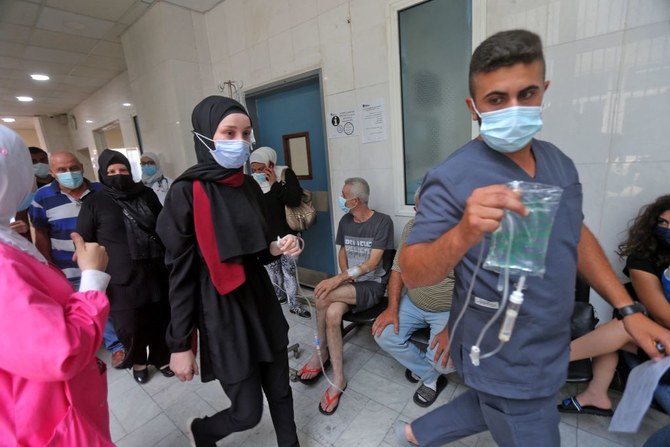
DUBAI: Lebanon is on the brink of another coronavirus disease (COVID-19) catastrophe, health officials warn, as the country grapples with a deepening financial crisis and political turmoil.
The small Mediterranean country, which has gone through two full-fledged lockdowns already, has seen cases gradually increase over the past month. Political leaders, meanwhile, are busy wrangling over sectarian quotas that have floundered efforts to form a government.
On Sunday, Lebanon’s Ministry of Public Health registered 1,552 cases, while five people were reported to have died, bringing the total death toll to 7,943.
Before the summer season kicked off, Lebanon managed to bring down cases to less than 100 per day after implementing strict measures to stave off new infections. Coupled with its vaccine rollout, residents and officials breathed a short sigh of relief.
However, with Beirut in dire need of foreign currency amid a liquidity crunch, officials elected to loosen restrictions once again in a bid to attract free-spending tourists and expats.
As the summer season now draws to close, COVID-19 cases are on the rise again while health practitioners scramble to avoid a repeat of this year’s Christmas holiday rush.
After loosening restrictions to help capitalize on the expected holiday rush back in January, a COVID-19 surge killed over 1,000 people while a flood of cases overwhelmed hospitals, forcing the state to impose a strict lockdown devoid of any financial aid.
“It was not difficult to predict that the decision in June to ease COVID-19 restrictions, despite a highly infectious variant and a low vaccination rate in Lebanon, would lead to (a surge),” Dr. Firas Abiad, the general manager of Rafik Hariri University Hospital, tweeted Monday.
“The justification, always, is that it is a necessary evil, required to bring in much-needed fresh dollars. The consequences of this decision, particularly the loss of lives, apparently were not calculated. Even hospitals were left to prepare on their own for the wave to come,” he added.
Speaking to a local TV station Sunday, caretaker Health Minister Hamad Hassan warned that the “danger now lies in the decline hospitals’ readiness compared to what it was in the past.”
Hospitals, like virtually all other sectors, have been hit hard by the country’s collapse. Severe medicine shortages, electricity blackouts and mass migration of medical staff are but the tip of the problem.
A lockdown, Hasan said, will be inevitable by the end of September at the current virus incidence rate, adding that it could come when intensive care unit (ICU) occupancy hits between 70-75 percent.
According to the latest figures from the World Bank, national ICU occupancy levels currently stand at around 12 percent, while the average positivity rate reached six percent, up from one percent at the height of the lockdown measures.
The surge comes as the health care system teeters on the edge of a precipice, struggling to even keep the lights on and provide basic care for the country’s most vulnerable.
“We’re in disaster mode and total destruction,” Dr. Samer Saade, a lead emergency room (ER) physician at Hammoud Hospital University Medical Center in Sidon, told Arab News.
With less than 25 percent of the country’s residents fully vaccinated, his hospital has seen a steady rise in COVID-19 cases over the past two weeks.
“We currently have four patients in our COVID-19 ward, four in the ER and two in the ICU,” he said.
Yet the struggle, he says, is securing the necessary medication for both COVID-19 and none COVID-19 patients.
“Remdesivir, a drug used to treat coronavirus symptoms, is hard to find,” Saade said. Paracetamol, antibiotics and anesthetics have also become a rarity. “We’re running on fumes and operating on a day-to-day basis.”
The shortages have become so bad that his hospital has been forced to ration supply, refusing to admit patients who can be treated at home.
“If a COVID-19 patient is not critical, we ask them to go home,” the physician said.
Saade, who’s been practicing medicine for over two decades, sees no light at the end of the tunnel.
“Up until now, hospitals have been surviving thanks to donations from the international community following the deadly Aug. 4 blast,” he said.
These, however, are now drying up.
“We don’t know how we’ll intubate patients if we run out of anesthetics or oxygen,” Saade added.


![]()


Ravaged Lebanon on the brink of third COVID-19 surge, health officials warn
Short Url
https://arab.news/bzs4x
Ravaged Lebanon on the brink of third COVID-19 surge, health officials warn
- Concern grows amid financial, political crises, as 1,552 cases registered on Sunday, and death toll reaches 7,943
- Lebanon’s crashing economy has piled pressure on hospitals, leaving them increasingly ill-equipped to face any new wave of the coronavirus


Israel-backed militia kill two Hamas operatives in Gaza
- Popular Forces said it had carried out a raid in Rafah, killing two Hamas members who refused to surrender
CAIRO: An Israeli-backed Palestinian militia said on Wednesday it had killed two Hamas operatives in southern Gaza, marking a renewed challenge to Hamas after Israel empowered its rivals in areas under Israeli military control.
The armed group, known as the Popular Forces, said in a statement it had carried out a raid in Rafah, killing two Hamas members who refused to surrender and detaining a third. It shared a photo that it said depicted one of the slain men.
Hamas, which brands such groups as “collaborators,” declined to comment on the claim, which Reuters couldn’t independently authenticate. Rafah sits in territory under Israeli control under the terms of an October Israel-Hamas deal.
The Popular Forces, founded by an anti-Hamas armed Bedouin leader, Yasser Abu Shabab, is believed to be the largest group operating in Israel-controlled areas.
Abu Shabab was killed in December in what the group described as a family feud. He was replaced by his deputy Ghassan Duhine, who vowed no let up in the fight against Hamas. The Popular Forces and others have reported more recruits since the October deal took effect.
The emergence of the groups, though they remain small and localized, has added to pressures on Islamist Hamas and could complicate efforts to stabilize and unify a divided Gaza, shattered by two years of war. The groups remain unpopular among the local population, as they operate under Israeli control.
Nearly all of Gaza’s two million people live in Hamas-held areas, where the group has been reestablishing its grip and where four Hamas sources said it continues to command thousands of men despite suffering heavy blows during the war.
But Israel still holds well over half of Gaza — areas where Hamas’ foes operate beyond its reach. With President Donald Trump’s plan for Gaza moving slowly, there is no immediate prospect of further Israeli withdrawals.
Prime Minister Benjamin Netanyahu acknowledged Israeli backing for anti-Hamas groups in June, saying Israel had “activated” clans. Israel has given little detail since then.
The Popular Forces deny receiving support from Israel.
The armed group, known as the Popular Forces, said in a statement it had carried out a raid in Rafah, killing two Hamas members who refused to surrender and detaining a third. It shared a photo that it said depicted one of the slain men.
Hamas, which brands such groups as “collaborators,” declined to comment on the claim, which Reuters couldn’t independently authenticate. Rafah sits in territory under Israeli control under the terms of an October Israel-Hamas deal.
The Popular Forces, founded by an anti-Hamas armed Bedouin leader, Yasser Abu Shabab, is believed to be the largest group operating in Israel-controlled areas.
Abu Shabab was killed in December in what the group described as a family feud. He was replaced by his deputy Ghassan Duhine, who vowed no let up in the fight against Hamas. The Popular Forces and others have reported more recruits since the October deal took effect.
The emergence of the groups, though they remain small and localized, has added to pressures on Islamist Hamas and could complicate efforts to stabilize and unify a divided Gaza, shattered by two years of war. The groups remain unpopular among the local population, as they operate under Israeli control.
Nearly all of Gaza’s two million people live in Hamas-held areas, where the group has been reestablishing its grip and where four Hamas sources said it continues to command thousands of men despite suffering heavy blows during the war.
But Israel still holds well over half of Gaza — areas where Hamas’ foes operate beyond its reach. With President Donald Trump’s plan for Gaza moving slowly, there is no immediate prospect of further Israeli withdrawals.
Prime Minister Benjamin Netanyahu acknowledged Israeli backing for anti-Hamas groups in June, saying Israel had “activated” clans. Israel has given little detail since then.
The Popular Forces deny receiving support from Israel.
Latest updates




© 2026 SAUDI RESEARCH & PUBLISHING COMPANY, All Rights Reserved And subject to Terms of Use Agreement.