CAIRO: An Israeli-backed Palestinian militia said on Wednesday it had killed two Hamas operatives in southern Gaza, marking a renewed challenge to Hamas after Israel empowered its rivals in areas under Israeli military control.
The armed group, known as the Popular Forces, said in a statement it had carried out a raid in Rafah, killing two Hamas members who refused to surrender and detaining a third. It shared a photo that it said depicted one of the slain men.
Hamas, which brands such groups as “collaborators,” declined to comment on the claim, which Reuters couldn’t independently authenticate. Rafah sits in territory under Israeli control under the terms of an October Israel-Hamas deal.
The Popular Forces, founded by an anti-Hamas armed Bedouin leader, Yasser Abu Shabab, is believed to be the largest group operating in Israel-controlled areas.
Abu Shabab was killed in December in what the group described as a family feud. He was replaced by his deputy Ghassan Duhine, who vowed no let up in the fight against Hamas. The Popular Forces and others have reported more recruits since the October deal took effect.
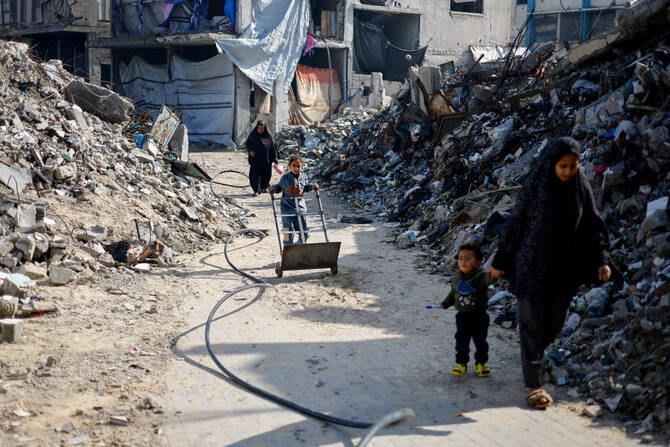
The emergence of the groups, though they remain small and localized, has added to pressures on Islamist Hamas and could complicate efforts to stabilize and unify a divided Gaza, shattered by two years of war. The groups remain unpopular among the local population, as they operate under Israeli control.
Nearly all of Gaza’s two million people live in Hamas-held areas, where the group has been reestablishing its grip and where four Hamas sources said it continues to command thousands of men despite suffering heavy blows during the war.
But Israel still holds well over half of Gaza — areas where Hamas’ foes operate beyond its reach. With President Donald Trump’s plan for Gaza moving slowly, there is no immediate prospect of further Israeli withdrawals.
Prime Minister Benjamin Netanyahu acknowledged Israeli backing for anti-Hamas groups in June, saying Israel had “activated” clans. Israel has given little detail since then.
The Popular Forces deny receiving support from Israel.


Israel-backed militia kill two Hamas operatives in Gaza
https://arab.news/jasm9
Israel-backed militia kill two Hamas operatives in Gaza

- Popular Forces said it had carried out a raid in Rafah, killing two Hamas members who refused to surrender


Historic decree seeks to end decades of marginalization of Syria’s Kurds
DAMASCUS/RIYADH: A decree issued by President Ahmad Al-Sharaa on Friday marks a historic end to decades of marginalization of Syria’s Kurdish minority and seeks to open a new chapter based on equality and full citizenship in post-liberation Syria.
The presidential action, officially known as Decree No. 13, affirms that Syrian Kurds are an integral part of the national fabric and that their cultural and linguistic identity constitutes an inseparable element of Syria’s inclusive, diverse, and unified national identity.
Al-Sharaa’s move seeks to address the consequences of outdated policies that distorted social bonds and divided citizens.
The decree for the first time grants Kurdish Syrians rights, including recognition of Kurdish identity as part of Syria’s national fabric. It designates Kurdish as a national language alongside Arabic and allows schools to teach it.
Al-Sharaa’s decree came after fierce clashes that broke out last week in the northern city of Aleppo, leaving at least 23 people dead, according to Syria’s health ministry, and forced more than 150,000 to flee the two Kurdish-run pockets of the city. The clashes ended after Kurdish fighters withdrew.
The Syrian government and the Kurdish-led Syrian Democratic Forces (SDF), that controls the country’s northeast, have engaged in months of talks last year to integrate Kurdish-run military and civilian bodies into Syrian state institutions by the end of 2025, but there has been little progress.
The end of an era of exclusion
For more than half a century, Kurds in Syria were subjected to systematic discriminatory policies, most notably following the 1962 census in Hasakah Governorate, which stripped thousands of citizens of their nationality and deprived them of their most basic civil and political rights.
These policies intensified after the now-dissolved Baath Party seized power in 1963, particularly following the 1970 coup led by criminal Hafez al-Assad, entrenching a state of legal and cultural exclusion that persisted for 54 years.
With the outbreak of the Syrian revolution in March 2011, Syrian Kurds actively participated alongside other segments of society. However, the ousted regime exploited certain separatist parties, supplying them with weapons and support in an attempt to sow discord and fragment national unity.
Following victory and liberation, the state moved to correct this course by inviting the Kurdish community to fully integrate into state institutions. This approach was reflected in the signing of the “March 10 Agreement,” which marked an initial milestone on the path toward restoring rights and building a new Syria for all its citizens.
Addressing a sensitive issue through a national approach
Decree No. 13 offers a balanced legal and political response to one of the most sensitive issues in modern Syrian history. It not only restores rights long denied, but also redefines the relationship between the state and its Kurdish citizens, transforming it from one rooted in exclusion to one based on citizenship and partnership.
The decree shifts the Kurdish issue from a framework of conflict to a constitutional and legal context that guarantees meaningful participation without undermining the unity or territorial integrity of the state. It affirms that addressing the legitimate demands of certain segments strengthens, rather than weakens, the state by fostering equal citizenship, respecting cultural diversity, and embracing participatory governance within a single, centralized state.
Core provisions that restore dignity
The decree commits the state to protecting cultural and linguistic diversity, guaranteeing Kurdish citizens the right to preserve their heritage, develop their arts, and promote their mother tongue within the framework of national sovereignty. It recognizes the Kurdish language as a national language and permits its teaching in public and private schools in areas with significant Kurdish populations, either as an elective subject or as part of cultural and educational activities.
It also abolishes all laws and exceptional measures resulting from the 1962 Hasakah census, grants Syrian nationality to citizens of Kurdish origin residing in Syria, including those previously unregistered, and guarantees full equality in rights and duties. In recognition of its national symbolism as a celebration of renewal and fraternity, the decree designates Nowruz Day (21 March) as a paid official holiday throughout the Syrian Arab Republic.
A call for unity and participation
In a speech following the issuance of the decree, President Ahmad al-Sharaa addressed the Kurdish community, urging them not to be drawn into narratives of division and calling on them to return safely to full participation in building a single homeland that embraces all its people. He emphasized that Syria’s future will be built through cooperation and solidarity, not through division or isolation.
The decree presents a pioneering national model for engaging with diversity, grounded not in narrow identities but in inclusive citizenship, justice, and coexistence. The decree lays the foundations for a unified and strong Syria that respects all its components and safeguards its unity, sovereignty, and territorial integrity.


