

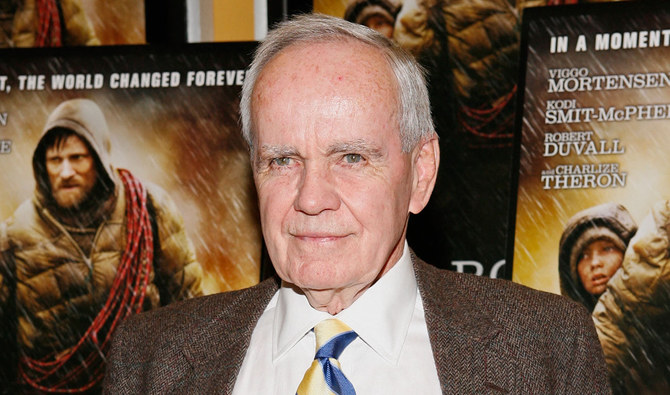
Twitter accidentally verifies fake account of novelist Cormac McCarthy

Both the author’s agent and publisher confirmed that McCarthy has never signed up for Twitter. (AFP)
Short Url
Updated 04 August 2021
Follow

Twitter accidentally verifies fake account of novelist Cormac McCarthy


LONDON: Twitter admitted on Tuesday that the platform had accidentally given a fake account for renowned author and novelist Cormac McCarthy a blue tick marking it as a “verified user.”

The account, under the misspelled name “CormacMcCrthy,” was registered in 2018 and was recently tweeting about kombucha and SoundCloud for thousands of followers on the platform.


Both the author’s agent and publisher confirmed that McCarthy has never signed up for Twitter.

A spokesperson for Twitter said: “The account referenced was verified by mistake and that has since been reversed. The account will also be required to adhere to Twitter’s parody, news feed, commentary, and fan account policy.”

This is the second time Twitter has verified a fake account supposedly belonging to McCarthy; the first time was in 2012.

The fake account of 2012 was not only verifed, but also welcomed by Twitter’s chief executive Jack Dorsey.

In order to qualify for verification, Twitter users must upload an ID to authenticate their identity or show that an official website links directly to their account.

However, the fake account “CormacMcCrthy” did neither, and Twitter verified the account anyway following a viral tweet that gained more than 122 thousand likes.

Twitter restarted its verification process in May after halting it for several years to reassess how the process works.

Verification was initially introduced to combat identity theft on the platform and has since grown to include an array of special features for those carrying a blue tick.

Features include access to additional tools for notifications, priority for algorithmic filters and moderation, and a few or no adverts on the site.

The process was paused in 2017 and restarted in May 2021, only to be paused again a week later because of a flood of requests for verification.


UK, France mull social media bans for youth as debate rages

Updated 19 January 2026
Follow

UK, France mull social media bans for youth as debate rages

  • Countries including France and Britain are considering following Australia’s lead by banning children and some teenagers from using social media

PARIS: Countries including France and Britain are considering following Australia’s lead by banning children and some teenagers from using social media, but experts are still locked in a debate over the effectiveness of the move.
Supporters of a ban warn that action needs to be taken to tackle deteriorating mental health among young people, but others say the evidence is inconclusive and want a more nuanced approach.
Australia last month became the first nation to prohibit people under-16s from using immensely popular and profitable social media platforms such as Instagram, Facebook, Tiktok and YouTube.
France is currently debating bills for a similar ban for under-15s, including one championed by President Emmanuel Macron.
The Guardian reported last week that Jonathan Haidt, an American psychologist and supporter of the Australian ban, had been asked to speak to UK government officials.
Haidt argued in his bestselling 2024 book “The Anxious Generation” that too much time looking at screens — particularly social media — was rewiring children’s brains and “causing an epidemic of mental illness.”
While influential among politicians, the book has proven controversial in academic circles.
Canadian psychologist Candice Odgers wrote in a review of the book that the “scary story” Haidt was telling was “not supported by science.”
One of the main areas of disagreement has been determining exactly how much effect using social media has on young people’s mental health.
Michael Noetel, a researcher at the University of Queensland in Australia, told AFP that “small effects across billions of users add up.”
There is “plenty of evidence” that social media does harm to teens, he said, adding that some were demanding an unrealistic level of proof.
“My read is that Haidt is more right than his harshest critics admit, and less right than his book implies,” Noetel said.
Given the potential benefit of a ban, he considered it “a bet worth making.”
After reviewing the evidence, France’s public health watchdog ANSES ruled last week that social media had numerous detrimental effects for adolescents — particularly girls — while not being the sole reason for their declining mental health.
Everything in moderation?
Noetel led research published in Psychological Bulletin last year that reviewed more than 100 studies worldwide on the links between screens and the psychological and emotional problems suffered by children and adolescents.
The findings suggested a vicious cycle.
Excessive screen time — particularly using social media and playing video games — was associated with problems. This distress then drove youngsters to look at their screens even more.
However, other researchers are wary of a blanket ban.
Ben Singh from the University of Adelaide tracked more than 100,000 young Australians over three years for a study published in JAMA Pediatrics.
The study found that the young people with the worst wellbeing were those who used social media heavily — more than two hours a day — or not at all. It was teens who used social networks moderately that fared the best.
“The findings suggest that both excessive restriction and excessive use can be problematic,” Singh told AFP.
Again, girls suffered the most from excessive use. Being entirely deprived of social media was found to be most detrimental for boys in their later teens.
’Appallingly toxic’
French psychiatrist Serge Tisseron is among those who have long warned about the huge threat that screens pose to health.
“Social media is appallingly toxic,” he told AFP.
But he feared a ban would easily be overcome by tech-savvy teens, at the same time absolving parents of responsibility.
“In recent years, the debate has become extremely polarized between an outright ban or nothing at all,” he said, calling for regulation that walks a finer line.
Another option could be to wait and see how the Australian experiment pans out.
“Within a year, we should know much more about how effective the Australian social media ban has been and whether it led to any unintended consequences,” Cambridge University researcher Amy Orben said.
Last week, Australia’s online safety watchdog said that tech companies have already blocked 4.7 million accounts for under 16s.