Saudi Aramco investors expect profit surge after strong first half

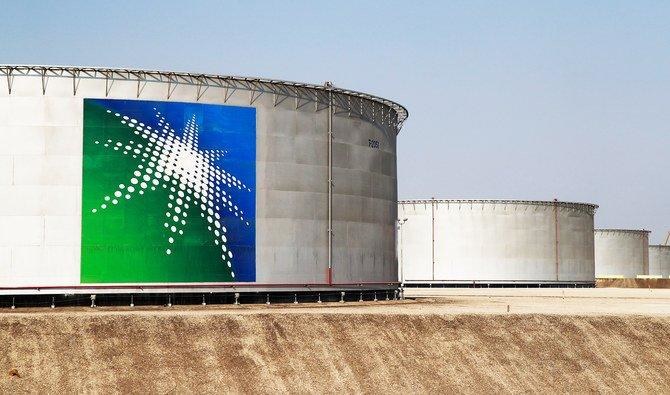
Oil tanks at a Saudi Aramco oil facility in Abqaiq. (Reuters)
Short Url
Updated 04 August 2021
Follow

Saudi Aramco investors expect profit surge after strong first half

  • Investors looking for news on size of dividend
  • JP Morgan predicts $23.7bn of net income

DUBAI: The oil reporting season will reach a climax next week with the announcement of first half results from the biggest company in the sector, Saudi Aramco.

With strong crude prices for most of the six months to June 30, and rising output as OPEC+ constraints were steadily lifted during the period, analysts are expecting a big increase in profits from the Saudi oil giant.

Analyst Christian Malek at JP Morgan is forecasting around $23.7bn of net income, a huge jump on the $6.6bn Aramco reported last year after the oil price collapsed as the COVID-19 pandemic severely hit demand.

“Against a positively trending demand/price backdrop, we expect a robust quarterly net income print from Aramco,” Malek said in a recent report to investors.

Higher oil prices, seasonally higher gas volumes, strong conditions in the petrochemical business and higher throughput from the start up of the Jazan facility will contribute to a strong first half performance, he added.

But analysts will also be looking for news on the dividend. At the time of its flotation in late 2019, Aramco promised at least $75bn per year in payouts to shareholders, but there is increasing speculation that the company might pay a higher special dividend for the first half, buoyed by strong financials. Other big oil companies like Shell, BP and Total all announced measures to boost shareholder returns in results this week.

“There is a logic to the argument for a special dividend this time round,” Malek told Arab News. “Aramco has done fantastically well consolidating fiscally. The majors in the oil sector have all been looking at ways of returning cash to shareholders, and there is no reason Aramco should be an exception.”

Other analysts agreed that there was scope for Aramco to boost its dividend.

“Aramco has had a fantastic year so far, and the results will be good,” said Ranjith Raja, head of MENA oil and shipping research at data group Refinitiv. “Other oil companies announced dividend increases or share buy-backs, so why not Aramco? They would not only be meeting the $75bn promise, but going beyond that, which would be very good for investor sentiment.”

In a program of investor and media calls after the results are announced on Sunday, analysts will ask CEO Amin Nasser about plans for further asset sales after the disposal of a stake in its pipeline business earlier this year, and for an update on the renewed talks about a link-up with Indian refining and petrochemicals group Reliance Industries.

They will also seek guidance on the progress of plans to sell another tranche of shares in Aramco, believed to be under consideration at the company.

Aramco’s finances are regarded as especially strong in a global oil sector that is just beginning to recover from the pandemic recession.

Last week, ratings agency Fitch upgraded Aramco’s status from negative to stable, explaining “Saudi Aramco’s financial profile is conservative compared with that of international integrated oil producers.”

Aramco’s Tadawul-traded shares fell 0.4 percent on Aug. 4 to SR34.95 a piece.


Saudi Arabia, Japan trade rises 38% between 2016 and 2024, minister says

Updated 11 January 2026
Follow

Saudi Arabia, Japan trade rises 38% between 2016 and 2024, minister says

RIYADH: Trade between Saudi Arabia and Japan has increased by 38 percent between 2016 and 2024 to reach SR138 billion ($36 billion), the Kingdom’s investment minister revealed.

Speaking at the Saudi-Japanese Ministerial Investment Forum 2026, Khalid Al-Falih explained that this makes the Asian country the Kingdom’s third-largest trading partner, according to Asharq Bloomberg.

This falls in line with the fact that Saudi Arabia has been a very important country for Japan from the viewpoint of its energy security, having been a stable supplier of crude oil for many years.

It also aligns well with how Japan is fully committed to supporting Vision 2030 by sharing its knowledge and advanced technologies.

“This trade is dominated by the Kingdom's exports of energy products, specifically oil, gas, and their derivatives. We certainly look forward to the Saudi private sector increasing trade with Japan, particularly in high-tech Japanese products,” Al-Falih said.

He added: “As for investment, Japanese investment in the Kingdom is good and strong, but we look forward to raising the level of Japanese investments in the Kingdom. Today, the Kingdom offers promising opportunities for Japanese companies in several fields, including the traditional sector that links the two economies: energy.”

The minister went on to note that additional sectors that both countries can also collaborate in include green and blue hydrogen, investments in advanced industries, health, food security, innovation, entrepreneurship, among others.

During his speech, Al-Falih shed light on how the Kingdom’s pavilion at Expo 2025 in Osaka achieved remarkable success, with the exhibition receiving more than 3 million visitors, reflecting the Japanese public’s interest in Saudi Arabia.

“The pavilion also organized approximately 700 new business events, several each day, including 88 major investment events led by the Ministry of Investment. Today, as we prepare for the upcoming Expo 2030, we look forward to building upon Japan’s achievements,” he said.

The minister added: “During our visit to Japan, we agreed to establish a partnership to transfer the remarkable Japanese experience from Expo Osaka 2025 to Expo Riyadh 2030. I am certain that the Japanese pavilion at Expo Riyadh will rival the Saudi pavilion at Expo Osaka in terms of organization, innovation, and visitor turnout.”

Al-Falih also shed light on how Saudi-Japanese relations celebrated their 70th anniversary last year, and today marks the 71st year of these relations as well as how they have flourished over the decades, moving from one strategic level to an even higher one.