

UN hails reopening of Libya coastal road as historical achievement

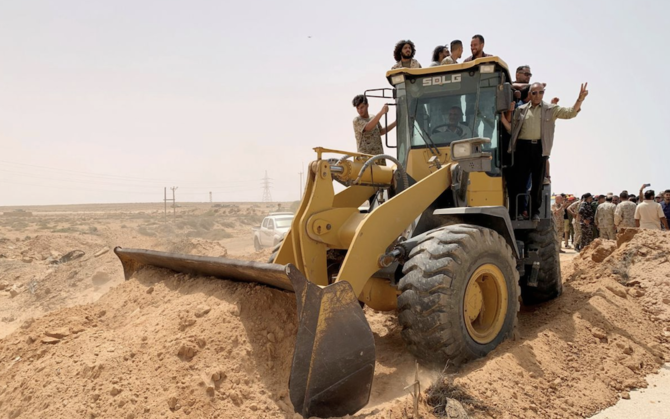
Libyan security officers stand on a truck during the re-opening of the cross road across the frozen frontline between east and west in Libya. (Reuters/File Photo)
Short Url
Updated 30 July 2021
Follow

UN hails reopening of Libya coastal road as historical achievement

  • Road linking the country’s long-divided east and west reopens after the UN demanded the safe passage of civilians and goods
  • Highway had been closed since April 2019 when eastern commander Khalifa Hifter launched a military campaign to capture Tripoli 

NEW YORK: After nearly two years of closure, the UN Support Mission in Libya (UNSMIL) on Friday welcomed the official reopening of the coastal road linking Libya’s long-divided east and west.

Calling it a landmark and historical achievement, Jan Kubis, the UN Secretary-General’s special envoy for Libya said, “the opening of the coastal road is a critical step to further the implementation of the cease-fire agreement of Oct. 23, 2020. Equally important, it will allow the free movement of commerce, humanitarian support, and the people of Libya.”

The highway had been closed since April 2019 when eastern commander Khalifa Hifter launched a military campaign to capture the capital of Tripoli from the then Government of National Accord.

Hifter endorsed the reopening of the road along the Mediterranean where a potential resumption of traffic is seen as a crucial step toward peace between the warring parties. 

The highway reopening was an “addition to other significant confidence-building measures achieved thus far, such as the resumption of flights and the exchange of detainees,” Kubis said.

He thanked Libyan Prime Minister Abdulhamid Dbeiba for the release of salaries for the security forces. Kubis also hailed the role of the 5+5 Joint Military Commission (JMC), the presidency council, and the Government of National Unity for the achievement. 

“It is another step in strengthening peace, security, and stability in the country, and in the unification of its institutions,” Kubis said. 

The special envoy called on Libyan leaders to follow the “exemplary work of the 5+5 JMC” and “set aside their differences and work together to implement the roadmap and hold elections on Dec. 24.”

The highway was reopened following the 11th meeting of the JMC in Sirte.

“The next major step in the ceasefire agreement’s implementation process is to commence the withdrawal of all mercenaries, foreign fighters, and forces from Libya without delay,” Kubis said.

The JMC called on the UNSMIL to convene a meeting with international stakeholders to discuss a plan for the withdrawal. 

The JMC also requested that the deployment of UN ceasefire monitors be expedited. 

The warring parties signed a UN-sponsored cease-fire agreement that ended the fighting in October 2020.


UN: Sudan war civilian death toll more than doubled in 2025

Updated 3 sec ago
Follow

UN: Sudan war civilian death toll more than doubled in 2025

  • Rights chief Volker Turk says RSF paramilitaries inflicted "carnage” in attacks last year on Zamzam campand El-Fasher in Darfur
  • Recent drone attacks in Kordofan region and elsewhere have 'killed or injured nearly 600 civilians'
GENEVA: Killings of civilians in Sudan’s war more than doubled in 2025 compared with the previous year, the United Nations rights chief said Thursday, warning that thousands more dead are unidentified or remain missing.
Since April 2023, Sudan has been engulfed in a conflict between the army and the Rapid Support Forces (RSF) that has killed tens of thousands, displaced 11 million people and triggered one of the world’s worst humanitarian crises.
“This war is ugly. It’s bloody and it’s senseless,” Volker Turk told the UN Human Rights Council, blaming both warring sides, which have so far rejected any form of humanitarian truce. He also blamed foreign sponsors funding what he called a “high-tech” conflict.
“In 2025, my office’s documentation points to an over two and a half times increase in killings of civilians compared with the previous year. Many thousands are still missing or unidentified,” Turk said.
There have been no official figures on the overall death toll in the conflict.
Turk condemned what he called the “heinous and ruthless” brutalities committed, including sexual violence, summary executions and arbitrary detentions.
He highlighted “carnage” inflicted by the RSF during an attack on the Zamzam displacement camp in April, and again in October in El-Fasher, which was the army’s last foothold in western Darfur.
Sexual violence, including rape, gang rape, sexual torture and slavery, has also surged, Turk said, with more than 500 victims documented in 2025. “The bodies of Sudanese women and girls have been weaponized to terrorize communities.”
He added that he is “extremely worried these crimes may be repeated.”

- ‘Madness’ -

Since the fall of El-Fasher, the fighting has moved deeper into neighboring Kordofan where drone strikes have killed dozens at a time.
Since January, escalating drone attacks in the southern Kordofan region and beyond have “killed or injured nearly 600 civilians,” Turk said, including in attacks on humanitarian aid convoys.
The UN’s resident and humanitarian coordinator for Sudan, Denise Brown, said on Thursday that access to the cities of Kadugli and Dilling in South Kordofan — long cut off by an RSF siege until the army recently lifted it — had been effectively impossible.
“We were not able to get supplies in. We had to remove our staff for their own safety,” she said, after stepping off the first UN flight to Khartoum since the war began on Thursday.
Famine was declared last November in the North Darfur capital El-Fasher and in Kadugli, the capital of South Kordofan, according to a UN-backed assessment. The same assessment said Dilling in South Kordofan is also likely facing famine conditions.
Turk said both the army and the RSF continued to use “explosive weapons in densely populated areas, often without warning — showing utter disregard for human life.”
Turk highlighted the “increased use of advanced long-range drones,” which has “expanded harm to civilians in areas far from the front lines that were previously peaceful.”
Turk also voiced concern over “the growing militarization of society,” including the recruitment of children and young people into the fighting.