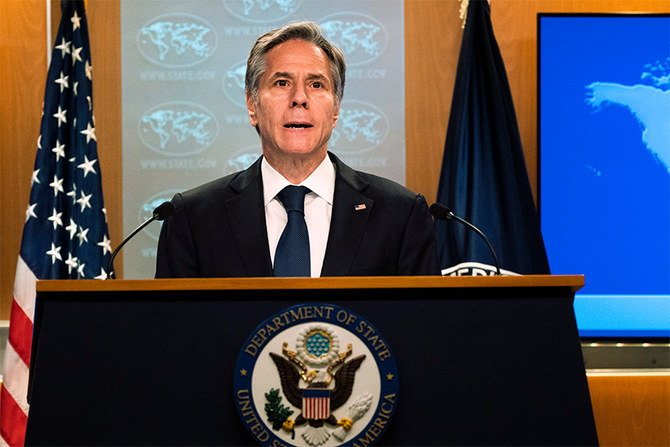
ISLAMABAD: US Secretary of State Antony Blinken said on Thursday Pakistan had a “vital role” to play in influencing the Taliban and ensuring the insurgent group did not take over Afghanistan by force.
In his first visit to India since joining US President Joe Biden’s administration, Blinken met his Indian counterpart, Foreign Minister Subrahmanyam Jaishankar, and other officials on Wednesday before calling on Prime Minister Narendra Modi.
His remarks about Pakistan come amid a key visit to Washington by Pakistan’s National Security Adviser Dr. Moeed Yusuf and the Director General of Inter-Services Intelligence, Lt. Gen. Faiz Hameed.
“Pakistan has a vital role to play in using its influence with the Taliban to do whatever it can to make sure that the Taliban does not seek to take the country by force,” the US secretary of state told the Times of India channel. “And it does have influence, and it does have a role to play, and we hope that it plays it,” he added.
In an interview with ABC News, Blinken said the entire world was hearing “deeply, deeply troubling” reports of atrocities in Afghanistan, which “certainly do not speak well of the Taliban’s intentions for the country as a whole.”
In an interview to Al Jazeera, Blinken said an Afghanistan that “does not respect the basic gains of the last 20 years, that Afghanistan will be a pariah in the international community.”
The interviews, released by the secretary’s office in Washington, reflect growing US concern that the Taliban were determined to take Kabul by force instead of coming in through a political settlement and a government that included all Afghan factions.
As the United States prepares to formally end its 20-year military mission in Afghanistan on August 31, Taliban insurgents are quickly seizing territory once controlled by the US-backed government of President Ashraf Ghani, raising fears they could eventually try to take the capital Kabul.
On Thursday, in a meeting with Afghan journalists, Prime Minister Imran Khan said Pakistan was neither “responsible” for the actions of the Afghan Taliban, nor a spokesperson for the group.
“What the Taliban are doing or are not doing has nothing to do with us and we are not responsible, neither are we the spokesperson of the Taliban,” Khan was quoted by Pakistan’s Express Tribune newspaper as saying.
He said a “military solution” in Afghanistan had been a “flawed strategy” of the United States, asking what the US could achieve from operating bases out of Pakistan which it could not achieve by operating in Afghanistan for two decades.
“It was a flawed strategy. They should have talked to the Taliban from a position of strength when there were 150,000 NATO soldiers present in Afghanistan. There is no reason for the US to operate from Pakistan,” Khan said, reiterating that Pakistan would not get dragged into more conflict in Afghanistan.


![]()

Pakistan has ‘vital role’ in ensuring Taliban don’t take Afghanistan by force — Blinken
Short Url
https://arab.news/v2qxe
Pakistan has ‘vital role’ in ensuring Taliban don’t take Afghanistan by force — Blinken
- US secretary of state’s remarks come amid key visit to Washington by Pakistani national security adviser and spy chief
- Reflect growing US concern that Taliban determined to take Kabul by force and rejecting a political settlement
Latest updates


© 2026 SAUDI RESEARCH & PUBLISHING COMPANY, All Rights Reserved And subject to Terms of Use Agreement.