Deadly floods, landslides hit Rohingya refugee camps in Bangladesh

1 / 4
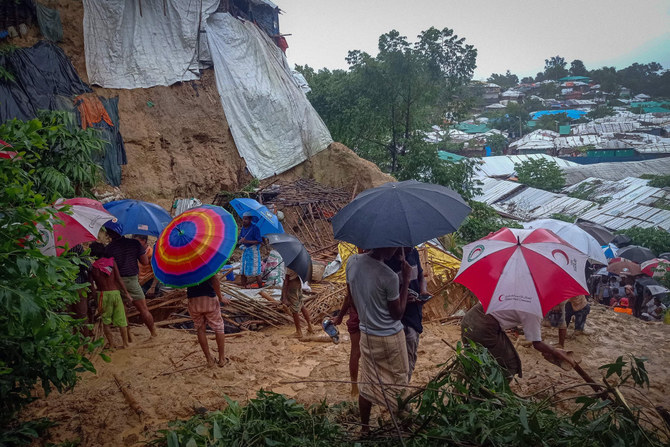
Rohingya refugees try to salvage their belongings at the Balukhali camp in Cox’s Bazar, Bangladesh, where their makeshift homes have been flooded or destroyed by landslides. (Photo courtesy: Mohammad Kasem)
2 / 4
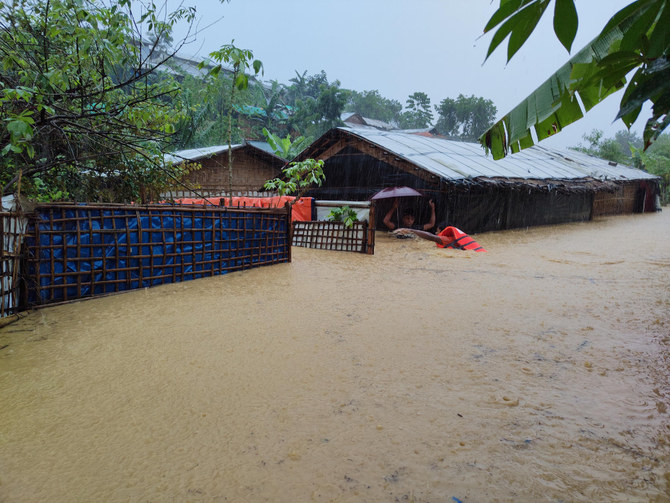
Days of torrential rain have left the Balukhali camp for Rohingya refugees in Cox’s Bazar, Bangladesh, flooded. (Photo courtesy: Mohammad Kasem)
3 / 4
Rohingya refugees work amid the debris of houses damaged by landslides and flash floods in Balukhali camp on July 27, 2021.(Photo by Tanbir Miraj / AFP)
4 / 4
General view of a flooded area following heavy monsoon rains at Cox's Bazar, Bangladesh, on July 27, 2021. (Arakan Times/via REUTERS)
Short Url
Updated 30 July 2021
Follow

Deadly floods, landslides hit Rohingya refugee camps in Bangladesh

  • More than 2,000 families were evacuated from the hilly slopes of the Balukhali camp in Cox’s Bazar
  • Met office expert warns that the extreme weather-related incidents could continue for several days

DHAKA: Bangladeshi authorities have evacuated nearly 10,000 Rohingya refugees from makeshift settlements in the Cox’s Bazar district, after at least six were killed by landslides and flash floods in the past four days, officials said on Thursday.

Cox’s Bazar, where more than 1 million Rohingya refugees live in 34 camps, is one of the most disaster-prone parts of Bangladesh. After days of torrential rain the refugees were moved from the cramped Balukhali camp, where many makeshift homes have been built on hilly slopes prone to landslides and mudslides.

“About 8,000 to 10,000 people from 2,000 families were relocated from their tents,” Refugee Relief and Repatriation Commissioner (RRRC) Shah Rezwan Hayat told Arab News.

According to commission, six refugees were killed when the worst landslide hit the camp on Tuesday.

“Our prime focus at this moment is to save the people’s lives,” Shamsuddouza Nayan, additional commissioner for refugees, relief and repatriation, told Arab News. “We are continuously monitoring the situation on ground. Thousands of Rohingyas who are vulnerable have been relocated to nearby learning centers and other safe places.”

While he expressed hope the situation would not worsen, as floodwater levels have started to fall, he added: “Everything depends on weather, which is unpredictable.”

Bangladesh Meteorological Department director Shamsuddin Ahmed was less optimistic, warning that extreme weather-related incidents could continue for several days. Intense rainfall, floods and landslides are an annual problem in the area due to its monsoon climate and its location on the Bay of Bengal.

“There is a clear low pressure on the Bay of Bengal, which is causing this adverse weather, and there are possibilities of heavy rainfall due to this monsoon low,” he said. “Some of the areas may go under water due to flash floods, and in some hilly regions there might be incidents of landslides.”

Some refugees said they had lost everything in the landslides.

“I lost all of my belongings as my tent went under the piles of mud,” Abdur Rahman, a father of three, told Arab News. “We could only save our lives from the devastating landslide.

“Now I have to start from zero with empty hands. I have no idea how I will manage the utensils and other household materials.”

Bibi Hajera said the extreme weather has heightened suffering of the refugees who were already struggling with the effects of the coronavirus pandemic and strict lockdowns.

“My five-year-old son, Mohammad Solaiman, has got a cold and fever,” she said. “Our six-member family has been evacuated to a learning center along with some other families. Now I am waiting for a doctor to get medicine for my son.”

Most of the Rohingya refugees in Bangladesh fled Rakhine state in Myanmar after a military crackdown in 2017 that the UN has said might amount to genocide.


Bangladesh readies for polls, worry among Hasina supporters

Updated 6 sec ago
Follow

Bangladesh readies for polls, worry among Hasina supporters

  • The Muslim-majority nation of 170 million people will hold elections on February 12, its first since the uprising
  • Hasina was sentenced to death for crimes against humanity in Nov. and her former ruling party has been outlawed

Gopalganj: Bangladesh is preparing for the first election since the overthrow of Sheikh Hasina, but supporters of her banned Awami League (AL) are struggling to decide whether to shift their allegiance.

In Gopalganj, south of the capital Dhaka and a strong bastion of Hasina’s iron-grip rule, residents are grappling with an election without the party that shaped their political lives for decades.

“Sheikh Hasina may have done wrong — she and her friends and allies — but what did the millions of Awami League supporters do?” said tricycle delivery driver Mohammad Shahjahan Fakir, 68, adding that he would not vote.

“Why won’t the ‘boat’ symbol be there on the ballot paper?” he said, referring to AL’s former election icon.

The Muslim-majority nation of 170 million people will hold elections on February 12, its first since the uprising.

Hasina, who crushed opposition parties during her rule, won landslide victories in Gopalganj in every election since 1991.

After a failed attempt to cling to power and a brutal crackdown on protesters, she was ousted as prime minister in August 2024 and fled to India.

She was sentenced to death in absentia for crimes against humanity by a court in Dhaka in November, and her former ruling party, once the country’s most popular, has been outlawed.

Human Rights Watch has condemned the AL ban as “draconian.”

“There’s so much confusion right now,” said Mohammad Shafayet Biswas, 46, a banana and betel leaf seller in Gopalganj.

“A couple of candidates are running from this constituency — I don’t even know who they are.”

As a crowd gathered in the district, one man shouted: “Who is going to the polling centers? We don’t even have our candidates this time.”

‘DEHUMANISE’

Hasina’s father, Sheikh Mujibur Rahman, the founding president of Bangladesh, hailed from Gopalganj and is buried in the town.

Statues of Rahman have been torn down nationwide, but in Gopalganj, murals and statues are well-maintained.

Since Hasina’s downfall, clashes have broken out during campaigning by other parties, including one between police and AL supporters in July 2025, after which authorities filed more than 8,000 cases against residents.

Sazzad Siddiqui, a professor at Dhaka University, believes voter turnout in Gopalganj could be the lowest in the country.

“Many people here are still in denial that Sheikh Hasina did something very wrong,” said Siddiqui, who sat on a government commission formed after the 2025 unrest.

“At the same time, the government has constantly tried to dehumanize them.”

This time, frontrunners include candidates from the Bangladesh Nationalist Party (BNP) and Jamaat-e-Islami, the country’s largest religious party.

Both are from Hasina’s arch-rivals, now eyeing power.

“I am going door to door,” BNP candidate S.M Zilany, 57, told AFP, saying many would-be voters had never had a candidate canvass for their backing.

“I promise them I will stand by them.”

Zilany said he had run twice against Hasina — and was struck down by 34 legal cases he claimed had been politically motivated.

This time, he said that there was “a campaign to discourage voters from turning up.”

Jamaat candidate M.M Rezaul Karim, 53, said that under Hasina, the party had been driven underground.

“People want a change in leadership,” Karim told AFP, saying he was open to all voters, whatever their previous loyalties.

“We believe in coexistence; those involved in crimes should be punished; others must be spared,” Karim said.

Those once loyal to Hasina appear disillusioned. Some say they had abandoned the AL, but remain unsure whom to support.

“I am not going to vote,” said one woman, who asked not to be named.

“Who should I vote for except Hasina? She is like a sister.”