Deadly floods, landslides hit Rohingya refugee camps in Bangladesh

1 / 4
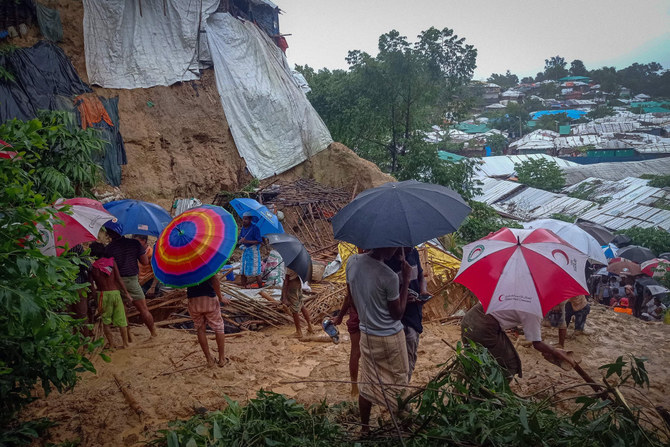
Rohingya refugees try to salvage their belongings at the Balukhali camp in Cox’s Bazar, Bangladesh, where their makeshift homes have been flooded or destroyed by landslides. (Photo courtesy: Mohammad Kasem)
2 / 4
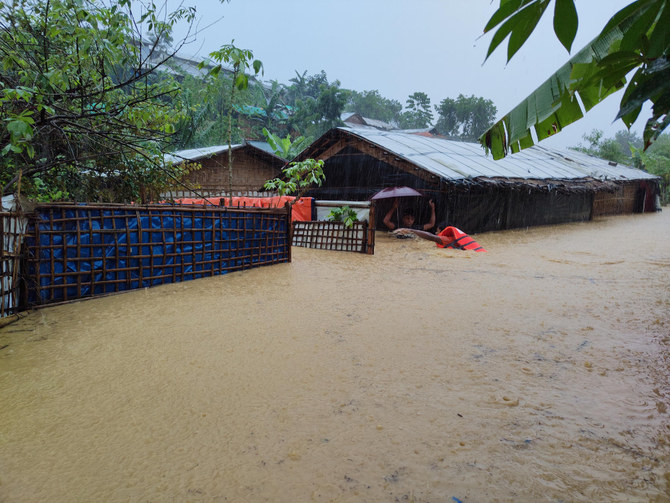
Days of torrential rain have left the Balukhali camp for Rohingya refugees in Cox’s Bazar, Bangladesh, flooded. (Photo courtesy: Mohammad Kasem)
3 / 4
Rohingya refugees work amid the debris of houses damaged by landslides and flash floods in Balukhali camp on July 27, 2021.(Photo by Tanbir Miraj / AFP)
4 / 4
General view of a flooded area following heavy monsoon rains at Cox's Bazar, Bangladesh, on July 27, 2021. (Arakan Times/via REUTERS)
Short Url
Updated 30 July 2021
Follow

Deadly floods, landslides hit Rohingya refugee camps in Bangladesh

  • More than 2,000 families were evacuated from the hilly slopes of the Balukhali camp in Cox’s Bazar
  • Met office expert warns that the extreme weather-related incidents could continue for several days

DHAKA: Bangladeshi authorities have evacuated nearly 10,000 Rohingya refugees from makeshift settlements in the Cox’s Bazar district, after at least six were killed by landslides and flash floods in the past four days, officials said on Thursday.

Cox’s Bazar, where more than 1 million Rohingya refugees live in 34 camps, is one of the most disaster-prone parts of Bangladesh. After days of torrential rain the refugees were moved from the cramped Balukhali camp, where many makeshift homes have been built on hilly slopes prone to landslides and mudslides.

“About 8,000 to 10,000 people from 2,000 families were relocated from their tents,” Refugee Relief and Repatriation Commissioner (RRRC) Shah Rezwan Hayat told Arab News.

According to commission, six refugees were killed when the worst landslide hit the camp on Tuesday.

“Our prime focus at this moment is to save the people’s lives,” Shamsuddouza Nayan, additional commissioner for refugees, relief and repatriation, told Arab News. “We are continuously monitoring the situation on ground. Thousands of Rohingyas who are vulnerable have been relocated to nearby learning centers and other safe places.”

While he expressed hope the situation would not worsen, as floodwater levels have started to fall, he added: “Everything depends on weather, which is unpredictable.”

Bangladesh Meteorological Department director Shamsuddin Ahmed was less optimistic, warning that extreme weather-related incidents could continue for several days. Intense rainfall, floods and landslides are an annual problem in the area due to its monsoon climate and its location on the Bay of Bengal.

“There is a clear low pressure on the Bay of Bengal, which is causing this adverse weather, and there are possibilities of heavy rainfall due to this monsoon low,” he said. “Some of the areas may go under water due to flash floods, and in some hilly regions there might be incidents of landslides.”

Some refugees said they had lost everything in the landslides.

“I lost all of my belongings as my tent went under the piles of mud,” Abdur Rahman, a father of three, told Arab News. “We could only save our lives from the devastating landslide.

“Now I have to start from zero with empty hands. I have no idea how I will manage the utensils and other household materials.”

Bibi Hajera said the extreme weather has heightened suffering of the refugees who were already struggling with the effects of the coronavirus pandemic and strict lockdowns.

“My five-year-old son, Mohammad Solaiman, has got a cold and fever,” she said. “Our six-member family has been evacuated to a learning center along with some other families. Now I am waiting for a doctor to get medicine for my son.”

Most of the Rohingya refugees in Bangladesh fled Rakhine state in Myanmar after a military crackdown in 2017 that the UN has said might amount to genocide.


2025 among world’s three hottest years on record, WMO says

Updated 14 January 2026
Follow

2025 among world’s three hottest years on record, WMO says

  • All eight datasets confirmed that the last three years were the planet’s three hottest since records began, the WMO said
  • The slight differences in the datasets’ rankings reflect their different methodologies and types of measurements

BRUSSELS: Last year was among the planet’s three warmest on record, the World Meteorological Organization said on Wednesday, as EU scientists also confirmed average temperatures have now exceeded 1.5 degrees Celsius of global warming for the longest since records began.
The WMO, which consolidates eight climate datasets from around the world, said six of them — including the European Union’s European Center for Medium-Range Weather Forecasts (ECMWF) and the British national weather service — had ranked 2025 as the third warmest, while two placed it as the second warmest in the 176-year record.
All eight datasets confirmed that the last three years were the planet’s three hottest since records began, the WMO said. The warmest year on record was 2024.

THREE-YEAR PERIOD ABOVE 1.5 C AVERAGE ⁠WARMING LEVEL
The slight differences in the datasets’ rankings reflect their different methodologies and types of measurements — which include satellite data and readings from weather stations.
ECMWF said 2025 also rounded out the first three-year period in which the average global temperature was 1.5 C above the pre-industrial era — the limit beyond which scientists expect global warming will unleash severe impacts, some of them irreversible.
“1.5 C is not a cliff edge. However, we know that every fraction of a degree matters, particularly for worsening extreme weather events,” said Samantha Burgess, strategic ⁠lead for climate at ECMWF.
Burgess said she expected 2026 to be among the planet’s five warmest years.

CHOICE OF HOW TO MANAGE TEMPERATURE OVERSHOOT
Governments pledged under the 2015 Paris Agreement to try to avoid exceeding 1.5 C of global warming, measured as a decades-long average temperature compared with pre-industrial temperatures.
But their failure to reduce greenhouse gas emissions means that target could now be breached before 2030 — a decade earlier than had been predicted when the Paris accord was signed in 2015, ECMWF said. “We are bound to pass it,” said Carlo Buontempo, director of the EU’s Copernicus Climate Change Service. “The choice we now have is how to best manage the inevitable overshoot and its consequences on societies and natural systems.”
Currently, the world’s long-term warming level is about 1.4 C above the pre-industrial era, ECMWF said. Measured on a short-term ⁠basis, average annual temperatures breached 1.5 C for the first time in 2024.

EXTREME WEATHER
Exceeding the long-term 1.5 C limit would lead to more extreme and widespread impacts, including hotter and longer heatwaves, and more powerful storms and floods. Already in 2025, wildfires in Europe produced the highest total emissions on record, while scientific studies confirmed specific weather events were made worse by climate change, including Hurricane Melissa in the Caribbean and monsoon rains in Pakistan which killed more than 1,000 people in floods.
Despite these worsening impacts, climate science is facing political pushback. US President Donald Trump, who has called climate change “the greatest con job,” last week withdrew from dozens of UN entities including the scientific Intergovernmental Panel on Climate Change.
The long-established consensus among the world’s scientists is that climate change is real, mostly caused by humans, and getting worse. Its main cause is greenhouse gas emissions from burning fossil fuels like coal, oil and gas, which trap heat in the atmosphere.