Saudi U-23 football team ends disappointing Tokyo 2020 with a loss to reigning champions Brazil

1 / 2
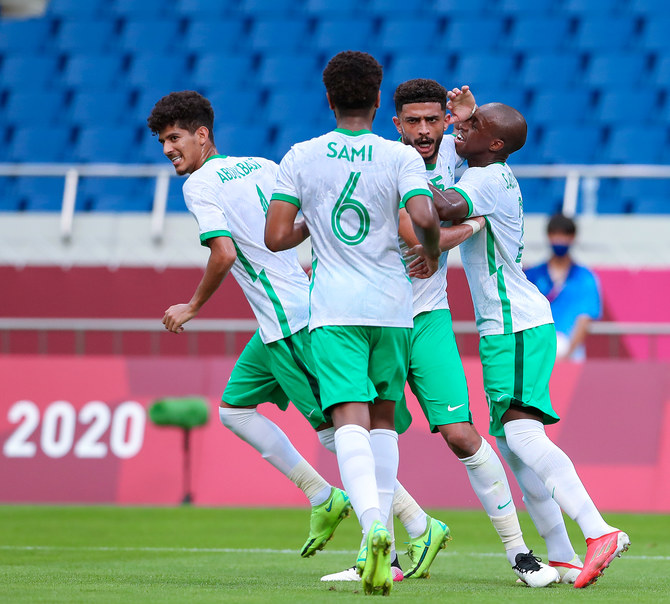
Saudi players celebrate Abdulelah Al-Amri’s equalizer against Brazil. (SAOC)
2 / 2
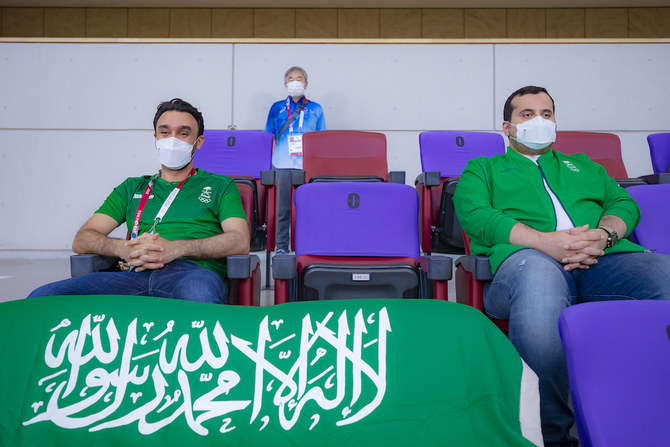
Prince Abdulaziz Bin Turki Al-Faisal, left, President of the Saudi Arabian Olympic Committee, watches the Saudi team against Brazil at Saitama Stadium. (SAOC)
Short Url
Updated 28 July 2021
Follow

Saudi U-23 football team ends disappointing Tokyo 2020 with a loss to reigning champions Brazil

  • Despite playing well in all three of their matches, the Young Falcons failed to win a single point at the Olympics

Saudi Arabia’s U-23 team bowed out of the Olympic football completion after losing 3-1 to Rio 2016 champions Brazil at Saitama Stadium on Wednesday afternoon.

The Saudis put in another commendable performance but defensive mistakes cost them the chance of claiming a single point from the three Group D clashes.

The match was watched by the President of the Saudi Arabian Olympic Committee (SAOC), Prince Abdulaziz Bin Turki Al-Faisal.

Having lost its first two group matches against Ivory Coast (2-1) and Germany (3-2), Saudi Arabia came into this fixture with nothing to play for except pride, while Brazil needed to avoid defeat to confirm progress to the quarterfinals.

Coach Saad Al-Shehri sent out a team that seemed focused on defending, but it took Brazil only 14 minutes to take the lead when Matheus Cunha headed past Amin Al-Bukhairi, the Saudi goalkeeper, who only managed to get a hand to the ball in his first start at Tokyo 2020.

On 20 minutes Brazil almost doubled its lead when Antony Santos headed against the bar from a precise Diego Carlos cross, and the pressure was maintained for several minutes as the Saudis struggled to hold the champions off.

The Young Falcons were getting plenty of possession of their own but were not able to threaten Brazil.

They finally scored the equalizer on 27 minutes when Salman Al-Faraj’s curling freekick was headed firmly by Abdulelah Al-Amri past Santos in the Brazil goal.

As against Germany in the second match, the Saudis were not awed by their more celebrated opponents and the goal gave them even more confidence to attack.

With three minutes left of the first half Cunha’s cross was almost turned in from close range by Antony but Al-Bukhairi saved superbly, injuring himself as the Brazilian attacker seemed to unintentionally step on his hand.

The early stages of the second half saw few chances at either end. Brazil should have taken the lead on 65 minutes after Richarlison’s shot was saved by Al-Bukhairi and Cunha struck the rebound against the post when it would have been easier to score.

Ten minutes later Brazil retook the lead after a Dani Alves freekick was cleared by the Saudi defence, but only to Bruno Guimaraes. He headed the ball back across the penalty area for Richarlison to finish with clinical header for this fourth goal of the tournament.

In the last seconds of normal time Richarlison scored again but the goal was ruled out for offside.

With seven minutes added on, there was still time for Richarlison to tap in Reinier’s cross for Brazil’s third in the 93rd minute.

Their win put Brazil at the top of Group D with seven points and they now progress to the quarterfinals, along with Ivory Coast. They managed a 1-1 draw with Germany, who depart Tokyo with Saudi Arabia.


Spain will host 2030 World Cup final, says RFEF president

Updated 28 January 2026
Follow

Spain will host 2030 World Cup final, says RFEF president

  • Louzan did not say whether the match would be played at Santiago Bernabeu or Camp Nou
  • Once completed in late 2028, the new stadium in Morocco is expected to hold 115,000 spectators

MADRID: Spanish Football Federation (RFEF) President Rafael Louzan has said that Spain will stage the final of the 2030 World Cup, which will be co-hosted by Spain, Portugal and Morocco.
Morocco wants to stage the game in Casablanca at the Grand Stade Hassan II, a huge stadium currently under construction north of the city.
“Spain has proven its organizational capacity over many years. It will be the leader of the 2030 World Cup and the final of that World Cup will be held here,” Louzan said late on Monday ⁠at an event organized by the Madrid Sports Press Association.
Louzan did not say whether the match would be played at Madrid’s Santiago Bernabeu or Barcelona’s Camp Nou, the two leading candidates.
Once completed in late 2028, the new stadium in Morocco is expected to hold 115,000 spectators. Morocco’s Royal Football Federation (FRMF) ⁠President Faouzi Lekjaa last year expressed his wish to see a final against Spain in Casablanca.
Louzan also alluded to the challenges Morocco faced during its hosting of the last Africa Cup of Nations, including the chaotic scenes during the final between Senegal and Morocco this month.
That match, which Senegal won 1-0, was overshadowed by fan disruptions and player protests that temporarily halted play.
“Morocco is really undergoing a transformation in every sense, with magnificent stadiums,” Louzan said. “We must ⁠recognize what has been done well. But in the Africa Cup of Nations, we have seen scenes that damage the image of world football.”
FIFA and the Portuguese and Moroccan football federations have not responded to requests for comment on the final’s location.
FIFA told Reuters last year it was premature to decide the venue for the 2030 final, saying the host city for the 2026 World Cup final was revealed only two years before the tournament. World soccer’s ruling body has the final say on where the match will be played.