

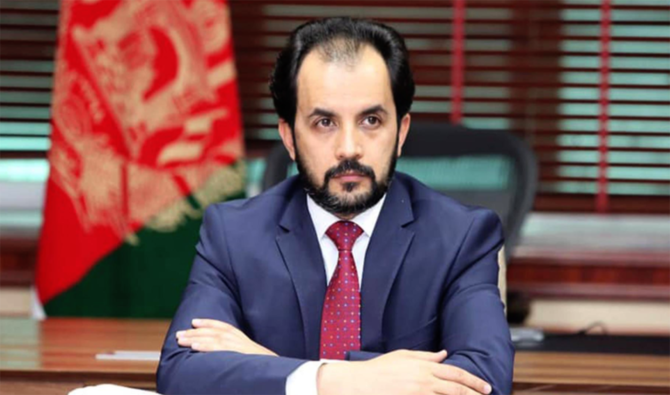

KABUL: The escalation of violence in Afghanistan has led to the spread of the coronavirus and severely hampered the government’s drive against the pandemic, according to the country’s public health minister.
This will have a long-term impact on Afghanistan, Wahid Majrooh told Arab News in an interview on Sunday.
“War affects all aspects of life, and service delivery and vaccination of COVID-19 cannot be an exception, especially when there is ongoing conflict when the health facilities happen to be caught in the middle of the battlefield,” Majrooh said.
“When people are displaced and their life priorities change, these all affect our vaccination program in different parts of the country, our healthcare service delivery; it has a very detrimental effect. It will have short and long-term impacts and consequences.”
Fighting between the Taliban and the Afghan government has intensified in the past two months after international troops pulled out of the country. Militant groups since then have made rapid gains, capturing government territories in rural areas and taking over main border crossings with Afghanistan’s neighbors.
According to a UN report released on Monday, more than 783 civilians were killed and 1,609 injured during May and June this year, a 47 percent increase compared with the same period in 2020.
Estimates by various government institutions calculate that more than 40,000 families have been displaced by the fighting between the Taliban and Afghan forces since May when US-led troops began withdrawing their remaining forces from Afghanistan.
The total number of displaced people due to battles in recent years stands at 3 million, officials say.
Majrooh could not provide an exact figure of how many people had been deprived of COVID-19 vaccinations but thought several million may have been affected.
“War has caused the concentration of people in small spaces like tents. Displaced people do not have the facility to use masks, do not have access to sanitation facilities. There is no doubt that the displacement and war have affected the spread and growth of COVID-19,” he said. The Taliban and Afghan government agreed during their talks in Qatar last week to allow safe access to vaccines for people across the country and to ensure the safety of medical workers.
Health Ministry figures as of Sunday showed that 144,285 Afghans have been infected by the coronavirus and 6,477 had died. However, officials said that the actual numbers for both could be higher as almost all Afghans quickly bury their dead without knowing the cause of death, and possibly thousands of COVID-19 affected patients may have died without reaching health facilities.
Majrooh said that the ministry’s data showed that Afghanistan had lately passed through the peak of UK and delta types of the virus and the trend was declining.
However, he added there were fears of another spike “given the lack of attention of people to public health measures we have proposed to the society.”
He said that authorities on Sunday had begun the gradual lifting of a two-month lockdown, mostly applied to schools, universities, wedding halls and swimming pools.
The minister warned that the curb would be reimposed as officials detected that the virus was spreading in an impoverished society where many, particularly in rural and war-affected regions, have less access to health services.
Majrooh thanked the world for offering “generous” support in cash, technical and health equipment and vaccines to foreign-aid reliant Afghanistan, which has been affected by a long drought and continual fighting.
However, he said that “COVAX failed to fulfill its commitment” of sending the millions of jabs the country was promised this year, adding they would be delivered in 2022.
“We are planning to vaccinate about 60 percent of our population. If it is a single dose, we need 24 million, if it is a double dose, we need 48 million doses,” he said.
So far Afghanistan has received more than four and half millions of doses of vaccine, 3.3 million of them (Johnson and Johnson) provided by the US, ministry officials told Arab News.
Majrooh warned that the escalation of war would severely impact Afghanistan and outlined the issues the country faced. “The context is deteriorating war, and inaccessibility issues of logistics in insecure provinces are huge challenges for the health sector. The health sector is overburdened with mass casualties caused by the ongoing conflict.”
Other challenges included people not following health recommendations, budgetary shortages and lack of oxygen, he said.


