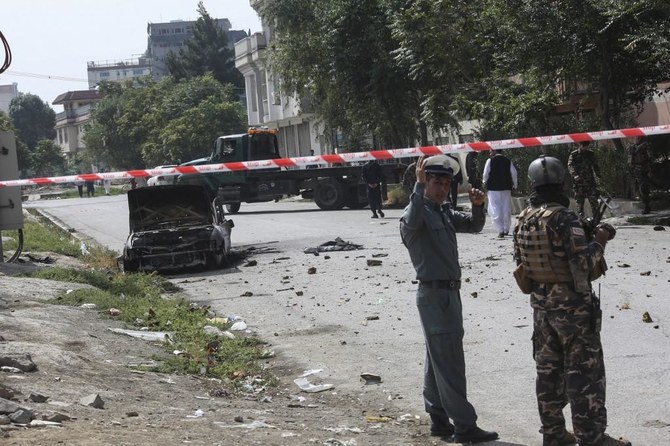
KABUL: Nearly 2,400 Afghan civilians were killed or injured in May and June as fighting between Taliban insurgents and Afghan security forces escalated, the highest number for those two months since records started in 2009, the United Nations said on Monday.
The UN’s Assistance Mission to Afghanistan (UNAMA) said in a report it had documented 5,183 civilian casualties between January and June, of which 1,659 were deaths. The number was up 47 percent from the same period last year.
The figures underscored the dire situation for Afghan civilians as intense fighting picked up in May and June after US President Joe Biden announced American troops would withdraw by September, bringing an end to 20 years of foreign military presence in the country.
“Of serious concern is the acute rise in the number of civilians killed and injured in the period from 1 May, with almost as many civilian casualties in the May-June period as recorded in the entire preceding four months,” UNAMA said in a statement.
Heavy clashes around the country have taken place in the past two months as the Taliban launches major offensives, taking rural districts, border crossings and surrounding provincial capitals, prompting Afghan and US forces to carry out air strikes to try and push back the insurgents.
Negotiators have been meeting in Qatar’s capital of Doha in recent weeks but diplomats have cautioned there has been little substantive progress since peace talks began in September.
“I implore the Taliban and Afghan leaders to take heed of the conflict’s grim and chilling trajectory and its devastating impact on civilians,” said Deborah Lyons, the UN Secretary-General’s Special Representative for Afghanistan. “Unprecedented numbers of Afghan civilians will perish and be maimed this year if the increasing violence is not stemmed.”

UN: Civilian casualties in Afghanistan at record level in May-June
https://arab.news/6n9dc
UN: Civilian casualties in Afghanistan at record level in May-June
- Dire situation for Afghan civilians as intense fighting picked up in May and June after US troops withdrawal announced
‘No country and no community’ should be left behind in digital transformation, Estonia’s president tells WGS
- Russia’s aggression against Ukraine shows cyberspace as frontline of conflict, says Alar Karis
- AI must be made to understand and interpret principles embedded in the UN charter
DUBAI: Estonia believes that “no country and no community” should be left behind in digital transformation, the country’s President Alar Karis said at the World Governments Summit on Wednesday.
“That is why we actively support international corporation through initiatives … Our aim is to help countries build secure, inclusive, and interoperable digital public infrastructure.
“Our digital footprint has reached some 150 countries,” Karis said in his address at the gathering.
In today’s geopolitical environment, digital systems are no longer mere infrastructure, they are strategic assets and targets, he noted.
Russia’s aggression against Ukraine, has clearly shown that cyberspace is now a frontline of conflict, according to Karis.
“Which means embedding cybersecurity, resilience, and legal accountability into every digital and AI project from the very beginning. Security is not a constraint on innovation; it is our foundation of trust and long-term sustainability.”
He stressed that Estonia has already demonstrated this practice publicly in identifying malicious cyber operations, enforcing accountability, and the application of international law in cyberspace.
“We have all witnessed rising tension and manifestations of brutality around the world. We must take care to ensure that AI is not affected by these developments … that is rightly understand what is good and bad, what is right and wrong,” said Karis.
He said that AI should be made to understand and interpret the principles embedded in the UN charter, which include territorial integrity, sovereignty, peaceful settlement of disputes, the right to self-defense, human rights, dignity, and international law.
Karis said that this should be done in “the same way that the founding fathers understood it and member states understand it today.”
He warned of ending up in a situation where force, justifications, explanations and malicious interpretations “earn sneaking victory and become perfectly reasonable to their masses.”
“This should not happen and indeed should be avoided,” he cautioned.
“This is an extremely important task for us. Steps to that end have already been taken by the United Nations.
“At the end of the year, the General Assembly established a global dialogue on AI governance which provides an inclusive platform … the thing the UN for states and stakeholders to discuss critical AI issues facing humanity today,” he said.
Estonia is honored to have been nominated together with El Salvador to co-facilitate this process, said Karis who assured that they will do so with great dedication.
Estonia’s ambition was not simply to run faster in the digital race, but to design better governance for AI here by serving as a trusted testing ground.
The country wants to place education and innovation at the heart of transformation, and anchor technology in democratic values and international law.
Karis added: “Estonia is often described as being at the forefront of digital governance and of establishing a vibrant startup ecosystem.
“Today 100 percent of our government services are online, allowing citizens and businesses to interact with the state securely, transparently, and at any time.”
“We have introduced the one-only principle. Citizens provide the data just once, and government agencies reuse it securely. Every citizen can see which official has accessed which of their records when and why,” he added.


