

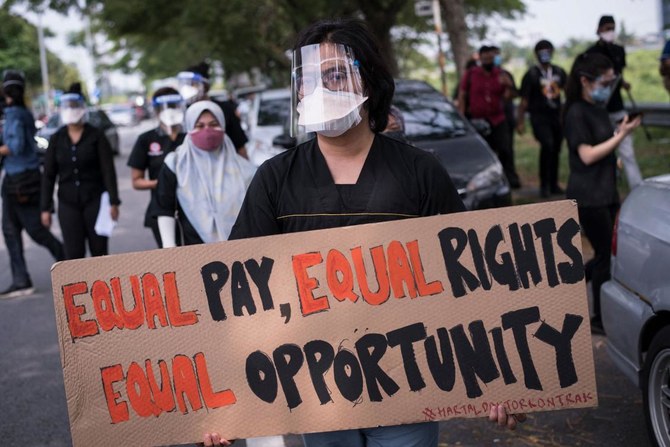

KUALA LUMPUR: Overworked contract doctors in Malaysia staged a nationwide walkout protest on Monday after their complaints about job insecurity were unaddressed by the government.
Up to 8,000 junior doctors walked out of public hospitals, some dressed in black, demanding better benefits and job security.
Last Friday, Prime Minister Muhyiddin Yassin responded to their demands for permanent positions within the healthcare system with an offer of a two-year contract extension for those who have completed their compulsory service while an extension of four years was offered to those pursuing their specialisation programs with equal benefits for contract doctors.
The organisers of the protest — dubbed the Hartal Doktor Kontrak — responded that the offer was an ill-thought policy that would worsen the situation due to the current contract system. They added that the government’s response was “shortsighted.”
They said: “We believe the announcement made would not mitigate the brain drain that is being faced by the public health sector and many more contract medical officers would end up leaving the system.”
In an interview with Arab News, a doctor from Ampang Hospital who requested anonymity said almost 100 contract doctors were involved in the walkout yesterday.
She has served as a contract medical officer for the past two years and there has been no indication of a permanent job in her future.
“I wait every year hoping that the government would grant us a permanent position within the healthcare system that offers benefits to pursue our specialisations, pay benefits and allowances as well as leave days just like permanent medical officers because mind you, we are all doing the same job,” she said.
Over the past decade in Malaysia, there has been an oversupply of medical graduates where its healthcare system requires junior doctors to serve with government institutions for no less than five years.
Medical school graduates are recruited into the government hospitals and clinics as contract doctors who must complete a three-year medical internship or housemanship with an additional two years of compulsory service with the Ministry of Health.
The contract system was introduced in December 2016 to address the glut.
“All of us want the same thing: We want our positions to be permanent and not contracted,” the doctors said.
The doctors who expressed an interest in joining the protest ahead of the date were met with intimidation and warnings of terminations and disciplinary action.
On Monday, police confirmed that an investigation would be opened in relation to the walkout staged in Kuala Lumpur Hospital, citing rule 10 of the Prevention Control of Infectious Diseases (Measures within Infected Local Areas) (National Recovery Plan) Regulations 2021, which disallows mass gatherings.
Dang Wangi district police Chief Assistant Commissioner Mohamad Zainal Abdullah confirmed the probe.
Last Sunday, Malaysia breached the 1 million mark in total infections despite the government calling for a state of emergency in January to contain the spread of the coronavirus disease (COVID-19).
While its healthcare system collapses under pressure, contract doctors say they have been working 12-hour shifts on a daily basis with no leave sanctioned.
Another doctor who is serving in Sungai Buloh told Arab News that the long working hours on the frontlines treating COVID-19 patients without job security is leading many to give up.
“The least we ask for is the certainty of having a job in our homeland. Is it too much to ask for, I guess not? If there’s no permanent job guaranteed for us, I bet you there’ll be left with zero specialists in the nearest future and Malaysia will be doomed,” she said.
According to the Health Ministry, 23,077 contract medical officers have been recruited since 2016, but only 789 have been made permanent.
Malaysia recorded 14,516 daily infections on Monday with the highest number of cases recorded in Selangor.


