


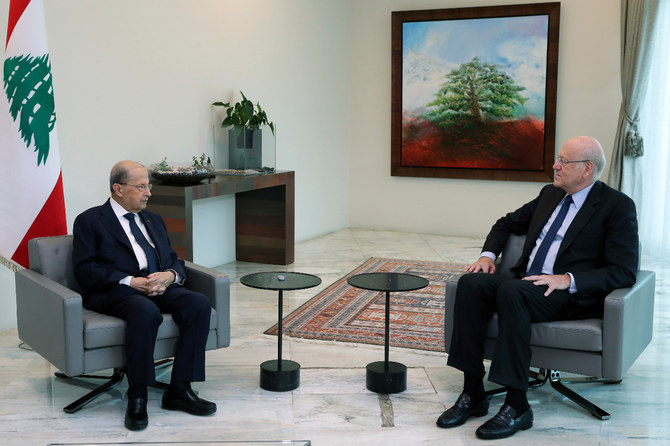

BEIRUT: Lebanese MPs have tasked former Prime Minister Najib Mikati with forming a government, ending a year of political deadlock that has crippled the country.
Mikati, who has been prime minister twice before, received a majority of votes from MPs during parliamentary consultations held on Monday by President Michel Aoun to appoint a Sunni figure to assemble a rescue government.
Saad Hariri quit earlier this month as prime minister-designate after almost 10 months of trying to form a government amid the country’s economic and financial collapse, as well as the challenges presented by the pandemic and the devastating aftermath of the Beirut port explosion. He and Aoun blamed each other for the failure to agree on a cabinet lineup.
Mikati won the votes of the most prominent blocs, including the Future bloc, Hezbollah's bloc, the Progressive Socialist Party bloc, and Parliament Speaker Nabih Berri's bloc.
But the Free Patriotic Movement (FPM) bloc, which is the political group affiliated with Aoun, refrained from nominating anyone as the FPM and Mikati failed to see eye-to-eye on the 2011 government’s political performance.
Mikati spoke to reporters shortly after he was appointed and said he would work to form a government and implement a French plan to save the country from its crippling financial crisis.
“I don’t have a magic wand and can’t perform miracles... but I have studied the situation for a while and have international guarantees,” Mikati said.
“We are in very difficult situation ... it is a difficult mission that can only succeed if we all work together,” he added.
France’s plan includes a government of specialists capable of initiating enough reforms to attract foreign aid.
The positive political atmosphere was reflected in a sudden drop in the black market exchange rate to about LBP16,000 to the dollar, after exceeding LBP22,000 during the past week.
Economy Minister Raoul Nehme asked importers and business owners to “reduce prices as quickly as possible before Tuesday morning.”
He warned that “severe penalties” would be taken against those who committed “price manipulation or fraud.”
But many believed that Mikati had already tried and failed in the past, while others said he was part of the same ruling system and would not be able to achieve reforms.
“We are cautiously looking forward to the possibility of Mikati's success in forming the government after former Prime Minister Saad Hariri and Ambassador Mustapha Adib failed to do so in less than a year,” political observers told Arab News, saying that Mikati would not give himself a long time to form a government. “If any obstacles arise, he will immediately step down,” they added.
Mikati comes to office as the Lebanese continue to struggle with deteriorating living conditions.
The European Union on Monday urged Lebanon’s political elite to form a government without delay.
“It is now of crucial importance that a credible and accountable government is formed in Lebanon without delay, one that is able to address the severe economic and social crises the country is facing,” the EU said in a statement.
“We call on the Lebanese political leaders to cooperate and allow for the swift formation of a credible and capable government, in the interest of the people of Lebanon,” it said.
France urged the formation of a “competent and capable” government in Lebanon to carry out reforms
The foreign ministry said it was “urgent” to form such a government and implement reforms “essential to the recovery of the country,” calling on “all Lebanese leaders to act in this direction as quickly as possible.”
People blocked roads on Monday, protesting about power cuts, a lack of medicine and medical supplies, and a lack of diesel to run private generators even on the black market.
Former MP Fares Souaid tweeted on Sunday: “In one of the most reputable hospitals, a girl got her eyelid stitched up without local anesthesia because the hospital did not have any.”
A man in Tripoli poured petrol over himself and set himself alight in the middle of the street in protest at his living conditions.
“The country has an opportunity today,” said Hariri. “As you can see, the exchange rate is decreasing, and that is what’s important.”
During their meeting on Sunday, the former prime ministers laid down the foundations and principles to support Mikati’s mandate to form a government “of independent, non-partisan specialists, by steering clear of the dominance of political parties, under pretexts of blocking thirds or others that force governments to resign, provided that this government is harmonious and united, enjoys the confidence of the Lebanese and the Arab and international communities, and can lead Lebanon during the next stage.”
After meeting Aoun as part of the parliamentary consultations, Hariri said he nominated Mikati because he would follow the constitutional path agreed upon at the meeting of the former prime ministers and would form a government as soon as possible.
“We should not stop at petty things while the country needs a government,” he added.
Aoun met a delegation from the French Senate on Monday and said the next government would be a rescue government. One of its tasks was to also supervise the parliamentary elections next May, he added.
There were media reports that Mikati met FPM leader Gebran Bassil MP, who is Aoun’s son-in-law, on Saturday as part of the preliminary meetings before the parliamentary consultations.
Mikati's office and Bassil's office denied claims they had discussed the distribution of ministerial portfolios in the lineup that Mikati would put together and that Bassil wanted the Ministry of Interior, which would supervise the parliamentary elections.
(Reuters, AFP, and AP)


