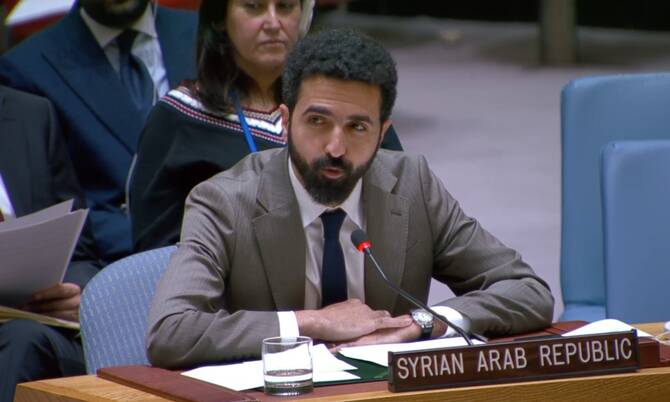
Secrecy, mines and Israeli strikes complicate removal of Assad-era chemical weapons, says Syrian envoy

Syria’s envoy to the UN Ibrahim Olabi said on Thursday that secrecy surrounding the nation’s former chemical weapons program, security risks from land mines and other unexploded ordnance, and Israel’s targeting of suspected weapons sites continue to complicate his government’s efforts to eliminate Assad-era chemical weapons. (Supplied)
Short Url
Updated 08 January 2026
Follow

Secrecy, mines and Israeli strikes complicate removal of Assad-era chemical weapons, says Syrian envoy

  • Nevertheless, new authorities made significant progress in their work with Organization for the Prohibition of Chemical Weapons, he tells UN Security Council
  • Syrian authorities grant OPCW experts unrestricted access to 23 sites and since October have been hosting the organization’s longest continuous presence in the country

NEW YORK CITY: Syria’s envoy to the UN said on Thursday that secrecy surrounding the nation’s former chemical weapons program, security risks from land mines and other unexploded ordnance, and Israel’s targeting of suspected weapons sites continue to complicate his government’s efforts to eliminate Assad-era chemical weapons.
Speaking at a UN Security Council meeting about Syria’s chemical weapons, Ambassador Ibrahim Olabi said the nation’s new authorities had nevertheless made significant progress over the past year in their work with the Organization for the Prohibition of Chemical Weapons.
Despite what he described as “major challenges,” Syria had moved the issue “from a stage of suspicion and manipulation to one of partnership with the OPCW,” he said, adding: “Syria has achieved a qualitative leap in its cooperation with the OPCW.”
This shift is reflected in recent decisions by the watchdog’s executive council and changing positions among its member states, Olabi noted.
Syria’s chemical weapons program has been under international scrutiny since the early years of the country’s civil war, when repeated chemical attacks killed or injured large numbers of civilians. The deadliest incident occurred in 2013 in the Damascus suburb of Eastern Ghouta, when a sarin attack killed hundreds and triggered international efforts to dismantle the country’s chemical arsenal.
Olabi said the authorities that took over after President Bashar Assad and his regime were toppled in December 2024 were confronting what he called the “heavy legacy of the Assad era,” during which chemical weapons were widely used against civilians. He described the program as an inherited burden rather than a policy of the new government.
“The chemical file is a prime example of these inherited issues, issues of which we were victims,” he added.
Syrian authorities have granted OPCW experts unrestricted access during eight deployments that included visits to 23 sites, he said, and since October have been hosting what he described as the organization’s longest continuous presence in the country.
“This marks the beginning of a sustained presence of the OPCW in Syria,” Olabi added.
Adedeji Ebo, the UN’s deputy high representative for disarmament affairs, said OPCW teams visited 19 locations in Syria last year, four of them previously declared chemical weapons sites and 15 suspected locations, where they conducted interviews and collected samples in their attempts to determine the full scope of undeclared chemical weapons activity.
Some other sites are in dangerous areas, he added, which poses significant risks to both Syrian and international personnel.
“On-site destruction may be required where conditions prevent safe removal,” Ebo said, noting that a recent OPCW decision authorizing expedited on-site destruction of weapons marked a positive step forward.
He also highlighted the reestablishment of Syria’s National Authority for the OPCW and the watchdog’s current, continuous presence in Damascus.
Olabi said Syrian national teams had identified two sites containing empty cylinders previously used to store toxic chemicals and had immediately reported them to the OPCW. Syrian authorities also handed over about 6,000 documents relating to the former regime’s chemical weapons program, he added, and helped arrange interviews with 14 witnesses, including individuals who were involved with the program.
Syrian authorities were also cooperating with international investigators examining chemical attacks by Assad’s government, he said, and accountability and justice for the victims are priorities for the new authorities.
“Syria reiterates its determination to continue the efforts to close this chapter,” Olabi said, adding that there was “no place for chemical weapons in today’s world.”


Syrian army extends hold over north Syria, Kurds report clashes

Updated 3 sec ago
Follow

Syrian army extends hold over north Syria, Kurds report clashes

DEIR HAFER: Syria’s army has seized swathes of the country’s north, dislodging Kurdish forces from territory over which they held effective autonomy for more than a decade.
The government appeared to be extending its grip on Kurdish-run areas after President Ahmed Al-Sharaa issued a decree declaring Kurdish a “national language” and granting the minority group official recognition.
The Kurds have said Friday’s announcement fell short of their aspirations, while the implementation of a March deal — intended to see Kurdish forces integrated into the state — has stalled.
Government troops drove Kurdish forces from two Aleppo neighborhoods last week and on Saturday took control of an area east of the city.
On Sunday, the government announced the capture of Tabqa, about 55 kilometers (34 miles) west of Raqqa.
“The Syrian army controls the strategic city of Tabqa in the Raqqa countryside, including the Euphrates Dam, which is the largest dam in Syria,” said Information Minister Hamza Almustafa, according to the official SANA news agency.
The Kurdish-led Syrian Democratic Forces (SDF), however, said they had “taken the necessary measures to restore security and stability” in Tabqa.
In Deir Hafer, some 50 kilometers east of Aleppo city, an AFP correspondent saw several SDF fighters leaving the town and residents returning under heavy army presence.
Syria’s army said four soldiers had been killed, while Kurdish forces reported several fighters dead. Both sides traded blame for violating a withdrawal deal.
Kurdish authorities ordered a curfew in the Raqqa region after the army designated a swathe of territory southwest of the Euphrates River a “closed military zone,” warning it would target what it said were several military sites.
The SANA news agency reported Sunday that the SDF destroyed two bridges over the Euphrates in Raqqa city, which lies on the eastern bank of the river.
Raqqa’s media directorate separately accused the SDF of cutting off Raqqa city’s water supply by blowing up the main water pipes.
Deir Ezzor governor Ghassan Alsayed Ahmed said on social media that the SDF fired “rocket projectiles” at neighborhoods in government-controlled territories in the city center of Deir Ezzor, Al-Mayadin, and other areas.
The SDF said “factions affiliated with the Damascus government attacked our forces’ positions” and caused clashes in several towns on the east bank of the Euphrates, opposite Al-Mayadin and which lie between Deir Ezzor and the Iraqi border.

- ‘Betrayed’ -

On Friday, Syrian Kurdish leader and SDF chief Mazloum Abdi had committed to redeploying his forces from outside Aleppo to east of the Euphrates.
But the SDF said Saturday that Damascus had “violated the recent agreements and betrayed our forces,” with clashes erupting with troops south of Tabqa.
The army urged the SDF to “immediately fulfil its announced commitments and fully withdraw” east of the river.
The SDF controls swathes of Syria’s oil?rich north and northeast, areas captured during the civil war and the fight against the Daesh group over the past decade.
US envoy Tom Barrack met Abdi in Irbil on Saturday, the presidency of Iraq’s autonomous Kurdistan region said.
While Washington has long supported Kurdish forces, it has also backed Syria’s new authorities.
US Central Command on Saturday urged Syrian government forces “to cease any offensive actions in the areas between Aleppo and al?Tabqa.”
France’s President Emmanuel Macron and the president of Iraqi Kurdistan, Nechirvan Barzani, also called for de-escalation and a ceasefire.

- Presidential decree -

Sharaa’s announcement on Friday marked the first formal recognition of Kurdish rights since Syria’s independence in 1946.
The decree stated that Kurds are “an essential and integral part” of Syria, where they have suffered decades of marginalization.
It made Kurdish a “national language” and granted nationality to all Kurds — around 20 percent of whom were stripped of it under a controversial 1962 census.
The Kurdish administration in Syria’s northeast said the decree was “a first step” but “does not satisfy the aspirations and hopes of the Syrian people.
In Qamishli, the main Kurdish city in the country’s northeast, Shebal Ali, 35, told AFP that “we want constitutional recognition of the Kurdish people’s rights.”
Nanar Hawach, senior Syria analyst at the International Crisis Group, said the decree “offers cultural concessions while consolidating military control.”
“It does not address the northeast’s calls for self-governance,” he said.
Also Saturday, the US military said a strike in northwest Syria had killed a militant linked to a deadly attack on three Americans last month.