

This is no coup, says Tunisia’s president

1 / 7
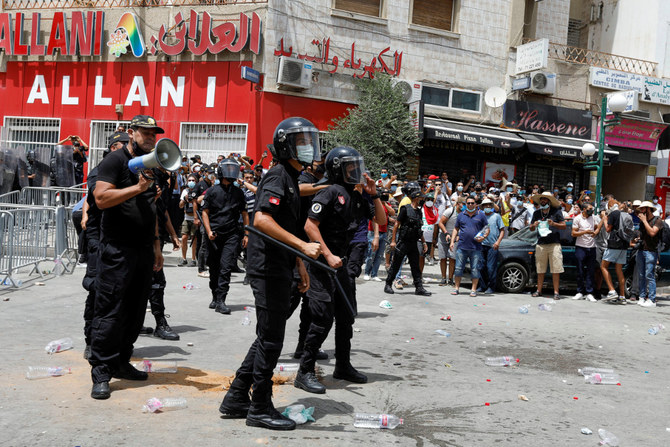
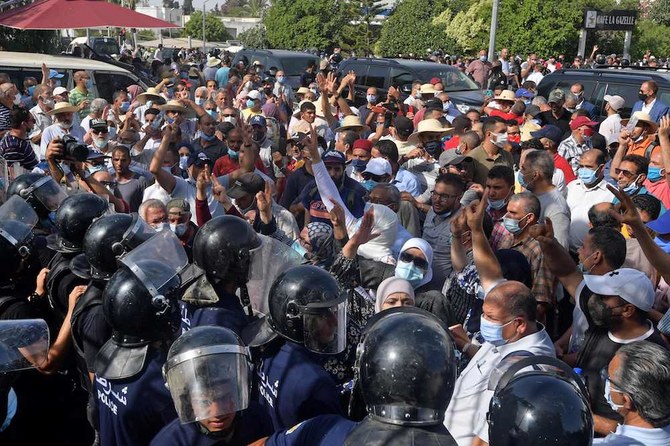
Demonstrators gather in front of police officers standing guard during an anti-government protest in Tunis, Tunisia, July 25, 2021. (AFP)
2 / 7
Tunisian President Kais Saied addresses the nation in this screengrab taken from Tunisian President's office footage on July 25, 2021. (Reuters TV)
3 / 7
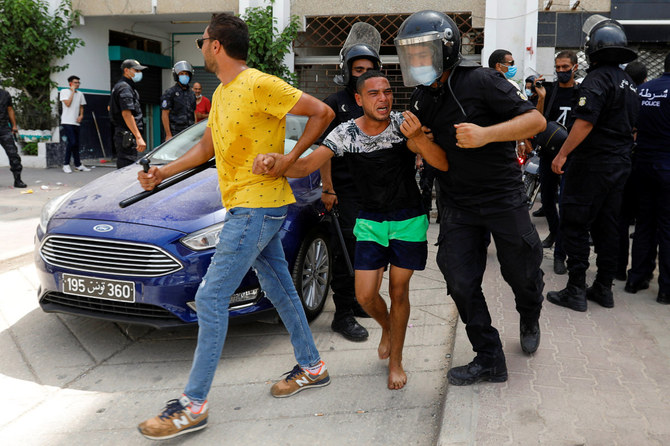
Tunisian police detain a demonstrator in Tunis on July 25, 2021. (REUTERS/Zoubeir Souissi)
4 / 7
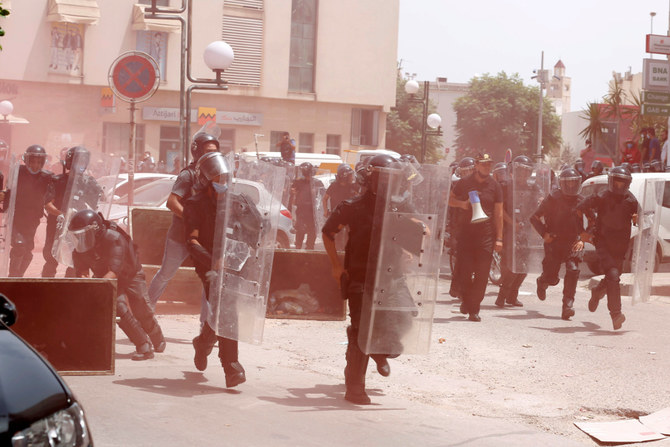
Tunisian police run towards demonstrators to quell an anti-government protest in Tunis on July 25, 2021. (REUTERS/Zoubeir Souissi)
5 / 7
Tunisian police run towards demonstrators to quell an anti-government protest in Tunis on July 25, 2021. (REUTERS/Zoubeir Souissi)
6 / 7
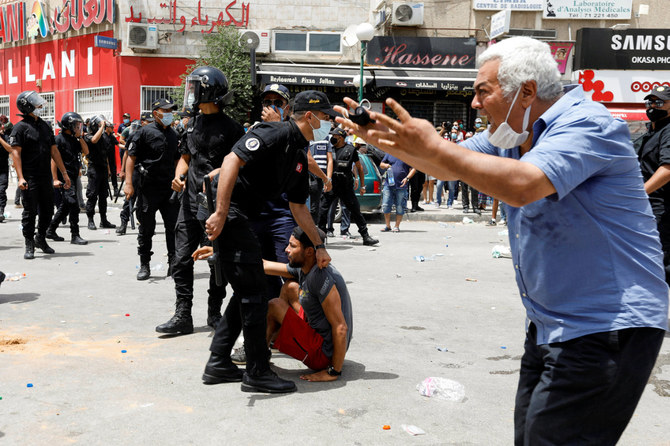
A man reacts as police officers detain a demonstrator during an anti-government protest in Tunis, Tunisia, on July 25, 2021. (REUTERS/Zoubeir Souissi)
7 / 7
Tunisian security officers hold back protesters outside the parliament building in the capital Tunis on July 26, 2021, following a move by the president to suspend the country's parliament and dismiss the Prime Minister. (AFP)
Short Url
Updated 28 July 2021
Follow

This is no coup, says Tunisia’s president

  • President Saied sacked defense minister and acting justice minister on Monday
  • Saudi FM receives phone call from Tunisian counterpart during which he was informed of developments

JEDDAH: Tunisian President Kais Saied dismissed Islamist claims of a “coup” on Monday after he removed the government and suspended parliament.

The president invoked emergency powers under the constitution after months of deadlock and disputes with the Islamist Ennahda party.

Saied said he had “taken the necessary decisions to save Tunisia, the state and the Tunisian people,” following street protests against the government’s handling of the COVID-19 pandemic.

The president also dismissed Defense Minister Ibrahim Bartaji and Hasna Ben Slimane, the acting justice minister, and ordered a nightly curfew from 7 p.m. to 6 a.m.
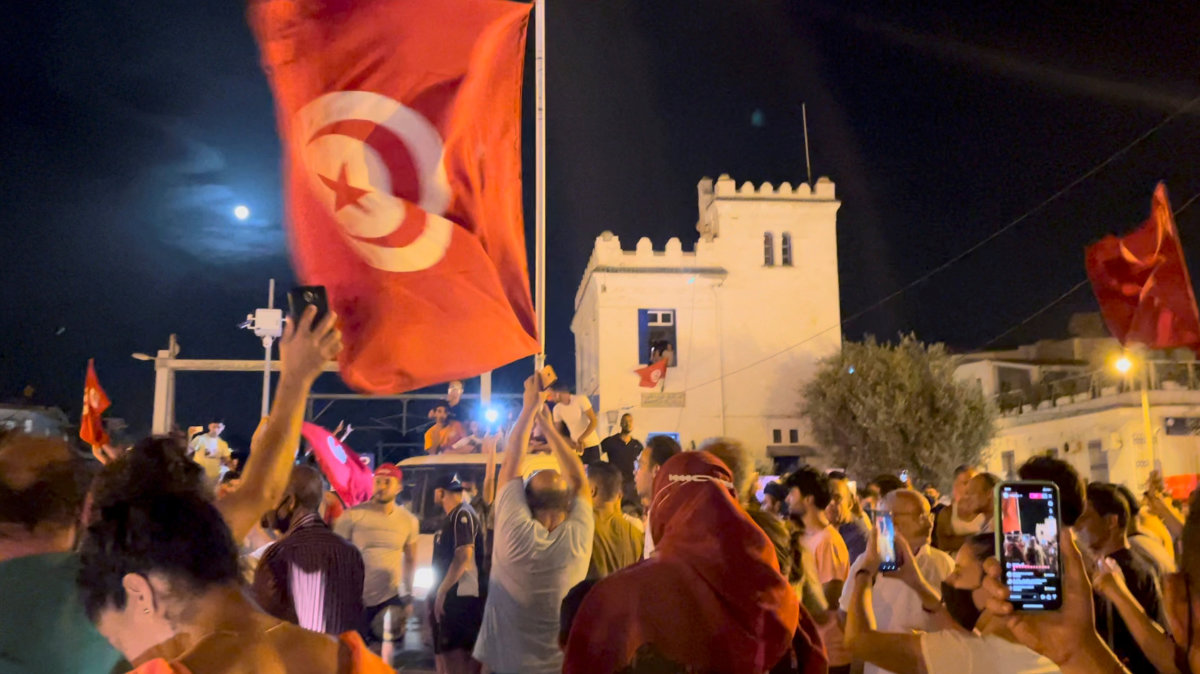


Crowds gather on the street after Tunisia's president suspended parliament, in La Marsa, near Tunis on July 26, 2021. (Social media via Reuters)

Saudi Foreign Minister Prince Faisal bin Farhan spoke to his Tunisian counterpart and said the Kingdom supported any measures that achieved security and stability in Tunisia.

US Secretary of State Antony Blinken spoke by telephone with Saied to urge respect for democracy, and urged him to “maintain open dialogue with all political actors and the Tunisian people,” the State Department said in a statement.
“He encouraged President Saied to adhere to the principles of democracy and human rights that are the basis of governance in Tunisia,” it said.
Blinken also promised US support on Tunisia’s economy and fight against COVID-19.

White House Press Secretary Jen Psaki said: “We are in touch at a senior level, and urge calm and support Tunisian efforts to move forward in line with democratic principles.”

The French Foreign Ministry urged a return “as soon as possible” to the “normal functioning” of government in Tunisia. It called “on all of the country’s political forces to avoid any form of violence and to preserve the country’s democratic gains.”

Dismissed Prime Minister Hichem Mechichi said he would not be a disruptive element, and would hand the responsibility to whoever the president chose. He was ready to serve Tunisia in any role, Mechichi said.
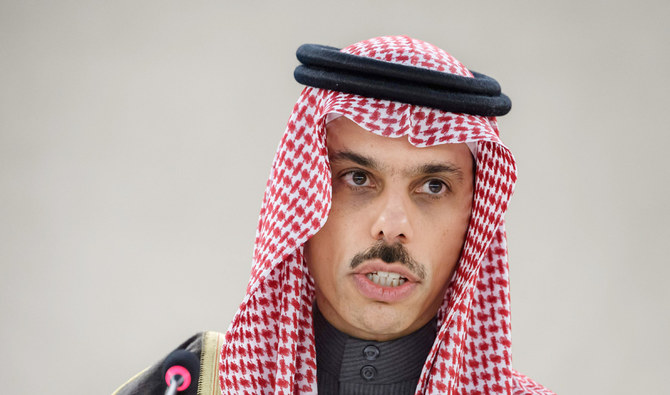


Saudi Foreign Minister Prince Faisal bin Farhan received a phone call from his Tunisian counterpart to discuss the situation in Tunisia. (AFP/File Photo)

Crowds poured on to the streets of Tunis in support of the president’s actions. Soldiers blockaded the parliament building in Tunis and surrounded Mechichi’s offices. Outside the building, rival supporters of Saied and Ennahda hurled insults and bottles at
each other.

“We are here to protect Tunisia. We have seen all the tragedies under the rule of the Muslim Brotherhood,” said Ayman, one of the president’s supporters.

Saied took office in 2019 after campaigning as the scourge of a corrupt, incompetent elite.

He said his actions were a constitutional and popular response to years of economic and political paralysis, and the constitution gave him power to dismiss the government, appoint a temporary administration, freeze parliament and lift the immunity of its members.

The president, who under the constitution controls the armed forces, warned his opponents against violence. “If anyone fires a single bullet, our forces will respond with a rain of bullets,” he said. 
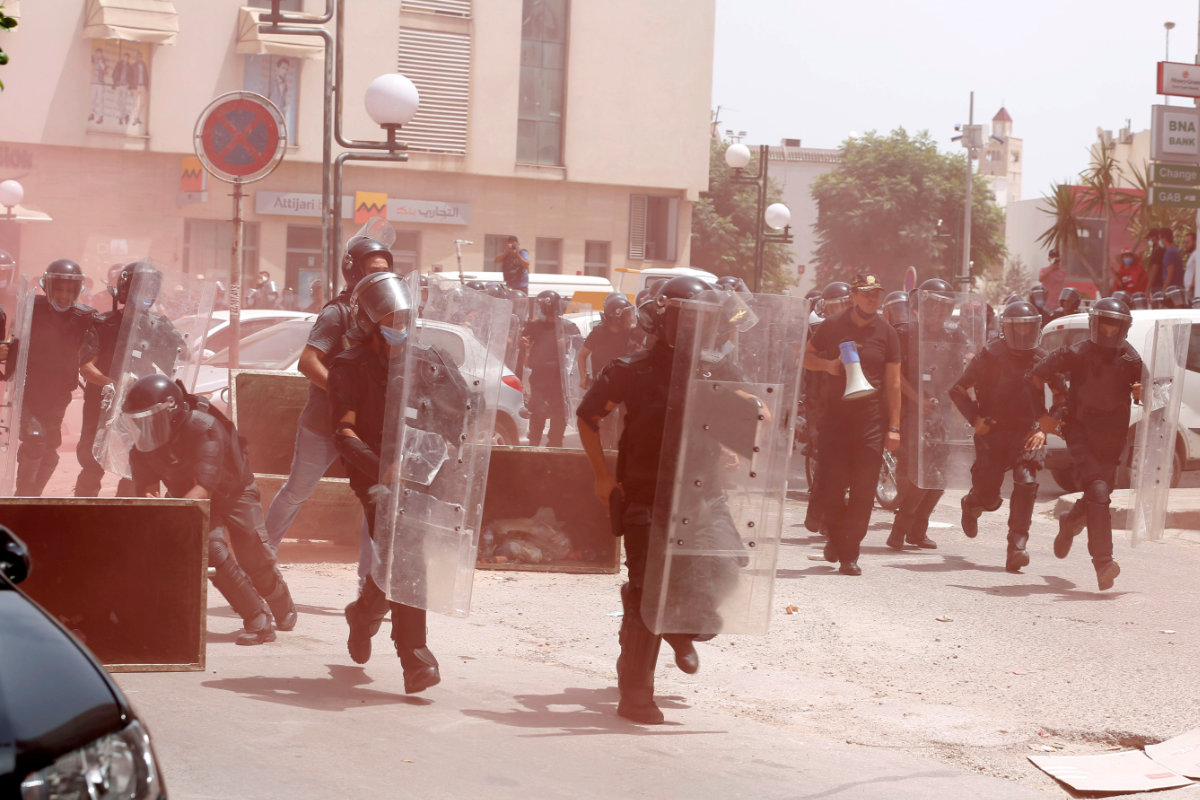


Tunisian police run towards demonstrators to quell an anti-government protest in Tunis on July 25, 2021. (Reuters)
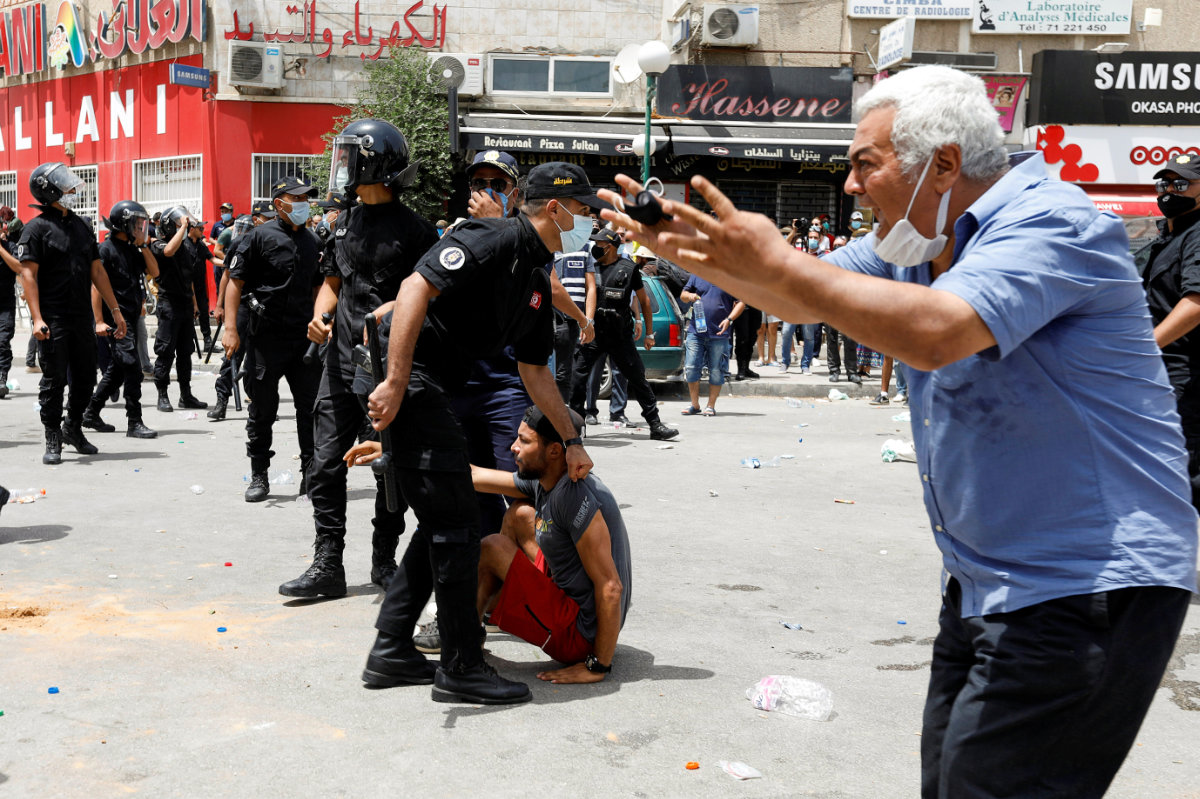


A man reacts as police officers detain a demonstrator during an anti-government protest in Tunis, Tunisia, on July 25, 2021. (Reuters)

An Arab League statement said the Tunisian foreign minister fully briefed its secretary general on the situation in Tunisia and added: “The...League urges Tunisia to quickly get through the current turbulent phase, restore stability and calm and the state's ability to work effectively to respond to the aspirations and requirements of the people.”
The United Nations called on all parties in Tunisia “to exercise restraint, refrain from violence and ensure that the situation remains calm,” a spokesperson for UN Secretary-General Antonio Guterres said on Monday.
“All disputes and disagreements should be resolved through dialogue,” UN spokesperson Farhan Haq said.
Haq declined to comment on whether the United Nations viewed the situation in Tunisia as a coup or not. 
The International Monetary Fund stands ready to continue to help Tunisia cope with the impact of the COVID-19 crisis, achieve a "job-rich" recovery and restore finances to a sustainable footing, a spokesperson said on Monday.

— With input from agencies 


Lebanon declares neutrality, bolsters embassy security amid regional turmoil

Updated 6 sec ago
Follow

Lebanon declares neutrality, bolsters embassy security amid regional turmoil

  • Beirut condemns attacks on Arab neighbors
  • Wassef Awada from Supreme Islamic Shiite Council confirms to Arab News Hezbollah’s support for just and protective state

BEIRUT: Lebanon’s leaders reaffirmed neutrality amid US and Israeli strikes on Iran, emphasizing that the country must be shielded from the region’s rapidly deteriorating security crisis.
During a press conference on Saturday, Prime Minister Nawaf Salam said while he could not completely discount the risk of threats against foreign embassies on Lebanese soil, his government had already put the necessary security measures in place.
Just before the US-Israel strikes began, Israel carried out strikes on what it said was “Hezbollah infrastructure” in south Lebanon.
Salam, who convened an emergency Cabinet session to assess the fallout, moved swiftly to calm public anxiety. “We have long been taking all precautionary measures,” he said, urging Lebanese citizens not to panic.
He confirmed that supply lines by land, sea and air remained open, that Middle East Airlines continued to operate flights, and that essential goods — food, medicine and fuel — were stocked for at least two months. “There is no need for queuing or rushing to pharmacies, supermarkets or fuel stations,” he said.
Salam said that he had spoken with the leaders of Arab states targeted in Iranian attacks on US bases in Kuwait, Bahrain, the UAE and Qatar.
The Lebanese economy has slowed amid growing concerns that Hezbollah could become involved in the conflict in defense of Iran.
This anxiety has manifested in long queues at gas stations and pharmacies, as people rushed to secure fuel and medical supplies, fearing shortages if the country was dragged into a conflict it could not withstand after emerging from a devastating war with Israel.
The Association of Oil Importing Companies said that it had sufficient petroleum products in stock to meet demand for at least 15 days.
Earlier in the day, Salam posted on X, urging the Lebanese to “show wisdom and patriotism, putting Lebanon’s interests above everything else amid the dangerous developments gripping the region.
“We will not allow anyone to drag this country into adventures that threaten its security and unity,” he stressed.
Hezbollah’s leader, Naim Qassem, was expected to deliver a speech on Saturday but it was postponed due to “recent developments.” Last month, Qassem threatened in a speech to “defend Iran against any Israeli or American aggression.”
However, Sheikh Ali Al-Khatib, vice president of the Supreme Islamic Shiite Council, the highest religious authority for Lebanon’s Shiite community, stressed on Friday the Shiite community’s support of state sovereignty.
He said that Lebanon once had to take up arms as “a necessity in the absence of the state.”
“If we were forced to take up arms, it was in self-defense, and we paid a heavy price; our cities were destroyed.”
Al-Khatib said the Shiite community supported “a strong state that protects its rights, sovereignty and borders,” and called for the adoption of a national security strategy.
Asked whether Al-Khatib’s position was coordinated with Hezbollah, Wassef Awada, adviser to the Supreme Islamic Shiite Council, confirmed to Arab News that his position was in full agreement with Hezbollah and its alley, the Amal Movement.
“Hezbollah affirms its support for a just and protective state that uses all its capabilities to confront external threats. This position is not subject to change under any circumstances, and the Supreme Islamic Shiite Council remains steadfast in its stance,” he told Arab News.
Awada said that most of the Shiite community opposed intervention in the war and that Hezbollah was aware of this. He added that the Amal Movement had also been clear in its support for the state.
On Saturday morning, the sound of Israeli interceptor missiles exploding was heard in southern Lebanon and the Bekaa Valley.
The Israeli army dropped explosive devices near the Lebanese border and carried out airstrikes on Wadi Barghaz, the Litani River, the outskirts of Wadi Al-Dalafa, the highlands of Iqlim Al-Tuffah, and the Jezzine district.
These mountains and valleys, located north of the Litani River, are believed to host a Hezbollah presence. Meanwhile, Israeli reconnaissance aircraft flew over southern Lebanon, passing over Sidon and reaching the Bekaa Valley.
Israeli army said that it “attacked Hezbollah infrastructure, targeting launch sites and underground tunnel entrances used by the terrorist group to advance plots against the IDF and the State of Israel,” accusing Hezbollah of operating within this infrastructure to rebuild its power.
President Joseph Aoun stressed that “sparing Lebanon the disasters and horrors of external conflicts, and preserving its sovereignty, security and stability, are an absolute priority.”
He contacted the prime minister, Transport Minister Fayez Rassamni, US Ambassador Michel Issa, and Army Commander Gen. Rudolph Haikal. His office said that he had stressed the need for maximum readiness and tight coordination across all state institutions.
He called on all parties to put Lebanon’s national interest above everything else and pledged that the state, through all its institutions, would stand as the first and last line of defense.
The Foreign Ministry added its voice to the chorus, formally condemning “any targeting of Arab states,” with Foreign Minister Youssef Raji underscoring Lebanon’s firm commitment to staying out of the fray.
At Beirut’s Rafic Hariri International Airport, traffic dropped sharply — though Lebanon stopped short of officially canceling flights or closing its airspace. The Civil Aviation Directorate attributed the near-standstill to the closure of airspace by Gulf states, Cyprus and neighboring countries, which rendered Beirut “practically unreachable for most airlines.”
The head of the Civil Aviation Authority, Captain Mohammed Aziz, said that no decision to close Lebanese airspace had been made, adding that he remained in continuous contact with the Minister of Public Works, airport security, and air navigation to monitor developments and take appropriate action as events evolve.